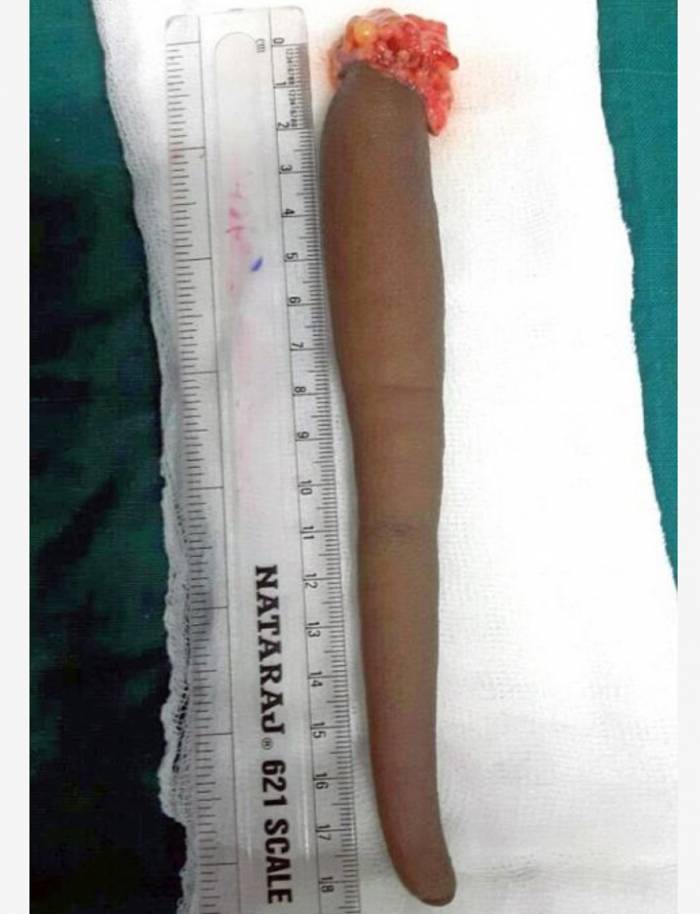
In a rare surgery, a team of neurosurgeons operated a 18-year-old boy and have successfully removed the 18cm long tail that grew at the posterior end of the body on the back.
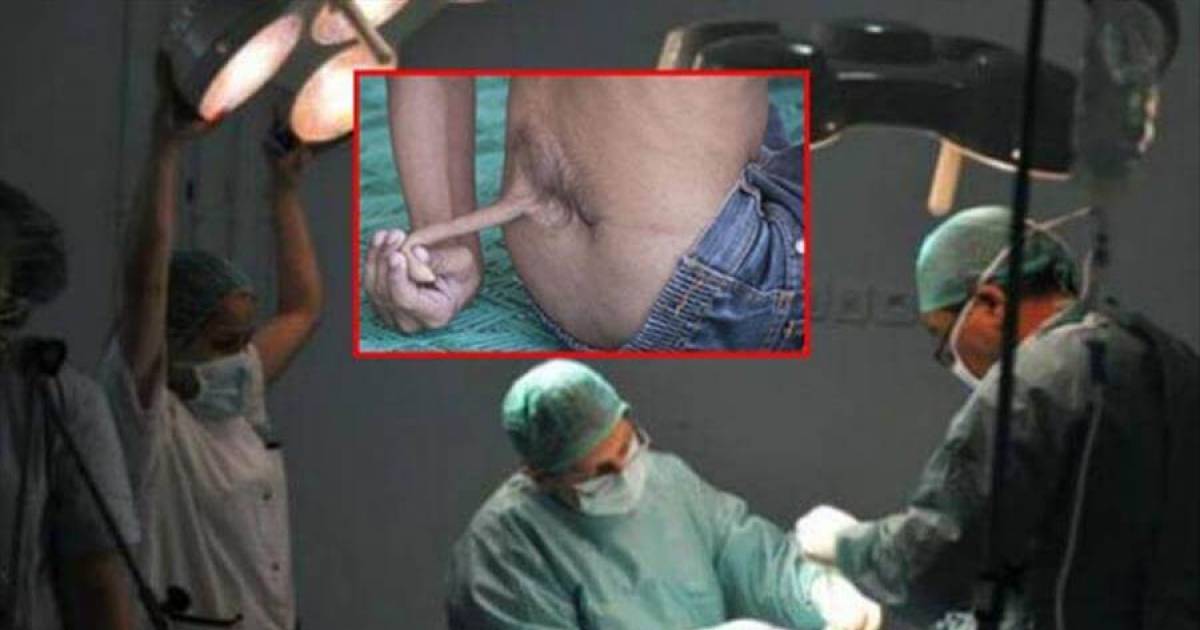
A Boy With 18cm Long Tail Finally Has The Growth Removed After It Became Painful For Him To Sit Or Sleep!
By
Deepak Mamgain in
Bizarre
On 9th October 2016
advertisement
#1
The 18-year-old, from Nagpur, India, went to hospital complaining the growth had become painful.
Doctors explained it was a vestigial tail that developed while he was in the womb - but should have disappeared naturally over time.
A neuro-development abnormality had meant it continued to grow while his spine was forming - despite the body usually absorbing the tail to form the back.
His family ignored the defect when he was born to prevent any social stigma from people who would consider him to be strange.
But when it became problematic and affected his day-to-day life he was taken to hospital to have it looked at.
#2
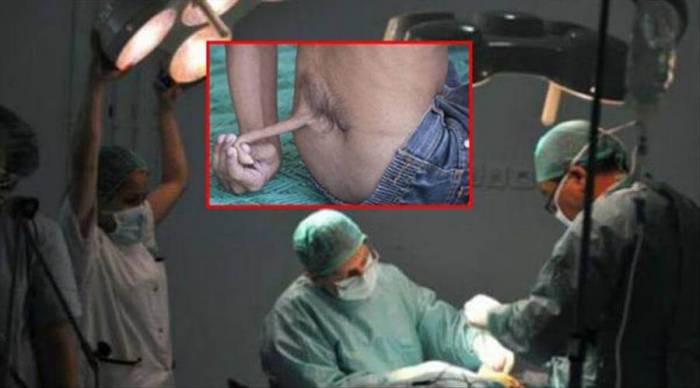
The parents of the boy were superstitious and that they did not bring the boy to the hospital though they knew that a tail was growing on the back and moreover it was not affecting the boys health, said The head of the neurosurgery department and the team, Dr Pramod Giri.
Dr Pramod Giri, who operated on him, said: ‘This is an extremely rare case and we have not seen such an abnormality here before.
'He was admitted only after he complained of extreme pain in his lower back, problems while sleeping and sitting.

advertisement
#3
"The defect was detected very early as it is present from the birth and since it grows with age it cannot be covered or hidden. But the parents as well as the boy hid these facts.Actually speaking the defect can be surgically corrected within few months of the birth" said the doctors.
#4
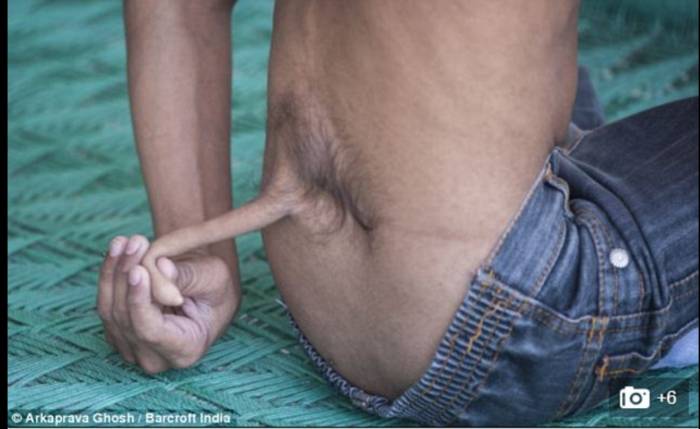
"As the tail kept growing a bone developed inside it where the boy underwent a seviour pain and suffering. This disturbed him both mentally and physically forcing the parents to get him to the hospital" explained the Chief Doctor Mr.Giri.
"Though the surgery is not very demanding, it is done by a neurosurgeon as it involves a part of the spinal cord. It arises from a compression at the tail end of the back and is medically referred as the neuro-development abnormality. This case is very rare and calls for a presentation in a medical journal as the tail is apparently the longest recorded so far," Dr Giri claimed.

advertisement
#5 WHAT IS A VESTIGIAL TAIL?
'The boy was also suffering from an extreme psychological issue because the tail was growing so he had to always adjust the tail in his clothes when sitting.'
He added: ‘The family were always aware but they ignored it and did not see a doctor as they were superstitious and considered it to be a good luck charm for the boy.
So what is a vestigial tail?
During pregnancy, every growing baby develops a vestigial tail before their spine starts to form.
However, it disappears naturally during the embryonic development as it is absorbed by the body to become the spine and nervous system.
But in some rare cases, children are born with a tail after the spine didn't form properly in the womb and it continued to grow.
They contain adipose and connective tissue, blood vessels, nerves and are covered by skin.
Vestigial tails are considered harmless but can affect the bladder and result in a loss of function of the lower body if left untreated.
Surgery to remove the growths is usually straightforward because they don't contain any bone, cartilage or spinal cord.
After six weeks of pregnancy, every growing baby possesses a vestigial tail - but it normally disappears during development as it grows to become the spine and nervous system.
However, sometimes children are born with one as a result of it continuing to grow - but there have only been 23 cases reported worldwide.
They contain adipose and connective tissue, blood vessels, nerves and are covered by skin.
Doctors say they are harmless and can be easily removed because they lack bone, cartilage and spinal cord.
But the abnormality can affect the bladder and reduce bowel control. It has also been known to result in extreme pain and a loss of function in the lower body.
The surgery to remove the growth was not complex but because it involves part of the spinal cord they had to be cautious, doctors said.
However, because there was no bone or muscular tissue in his tail, removing it was not difficult.
It is hoped the boy will be discharged from hospital later this week.