

If you find yourself lying in bed, anxiously watching the clock move closer to your alarm time, this military sleep technique can assist you in falling asleep in only two minutes. What's more, it has an impressive success rate of 96 percent among people who try it.
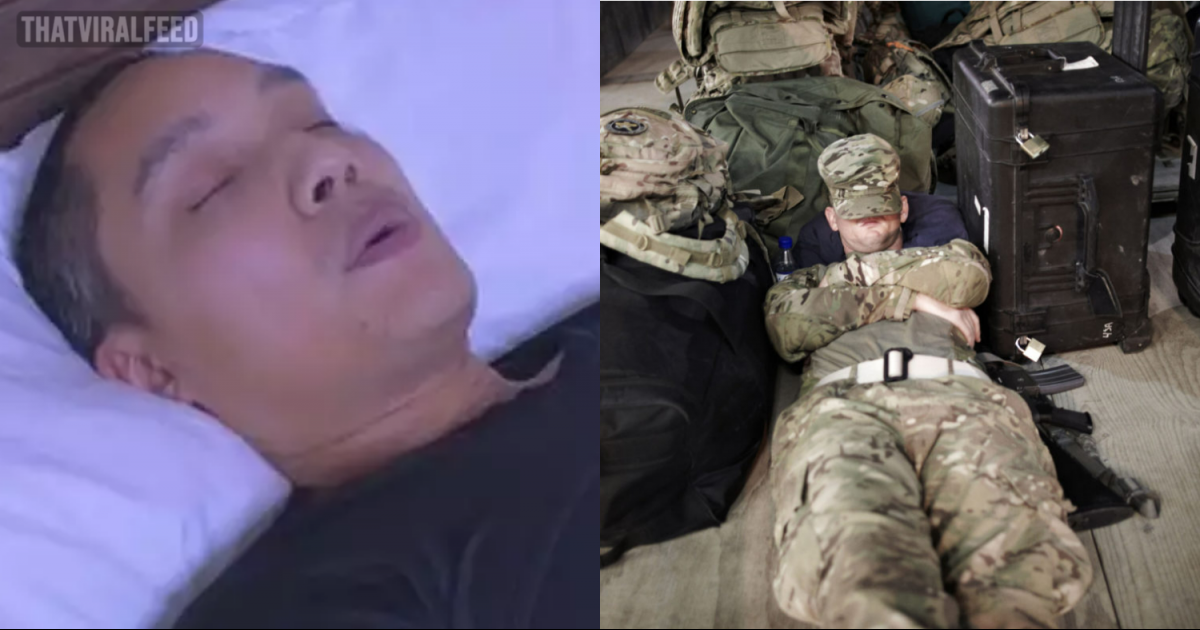
A Highly Effective Military Sleep Trick That Works For 96% Of People And Can Make You Fall Asleep In Just Two Minutes
By
Zainab Pervez in
Interesting
On 24th July 2023
advertisement
If you often struggle with falling asleep, you're not alone. According to the American Sleep Association (ASA), there are approximately 50 million to 70 million adults in the United States who have a sleep disorder.
justin_agustin / TikTok
Among them, insomnia is the most prevalent, with 30% of adults experiencing short-term insomnia-like symptoms and 10% dealing with chronic insomnia.
A significant study involving 440,000 adults revealed that 35% of individuals get less than seven hours of sleep each night. This puts millions of people at risk of facing serious health issues caused by sleep deprivation, such as obesity, heart disease, and diabetes.
However, the consequences of sleep deficiency are not limited to health problems.
advertisement
Lack of sleep poses a substantial problem for both individual productivity and the companies that employ them. A Harvard study in 2015 demonstrated that the average worker loses the equivalent of 11 days of productivity per year due to sleep-related issues.
Wonderful Engineering
Additionally, a 2017 study indicated that poor sleep costs U.S. businesses a staggering $411 billion annually in lost productivity.
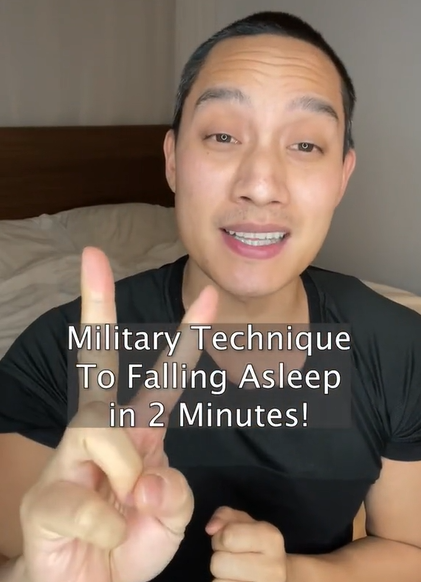
The insomnia swerve has become increasingly popular on social media, thanks to fitness coach Justin Agustin, who introduced it to his 1.9 million followers early last year.
The video has now garnered a staggering 12.6 million views, accompanied by the caption "Technique to fall asleep in 2 minutes!" However, it comes with a disclaimer that consistent practice for about six weeks is necessary to achieve significant results.
advertisement
Originally developed by the US Army, the technique was primarily intended for fighter pilots, ensuring they can maintain 100 percent of their reflexes.

justin_agustin / TikTok
It also proved useful for soldiers in active combat situations, enabling them to fall asleep amid noise and stress, even on the battlefield, to recharge and rejuvenate.
advertisement
The concept of "Military sleep" was initially introduced to the general public in 1981 through the book titled "Relax and Win: Championship Performance," authored by Lloyd Bud Winter, an American track and field coach.
Winter's intention behind sharing the technique was to decrease the frequency of sports injuries and enhance overall athletic performance.
advertisement
To practice the "Military sleep" technique, the first step is to find a comfortable position.
Wonderful Engineering
Then, shift your focus to your breathing, and gradually release tension throughout your entire body, starting from the forehead and facial features.
advertisement
Ensure that all muscles are relaxed, and let your arms rest loosely at your sides. Visualize a warm sensation spreading from your head to your fingertips.
Next, proceed to relax your chest by taking deep breaths, followed by the stomach, thighs, legs, and feet.
advertisement
Keep imagining the warmth traveling from your heart down to your toes, enveloping your entire body as you go through the relaxation process.
This method aims to promote a state of calmness and ease to facilitate falling asleep more effectively.
advertisement
As you practice the technique, it is essential to clear your mind of any stressors. One approach is to envision yourself lying on a tranquil canoe in the middle of a serene lake beneath blue skies.
Alternatively, imagine relaxing in a cozy, black velvet hammock within a pitch-black room.
advertisement
In case your mind begins to wander during the process, repeat the phrase "Don't think" to yourself for a duration of ten seconds. This helps to redirect your focus and maintain a calm mental state.
Agustin encourages his followers to share their progress with him, and they certainly didn't disappoint. Many have been updating him on how well they are doing with the technique and its effectiveness in aiding them to fall asleep.
advertisement
One commented: “I'm a military brat and was taught this. I also had a veteran as a psychology teacher in college who taught this. It definitely works."
And another said: "Pretty sure this is closer to what is called Progressive Muscle Relaxation which was developed by an American physician in 1908."