


The mystery surrounding Amelia Earhart’s disappearance in 1937 later motivated oceanographer Robert Ballard to search for clues about her final location
advertisement
One of the most persistent mysteries of the 20th century, alongside events such as the assassination of JFK and the disappearance of hijacker D.B. Cooper, is the question of what truly happened to world-famous aviator Amelia Earhart.
In the 88 years since Earhart and her navigator Fred Noonan vanished while attempting to fly around the world, researchers and historians have spent millions of dollars trying to locate their aircraft, the Lockheed Electra.
The widely accepted explanation is that the pair crashed into the Pacific Ocean after failing to locate Howland Island. The disappearance occurred on July 2, 1937, roughly six weeks and about 20,000 miles into their global journey.
Communication issues and navigation difficulties made it nearly impossible for them to find the small and remote island. As a result, many experts believe the aircraft eventually ran out of fuel and went down in the open sea.
Search missions carried out immediately after the disappearance, as well as many efforts in the decades that followed, have tried to locate the wreckage of the Electra in the vast waters around Howland Island.
Despite these repeated searches, investigators have never found clear evidence of the plane or its crew.
However, in 2019 oceanographer Robert Ballard uncovered information that led some researchers to consider another possibility. His findings suggested that Earhart might have survived the initial crash landing.

Robert Ballard, who discovered the Titanic, launched an expedition to track down Earhart's final resting place
Amy Sussman/Getty Images
advertisement
Ballard is not an ordinary oceanographer. Many people consider him one of the most accomplished researchers in marine exploration.
Over the years he has taken part in several historic discoveries beneath the ocean’s surface. Among the most famous are the wreck of the Titanic, the German battleship Bismarck, and the sunken aircraft carrier USS Yorktown.
Those achievements alone would place him among the most respected scientists in his field. He is also credited with discovering deep-sea hydrothermal vents, which revealed an entirely new type of ecosystem in the ocean.
During his investigation into Earhart’s disappearance, Ballard focused on one alternative theory. According to this idea, Earhart and Noonan may have landed on a coral reef roughly 350 miles southeast of Howland Island instead of crashing directly into the ocean.
The island connected to this theory is called Nikumaroro. For many years, some researchers have suggested that Earhart and Noonan might have reached this remote coral atoll after their plane ran low on fuel.
A number of disputed reports claimed that distress calls were heard from that region of the Pacific in the days following the disappearance.
However, critics have argued that some of those signals may have been hoaxes. The case attracted global attention at the time, and false reports were common during the search.
While Ballard focused on scanning the surrounding waters for possible aircraft wreckage, a separate team working with National Geographic examined the island itself for signs that the aviator or her plane might have reached land.
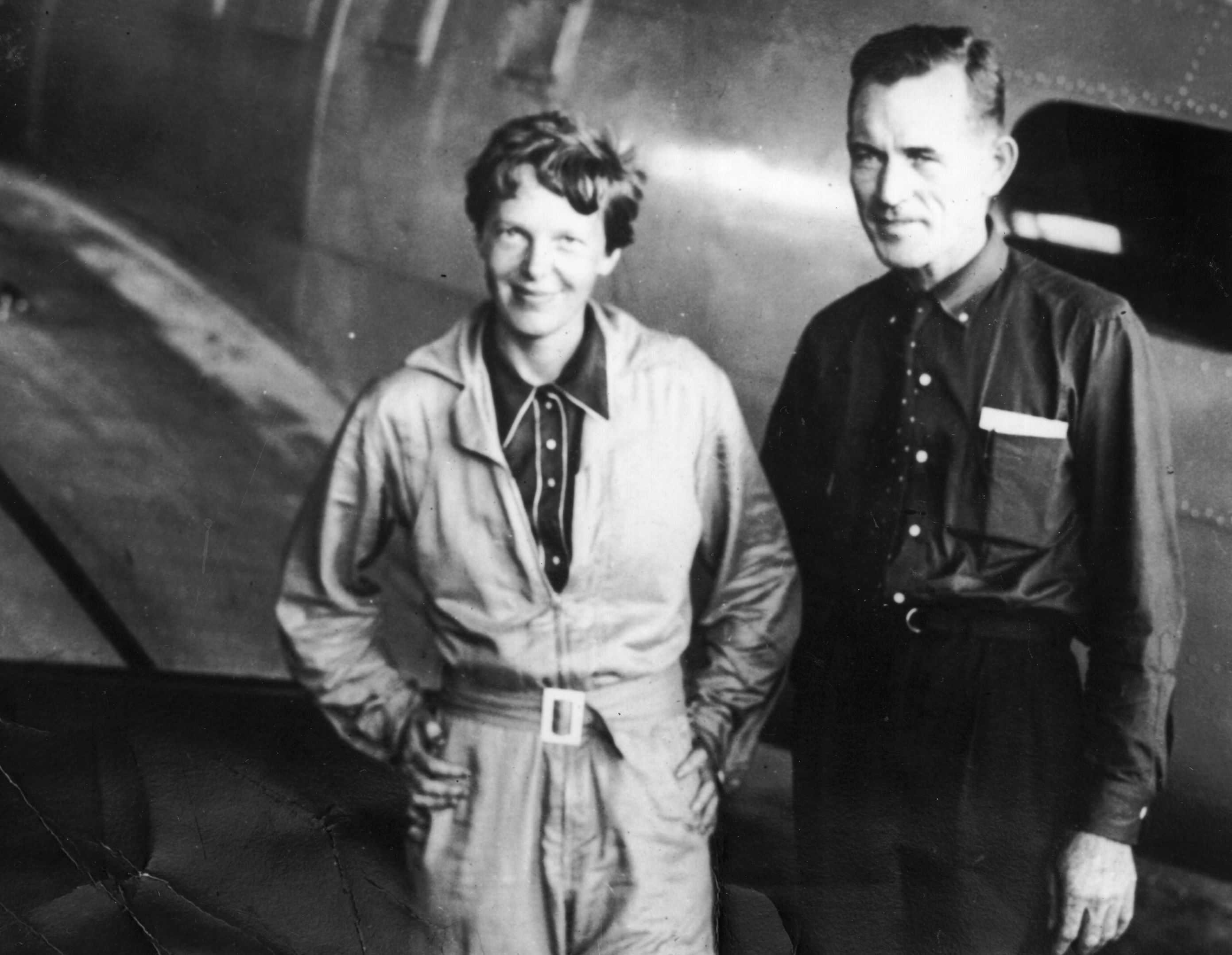
Amelia Earhart and Fred Noonan flew for over 20 hours but could not find Howland island
Topical Press Agency/Getty Images
advertisement
The investigation explored a theory that dates back to 1940. During that year, British officials stationed on the island reported discovering 13 human bones, including part of a skull.
At the time, some believed the remains might belong to the missing aviator.
Researchers studying the island also paid close attention to the behavior of its large coconut crabs. These powerful scavengers are known to move objects, including bones, across the ground.
To understand how this might affect human remains, the team left a pig carcass on the island and watched how the crabs interacted with it.
They later observed that the crabs dragged bones as far as 60 feet away from the original location.
This led to a theory that if Earhart had survived the crash and reached Nikumaroro, her remains might have been scattered across the island or lost to the surrounding ocean due to the crabs’ activity.
advertisement
Despite the effort involved in the investigation, Ballard and his team were unable to locate any clear evidence of the Electra in the waters near the reef.
The bones reported in 1940 had also disappeared long ago, which made it extremely difficult to confirm whether they were connected to Earhart.
National Geographic archaeologist Frank Hiebert later managed to track down a fragment believed to be part of the skull discovered on the island.
Although analysis suggested the bone belonged to an adult female, the results did not support the Earhart theory.
Further examination indicated that the skull fragment likely came from a Polynesian woman who had died on the reef more than 1,000 years ago.
The discovery did not solve the mystery of Earhart’s disappearance, but it did highlight how many unanswered questions still remain about what truly happened during her final flight.