

These cats are active, alert and agile. They study the actions of their people and learn how to open cabinets, doors and even windows. They are capable of scaling walls, roosting on top of refrigerators and other high places in the home.
advertisement
The Bengal may look like a wild cat
but breeders insist that the Bengal is as lovably friendly and docile as any full-blooded domestic cat. Fanciers describe Bengals as playful, gregarious, and energetic cats that have a generous dose of feline curiosity and that want to be involved with their family. Not intimidated by water, they will sometimes join their family for a swim, as long as it's on their terms.
Don’t get a Bengal if what you’re looking for is a sweet, gentle lap cat or a living sculpture that requires little interaction.
The intelligent, curious Bengal is highly active. Constantly on the move, he loves climbing to high places, enjoys playing fetch and going for walks on leash, and thrives best when he has access to a large outdoor enclosure where he can indulge in the favorite feline hobby of bird-watching.
advertisement
The Bengal could never be called delicate.
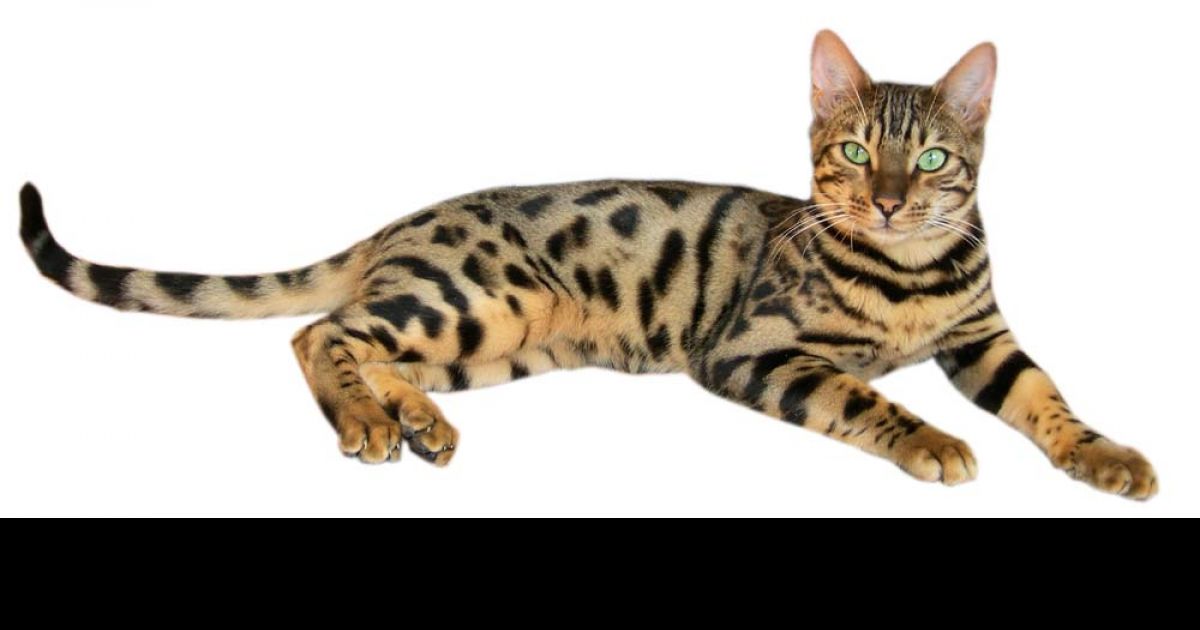
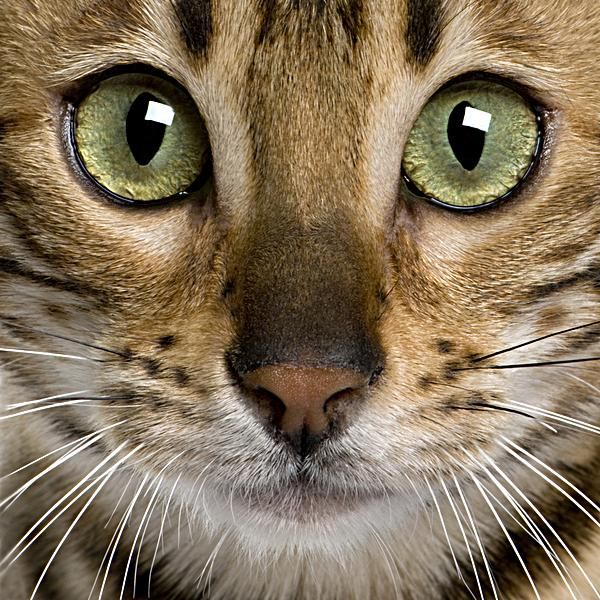
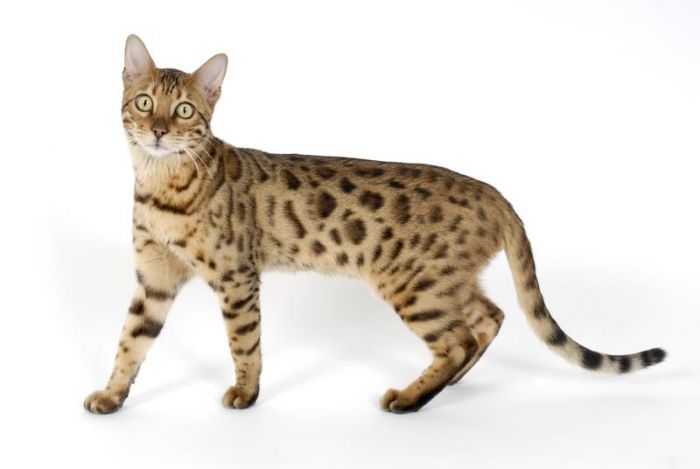
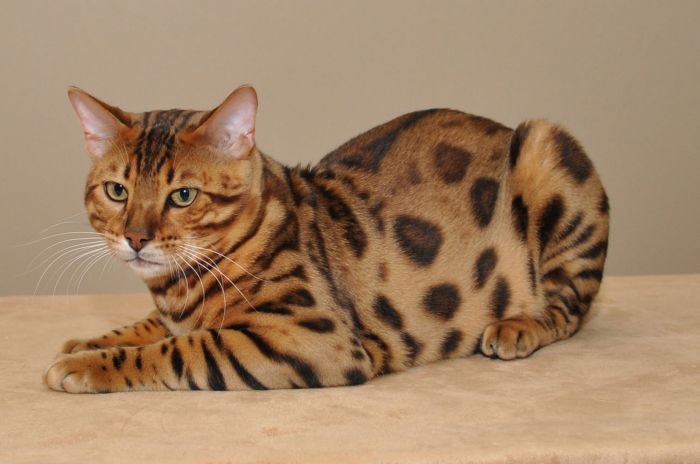
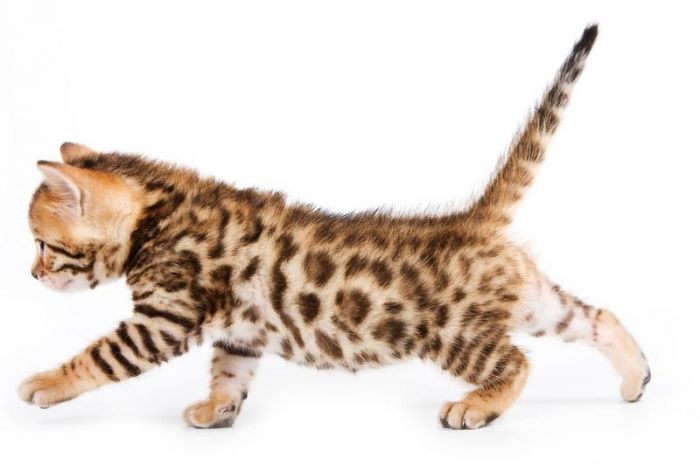
He is an athlete: agile and graceful with a strong, muscular body, as befits a cat who looks as if he belongs in the jungle. His broad head is a modified wedge shape, longer than it is wide, with rounded contours. Atop it are medium-size to small ears that are relatively short, set toward the side of the head. Large oval eyes are almost round. Joining the head to the body is a long, muscular neck. Supporting the body are medium-length legs, slightly longer in the back than in the front, with large, round paws. A thick, medium-length tail tapers at the end and is tipped in black. When a Bengal rolls over, you can see that another characteristic is a spotted belly.
The Bengal's spots are aligned horizontally rather than in random or tabby configuration.
Rosettes formed in a part-circle around a redder center is the preferred look. Emphasis is put on the contrast between the spots and the background color; the edges should be sharp and pattern distinct for a show-quality cat. In the marbled pattern, the markings are derived from the classic tabby gene, but the overall look is random, giving the impression of marble.
advertisement
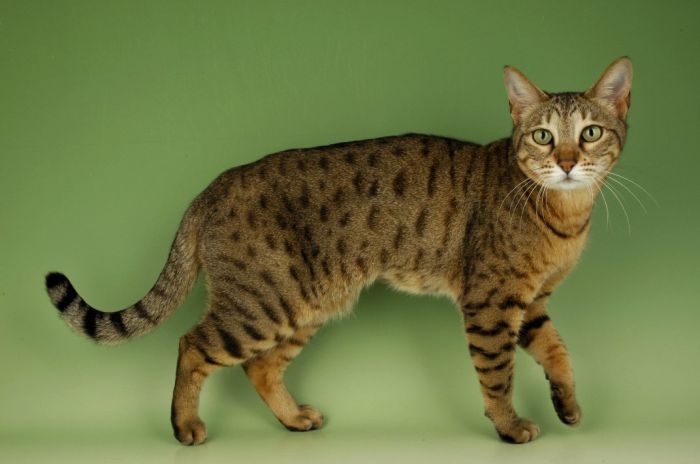
Bengals often possess a 'glitter gene' that gives the fur an iridescent glow, as if covered with warm frost.
Three recessive coat variations have been developed: the snow leopard, the marbled, and the snow marbled. These types are still quite rare.
advertisement
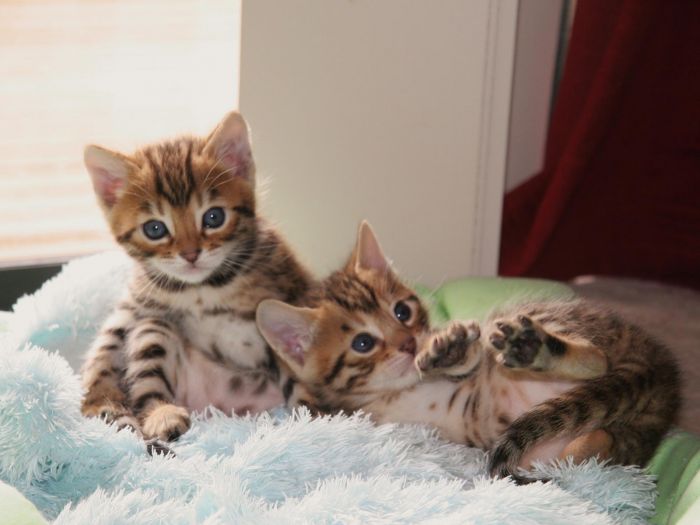
A new and controversial breed, the Bengal is fast growing in popularity, due in part to its wildcat appearance.
The Bengal began as a hybrid breed, created by crossing the Asian Leopard Cat with the domestic cat. The first "pet leopard" is traced back to Japan in the early 1940s, but the first appearance of Bengals in the United States was in the 1970s.
advertisement
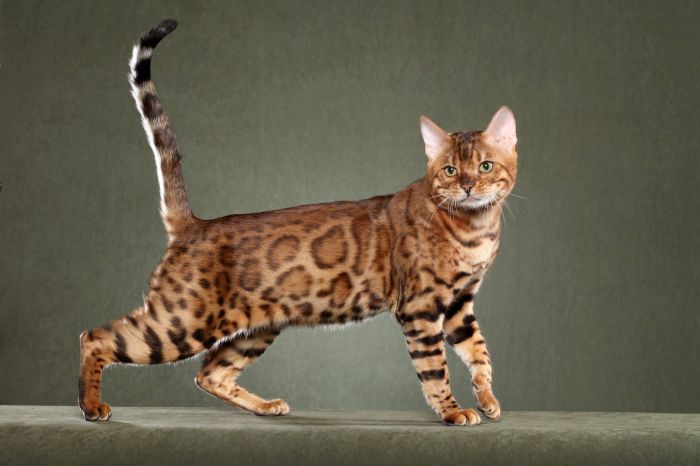
Coveted for its wildcat exotic looks
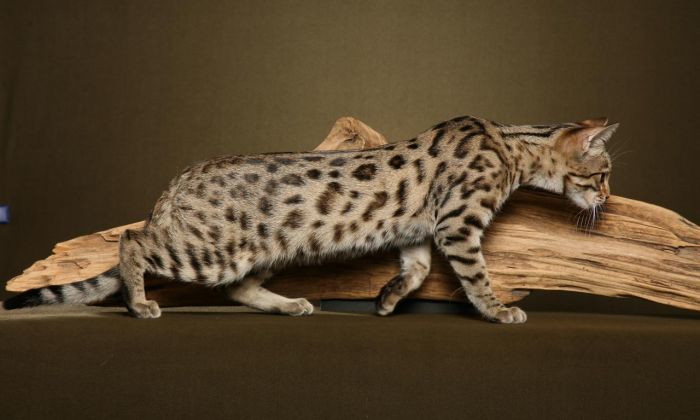
the Bengal prowls like a small leopard with its sleek, muscular body, oval eyes, broad nose, strong chin and wedge-shaped head. Its hind legs are slightly longer than the front legs, yielding a "stalking-like" gait.
advertisement
Bengals are generally healthy, but the following diseases have been seen in the breed:
Distal neuropathy, a nervous system disorder that causes weakness. It can occur in Bengals as early as 1 year of age. Fortunately, many cats recover on their own, although a few relapse.
Flat-chested kitten syndrome, a deformity that can range from mild to severe. Kittens who survive to adulthood usually show no signs once they reach maturity.
Hip dysplasia, which in severe cases can cause lameness
Hypertrophic cardiomyopathy, a form of heart disease that is heritable in some breeds.
Patellar luxation, a hereditary dislocation of the kneecap that can range from mild to severe. Severe cases can be alleviated with surgery.
Progressive retinal atrophy, a degenerative eye disease.
advertisement
Despite its rising popularity
the Bengal is definitely not a cat for everyone. They fare best with experienced cat owners willing to devote time each day for interaction. Bengals demand attention. They are quite talkative, capable of making a wide range of vocalizations from chirps and chortles to squeaks and howls. Some growl when they eat.
Bengals thrive in active households. They love to play long games of fetch, walk on leashes and play in water dishes and bathtubs.
advertisement