

The husband-and-wife team who co-founded BioNTech, the biotechnology company that collaborated with Pfizer to produce an efficient messenger-RNA (mRNA) injection against COVID-19, has predicted that a cancer vaccine might become publicly accessible by 2030.
Cancer Vaccine Possible By 2030, BioNTech Co-Founders Say
By
Haider Ali in
Science and Technology
On 17th October 2022
advertisement
Scientists who work as a husband-and-wife team expect a cancer vaccine to become available by 2030.
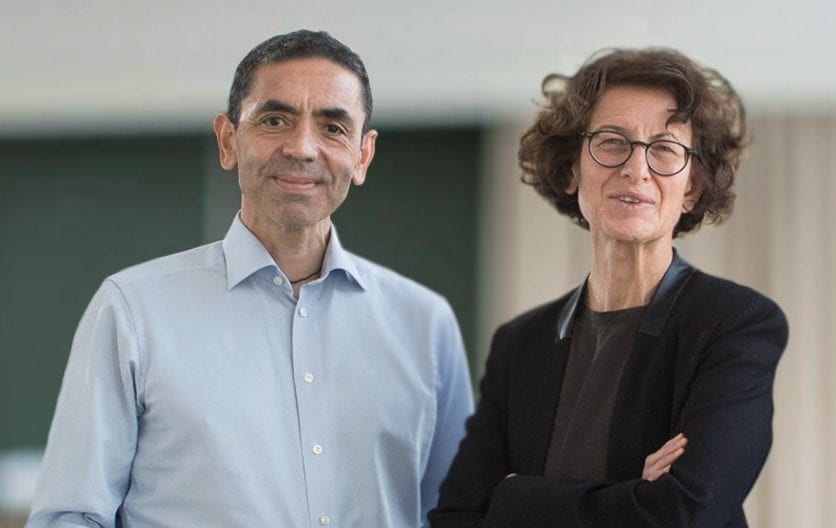
A German company named BioNTech, formed in 2008 by professors Ugur Sahin and Ozlem Tureci, is looking into new technology for cancer treatment.
Getty Images
But when the pandemic hit, Sahin and Ozlem used their technology to work with Pfizer to develop a Covid vaccine, which is currently being used as a model for cancer treatment.
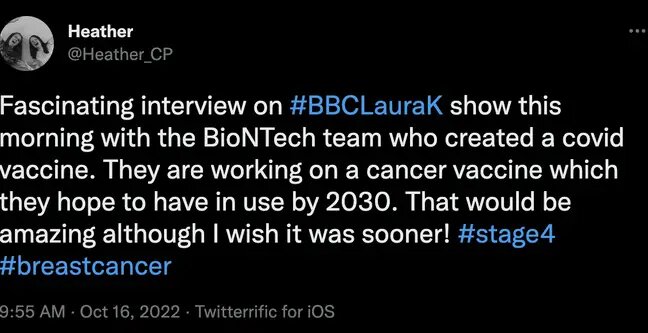
The two gave a very encouraging look into the novel cancer treatments they are working to develop on Sunday, October 16th, when they discussed their work on the BBC.
The goal of Sahin and Tureci's company is to treat cancer using messenger RNA (mRNA) technology, with the expectation that they will be able to treat tumor types like melanoma, bowel cancer, and many others.
Credit: Twitter/Heather_CP
advertisement
A personalized cancer vaccine is administered to patients in one of the ongoing trials by BioNTech in order to stimulate their immune systems to combat the disease.
In a nutshell, BioNTech's mRNA technology functions by giving instructions to cells so they may produce an antigen or protein.
This antigen is a component of the virus' spike protein when it comes to Covid treatment, but when it comes to cancer treatment, it would be a marker on the surface of tumor cells.
Sahin and Tureci believe that by doing this, the immune system will learn to identify and hunt down cancerous cells for destruction.
advertisement
Appearing on BBC’s Sunday with Laura Kuenssberg, Prof Tureci said: “mRNA acts as a blueprint and allows you to tell the body to produce the drug or the vaccine… and when you use mRNA as a vaccine, the mRNA is a blueprint for the 'wanted poster' of the enemy - in this case, cancer antigens which distinguish cancer cells from normal cells."
Tureci, BioNTech's chief medical officer, continued: "Every step, every patient we treat in our cancer trials helps us to find out more about what we are against and how to address that.”
"As scientists, we are always hesitant to say we will have a cure for cancer. We have a number of breakthroughs and we will continue to work on them."
advertisement
The ability of mRNA to create vaccines has now been demonstrated, thanks to Covid, but the BBC warns that "caution is needed."
It may be several years before we can definitively say whether BioNTech's treatments for bowel cancer, melanoma, and other tumor types actually live up to the hype, the broadcaster said, adding that many cancer trials are ineffective.