

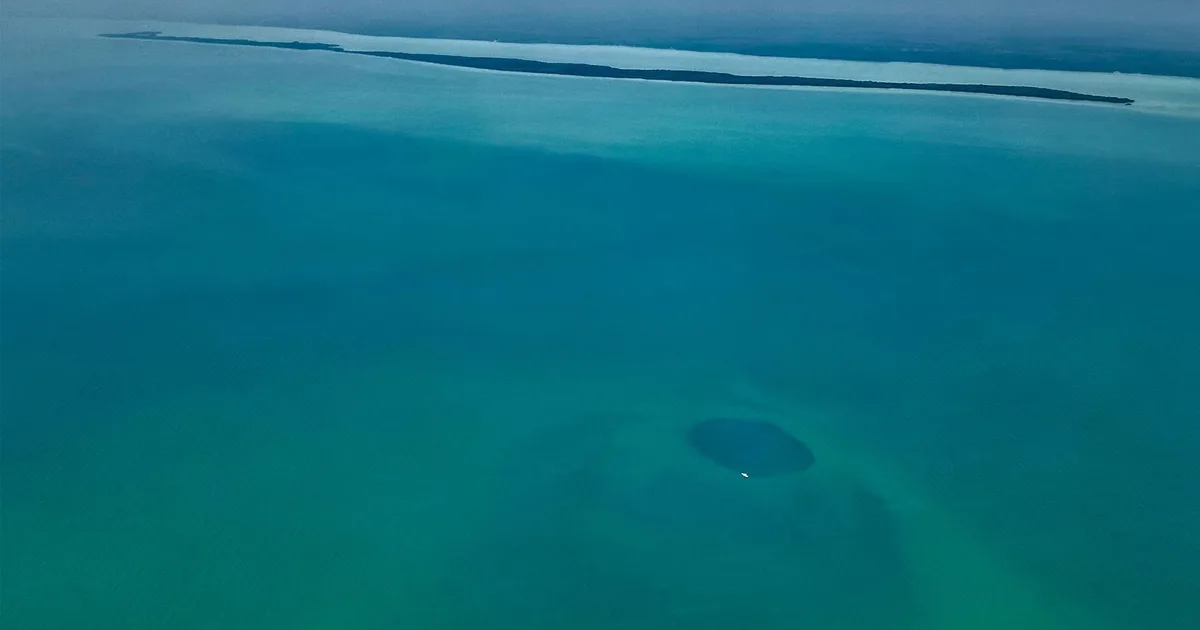
The massive underwater sinkhole has left marine experts with more questions than answers
advertisement
The deepest blue hole ever recorded sits just off the coast of Mexico, and researchers are still trying to understand it.
This enormous underwater sinkhole stretches more than 420 meters down, and even with modern tools, teams have not yet confirmed where the true bottom is. That uncertainty has added to the sense of mystery around the site.
The hole is known as Taam Ja', which means “deep water” in the Mayan language. It was first identified a little over 20 years ago by a local diver, though its full scale was not understood at the time. From the surface, visibility is limited, which makes it even harder to grasp just how vast it really is.
In 2021, scientists attempted to calculate its depth using an echo sounder, which sends sound waves downward and measures how long they take to bounce back.
That attempt produced an estimated depth of 275 meters. However, a later expedition in 2023 suggested that the hole extends to at least 420 meters, and even then, researchers could not confirm that they had reached the bottom.
To gather more accurate data, experts used a conductivity, temperature, and depth (CTD) profiler. This device measures water pressure and other environmental factors to help determine depth with greater precision.
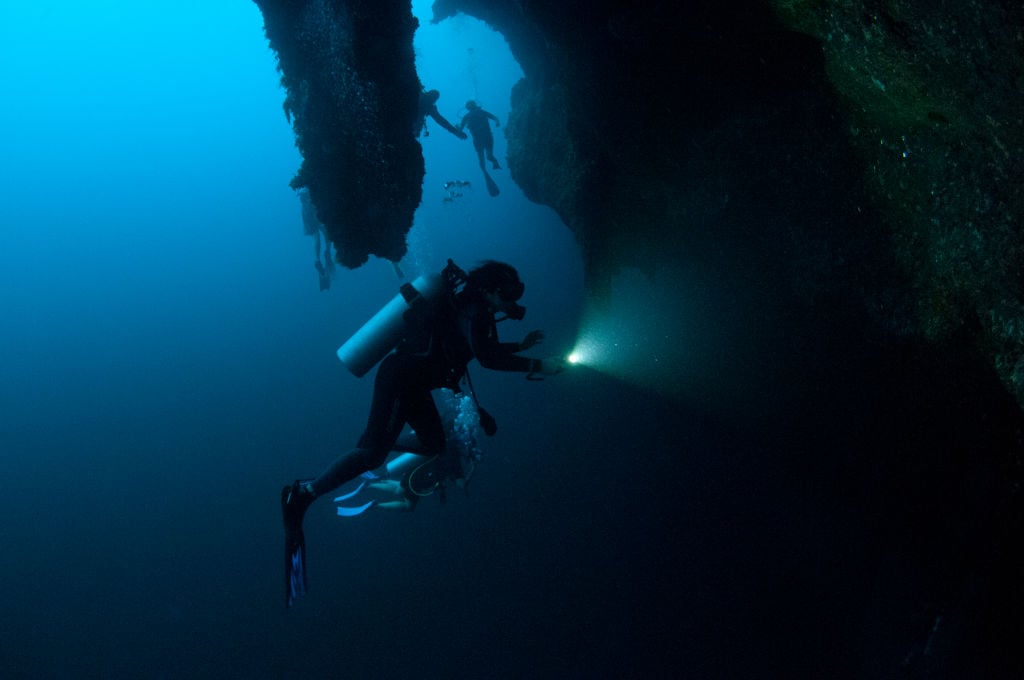
Divers have attempted to find out more about the blue hole
Andre Seale/VW PICS/Universal Images Group via Getty Images
advertisement
Located off Mexico’s Yucatán Peninsula, the blue hole has important geological and ecological features that interest marine biologists and oceanographers.
Blue holes are natural underwater caverns with steep vertical walls. They usually form in coastal areas.
They develop in regions where the bedrock consists of softer materials, such as limestone. Over time, erosion weakens the rock structure, causing sections to collapse and create deep, vertical sinkholes beneath the sea.
Most sinkholes measure only a few dozen meters in depth, although many connect to larger underwater cave systems.
Because blue holes often have limited water circulation, deep sections contain very little oxygen. Ocean currents do not easily reach these depths, which means only certain microbes and highly adapted organisms can survive there.
"While Taam Ja' is the deepest known blue hole, another famous example is the Great Blue Hole in Belize. Many have been keen to explore blue holes over the years, with Richard Branson exploring the latter with Fabien Cousteau, the grandson of French explorer Jacques Cousteau, in 2018."
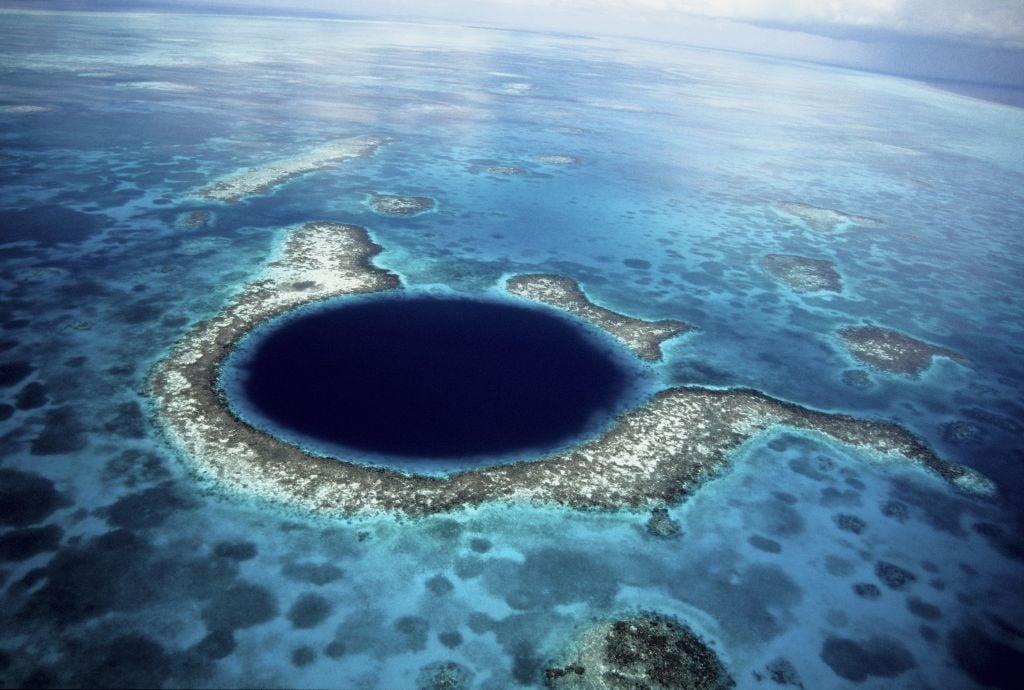
Scientists aren't sure about the exact depth of Taam Ja
Kurt AMSLER/Gamma-Rapho via Getty Images
advertisement
During exploration dives, researchers descended in separate vessels. At around 91 meters, they encountered a layer of hydrogen sulfide, a toxic compound that forms in low-oxygen environments.
Below that layer, the water turned extremely dark and appeared almost completely devoid of visible life. Conditions became harsher as they went deeper.
At what they believed to be the bottom during one dive, explorers discovered debris, including trash and a two-liter plastic bottle. They also recovered a long-lost GoPro camera that still contained vacation photos.
Two bodies were also found during previous explorations. They were believed to belong to divers who had gone missing during earlier expeditions.
advertisement
Branson said on the Virgin website: "The Blue Hole is made of a complex system of caves that once formed on dry land. It is proof of how oceans can rise quickly and catastrophically."
"Sea levels were once hundreds of feet lower. 10,000 years ago the sea level rose by about 300 feet when a lot of ice melted around the world. At 300 feet down you could see the change in the rock where it used to be land and turned into sea."