Artists very often leave special messages in their works. But we are used to looking at paintings as a whole, without paying heed to seemingly insignificant details.These famous canvases that aren’t as simple as they seem at first glance. There is a bonus at the end too: an unknown work by Leonardo da Vinci, which may turn out to be another masterpiece.
advertisement
#1 Mirror's Reflection - The Arnolfini Portrait (Jan Van Eyck)
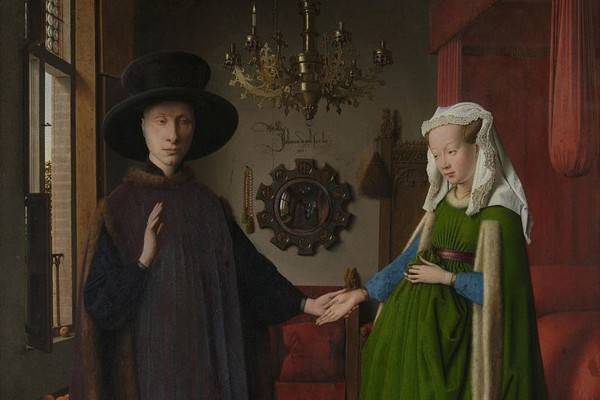
The Arnolfini Portrait, which is actually two portraits in one as there are two subjects, was painted in 1434, probably commissioned by the man in the painting (the pale Voldemort-looking fellow), Giovanni Arnolfini; either to celebrate his marriage or to commemorate the death of his wife Giovanna. Records from the 15th century are a bit patchy but one thing that most art historians agree on is that the woman on the right is not pregnant, it's just a stupid dress.
What makes Jan van Eyck's most celebrated piece so widely studied are two factors: for one thing it's small, only 82x59.5cm, but it's bursting with these incredibly fine, intricate details. The second factor is that there is a very tiny second painting in the piece itself.
#2 loving couple
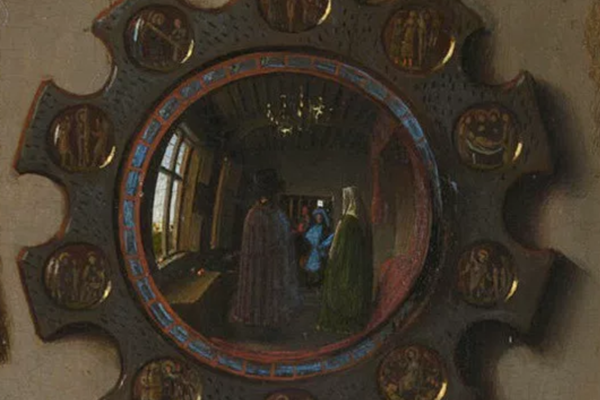
Look closely at the 'loving couple' (PDA was pretty chilly at this point in time) and you will see a small mirror between the two, look even closer into the mirror and you can see the reversed image of the painting.
The details of the couple's backs and the fine work in the room are already enough to amaze, but look even closer and you can see a figure painting the couple, presumably van Eyck.
advertisement
#3 The da Vinci Code
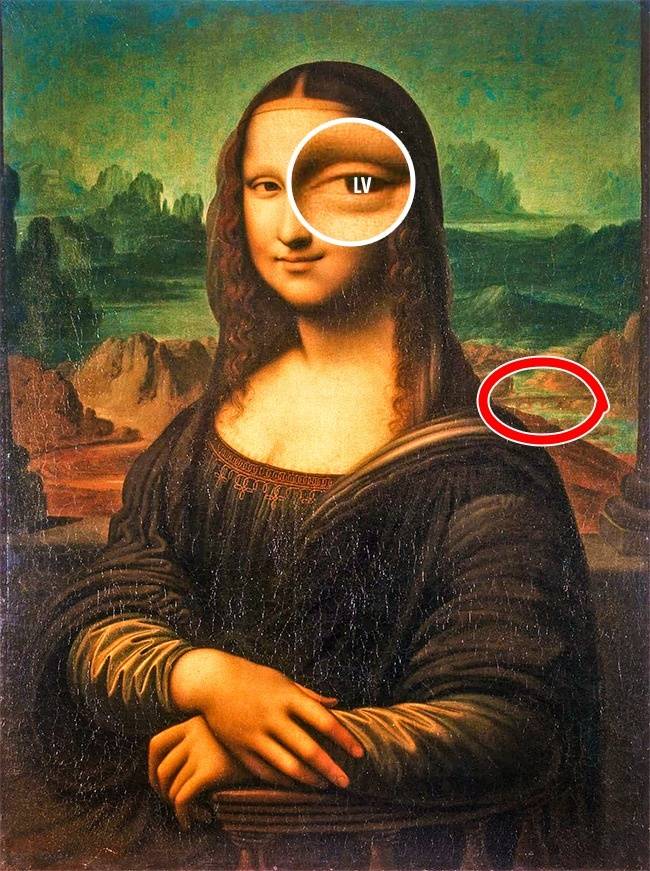
Members of Italy’s National Committee for Cultural Heritage found the letters "LV" in the right eye of the Mona Lisa. They could indicate the name of the artist, Leonardo da Vinci. Another find is symbols in the bridge, appearing to be the number 72. It is believed that the bridge (destroyed in 1472) behind the woman’s left shoulder is in the Italian city of Bobbio. Perhaps this way Leonardo wanted to hint at the setting.
#4 Pious Man And The Devil - The Old Fisherman (Tivadar Csontvary Kosztka)
Tivadar Csontvary Kosztka, thought to have been an undiagnosed schizophrenic, was working as a pharmacist in Hungary in 1880 when he received a message from God telling him to quit his job and become an artist because he would surpass all previous artists including his (Tivadar's not God's) hero Raphael. He did 10 years later, so at least God was patient.
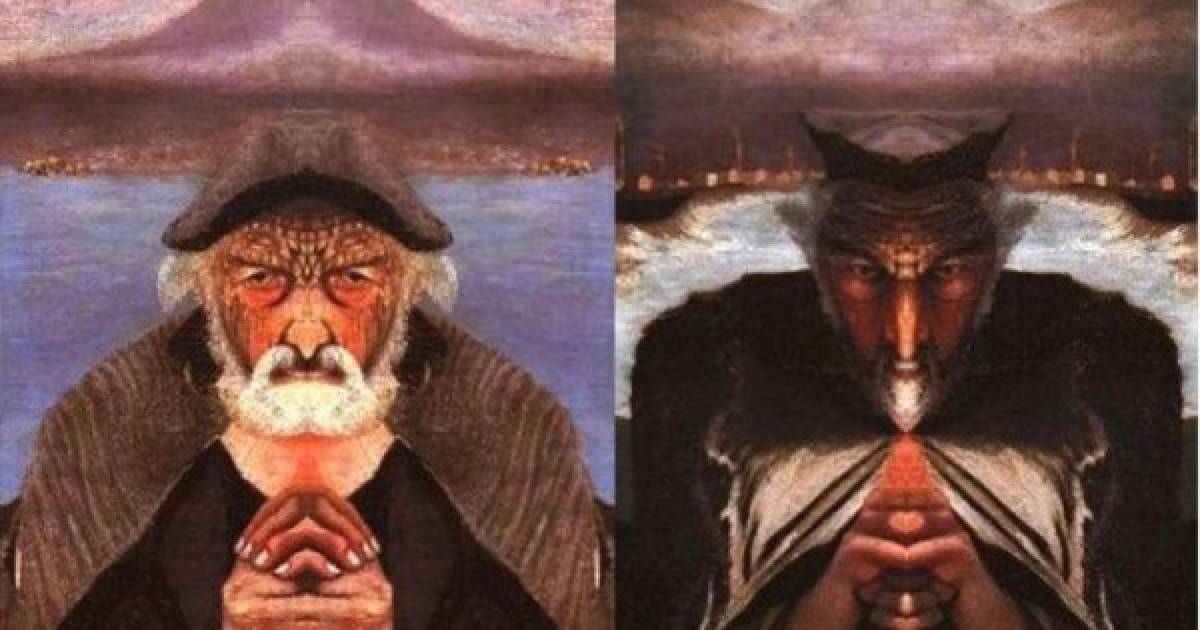
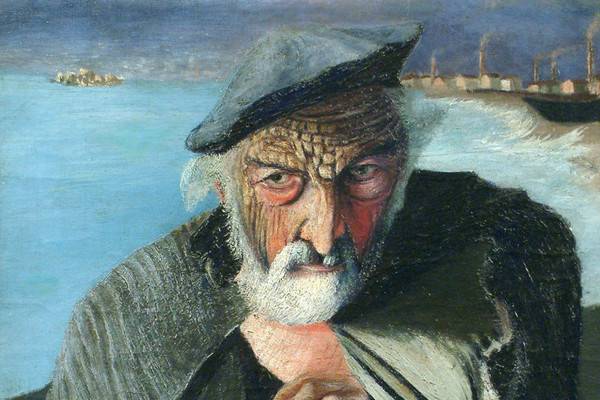
His most recognized work is the 1902 piece The Old Fisherman which is a painting of... an old fisherman. The man's face is somewhat jarring and unsymmetrical, and you could make a claim that this is due to the fisherman just being butt ugly unless of course you have a mirror and then the unevenness starts to make sense.
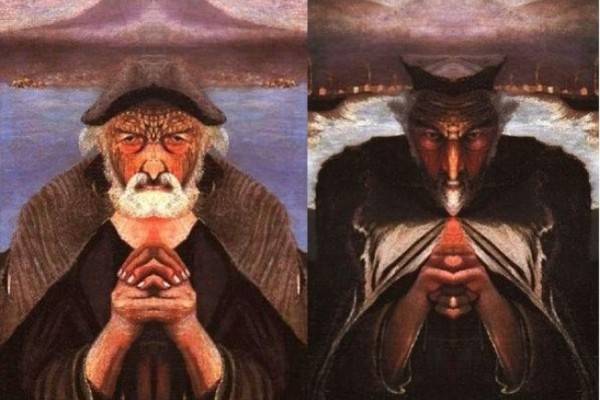
Holding a two sided mirror to the center of the painting grants the viewer with two different subjects, on one side a pious looking man praying the background nicely, light and gentle almost symbolizing the good of man. On the other side, however, is the devil, or at least someone that could be confused with the devil.
advertisement
#5 It's easy to miss as most of us don't walk into a museum with a mirror unless we want to find the security lasers.
advertisement
#6 Male or Female?
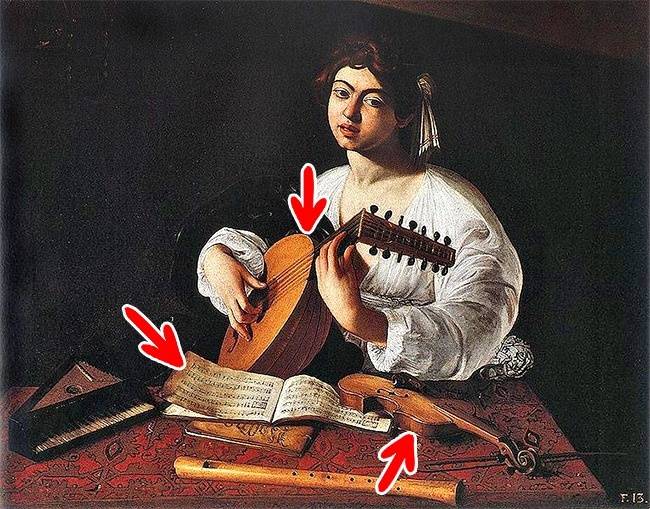
For a long time, the person in this painting by Caravaggio was considered a woman. Only at the beginning of the 20th century did art critics see a young man in the lute player. A few signs indicate this: the notes are the bass part of Jacques Arcadelt’s "You know I love you and adore you," as well as the lute and the violin, considered male instruments in Caravaggio’s time.
advertisement
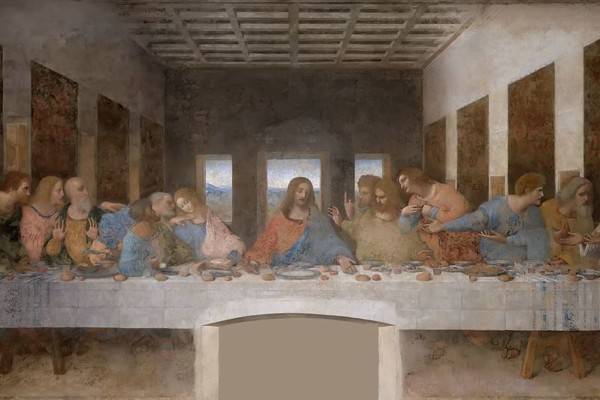
#7 Musical Marriage Prophecy - The Last Supper (Leonardo Da Vinci)
We need to address the elephant in the room. Coincidentally an elephant is one of the few things NOT to be purportedly hidden in Leonardo Da Vinci's The Last Supper.
The Last Supper has been examined for secret clues by a multitude of people throughout the years, due to Da Vinci's general tendency to hide hints and codes in his various works. Lynn Pickett and Clive Prince's 1997 book, Templar Revelation: Secret Guardians Of The True Identity Of Christ, claims that the figure next to Christ is in fact Mary Magdalene and this points to a conspiracy to hide the marriage of Jesus; if this sounds familiar, yes, it's the basis for The Da Vinci Code.
In 2007 Giovanni Maria Pala, an Italian musician, composed music supposedly hidden in the piece based on the fact that the placement and number of hands and loaves of bread are positioned in such a way as to be transposed into a musical staff when read right to left, which is how Da Vinci was known to code his writings.
A Vatican researcher, Sabrina Sforza Galitzia, says she deciphered a code in the painting that there would be a 'universal flood' in 4006. We'll know in 4006 if this theory proves to be correct.
advertisement
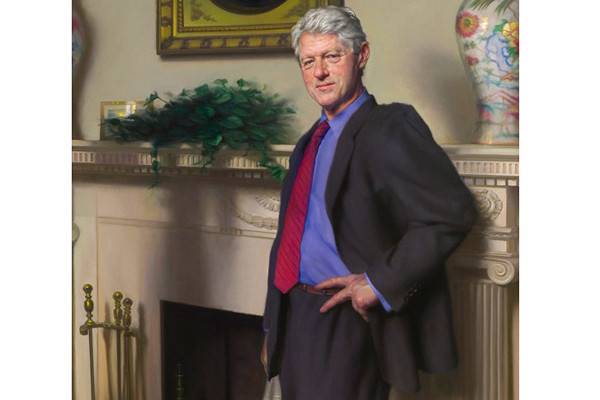
#8 A Reminder Of Monica - Portrait Of Bill Clinton (Nelson Shanks)
The most modern entry, the portrait of former US President Bill Clinton receives a special mention as the small, often missed, detail was pointed out by the artist himself.
Commissioned by the National Portrait Gallery in Washington DC, the painting was the sister of the official portrait which hangs in the White House; all former presidents sit for an official portrait and usually at least two are produced: one to hang in the National Portrait Gallery and one in the White House.
Famed portrait artist Nelson Shanks, not content with a standard portrait, included a long shadow to the right of Clinton which is supposed to be a silhouette of a dress, representing the 'blue dress' that was the key McGuffin of the Clinton-Lewinsky scandal.
Shanks revealed his intent in an interview with the Philadelphia Daily News in 2015: 'Clinton is probably the most famous liar of all time... I felt it necessary to depart from complete naivety in the painting and put in a subtle, subtle shadow across his presidency...'
Shanks has also painted portraits of Princess Diana, Pope John Paul II and Margaret Thatcher. It's as yet unclear what, if any, unsavoury easter eggs he may have hidden in his other works.
advertisement
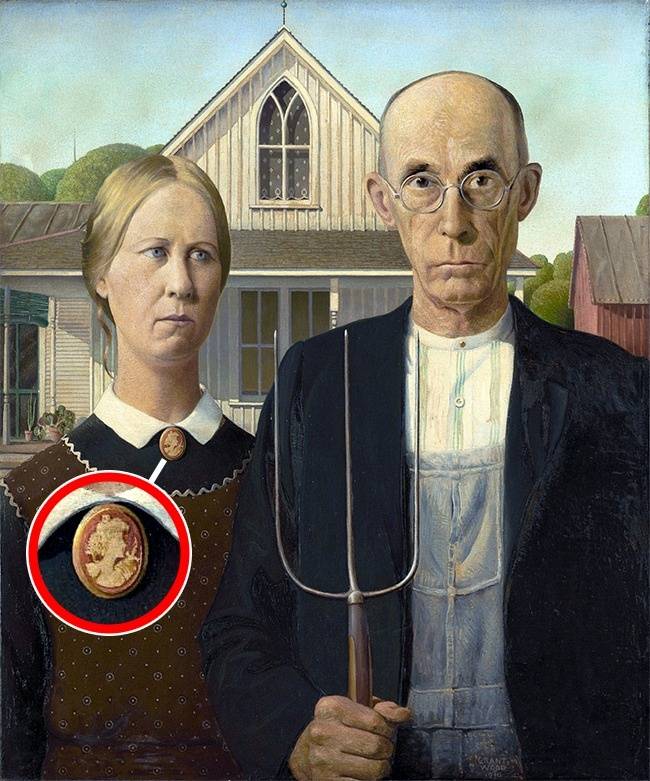
#9 Persephone and Hades
Take a look at this brooch: it shows Persephone, the Greek goddess of harvest and queen of the underworld. According to legend, Persephone was kidnapped by Hades, and the pitchfork in the hands of the farmer is just like Hades’s trident. Grant Wood has scattered many details around: for example, the stitching on the man’s denim overall, the stripes on his shirt, the window frames, and even the plant in the background mimic the shape of the pitchfork.
advertisement
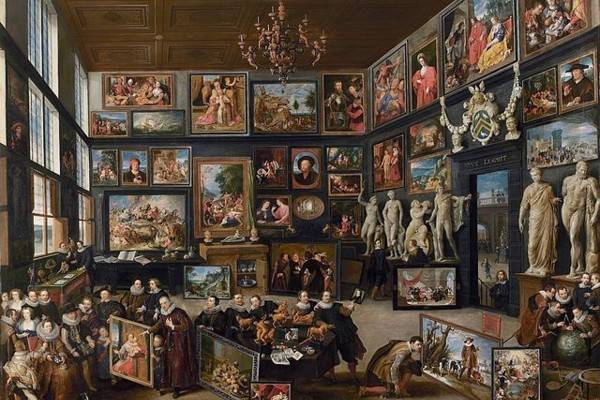
#10 He's Hiding In The Doorway - The Gallery Of Cornelis (Willem Van Haecht)
Cornelis van der Geest was a prominent spice merchant and hatter in 1600s; he was also a collector. And not just a few items, works by some of the greatest artists of all time.
Willem van Haecht curated van der Geest's collection and was a talented artist in his own right; he painted 'The Gallery Of Cornelis van der Geest' in 1628, as an idealized look at the man's collection.
Even the guests depicted in the piece are idealized, with guests including Rubens, van der Geest himself and Anthony van Dyck (for whom the facial hair style is named).
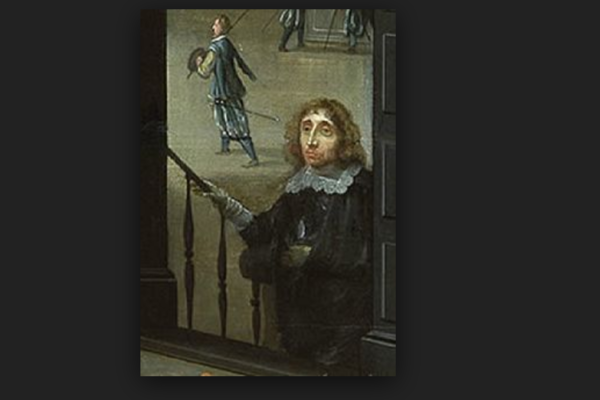
All the paintings are based on real works of art, including one of a naked woman that is actually a missing Van Eyck. It's an impressive work of art that depicts other pieces in their own styles but the gallery also contains a very small self-portrait of the artist himself.
advertisement
#11 In the doorway leading out of the grand hall you can see a young man sheepishly looking at the people who have come to examine the gallery:
This is Willem van Haecht. The look on his face is probably due to his nervousness of the people not putting things back where they belong.
advertisement
#12 Giant Creepy Skull Illusion - The Ambassadors (Hans Holbein)
Painted to commemorate the visit to London of Bishop Georges De Selve (on the right) and apparently to celebrate how cool and smart both men are, the assorted objects between them represent their interests and achievements.
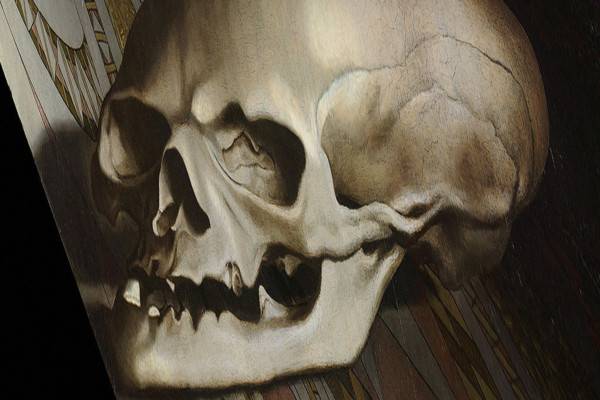
In the bottom center of the painting you notice a grayish blur and if you're lucky enough to see the painting in person and from the correct angle you will notice the blur is actually a massive skull. The skull is an anamorphic image (one that is only clear from certain angles) and seems tacked on to the painting as if Holbein really wanted to paint his illusion and decided to chuck it in despite the subject matter not really fitting the visual trick.
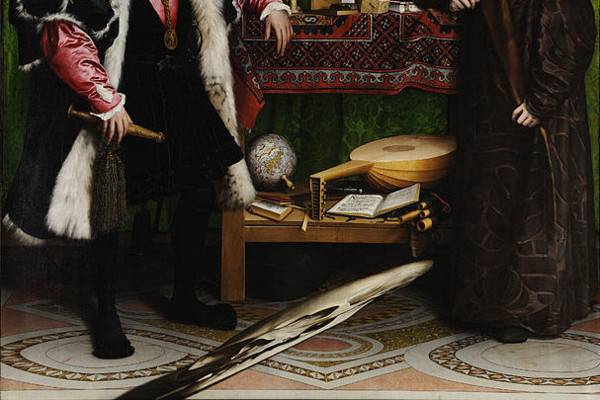
#13 'Memento Mori'
It wasn't unusual for the time to hide a little skull in your painting: the addition is referred to as a 'memento mori' a reminder of death, and this one may have been signed off by Dinteville, whose personal motto was 'remember thou shalt die'. Fun dude.
With the right reflections and magnifications you can make out text from the globe and books too, but these details are often overlooked because of the giant human skull in the middle.
advertisement
#14 A Fig Sign to the Pope
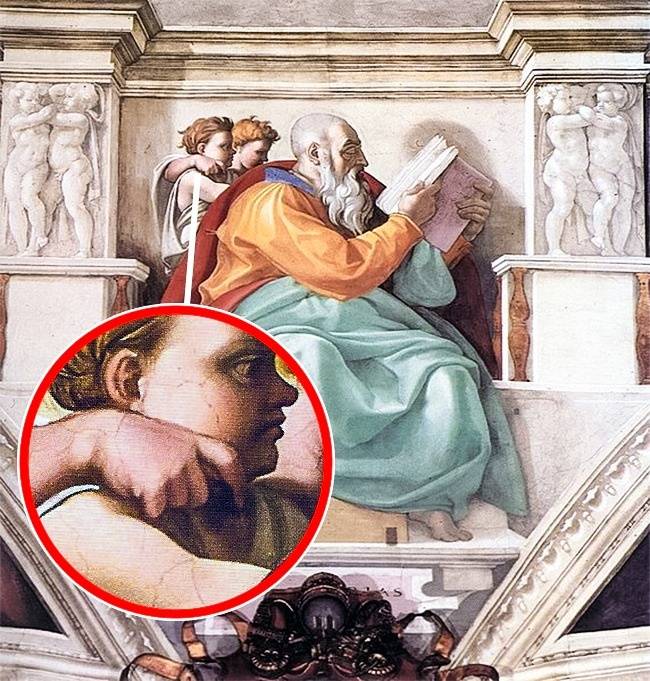
The conflict between Pope Julius II and Michelangelo led to the fact that one of the angels near Prophet Zechariah in the Sistine Chapel mural (the prophet was based on Julius II), folded his fingers in a fig sign. This gesture was thought to be indecent, so people got the hint.