

Vaccination is the administration of antigenic material (a vaccine) to stimulate an individual's immune system to develop adaptive immunity to a pathogen. Vaccines can prevent or ameliorate infectious disease. When a sufficiently large percentage of a population has been vaccinated, herd immunity results. The effectiveness of vaccination has been widely studied and verified. Vaccination is the most effective method of preventing infectious diseases.
advertisement
#1
Understanding the difference between vaccines, vaccinations, and immunizations can be tricky. Below is an easy guide that explains how these terms are used:
A vaccine is a product that produces immunity from a disease and can be administered through needle injections, by mouth, or by aerosol.
A vaccination is the injection of a killed or weakened organism that produces immunity in the body against that organism.
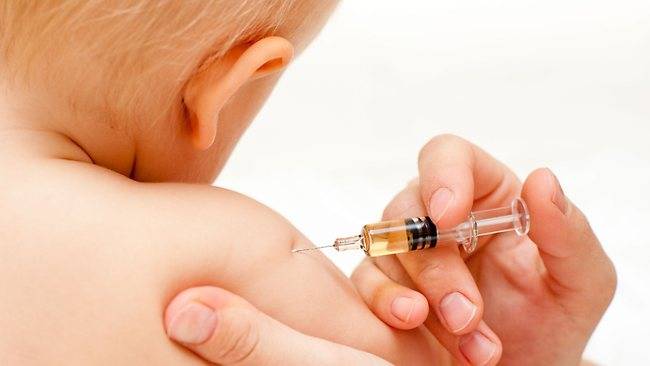
An immunization is the process by which a person or animal becomes protected from a disease. Vaccines cause immunization, and there are also some diseases that cause immunization after an individual recovers from the disease.
#2 Vaccines for infants and children age 0 to 6 years
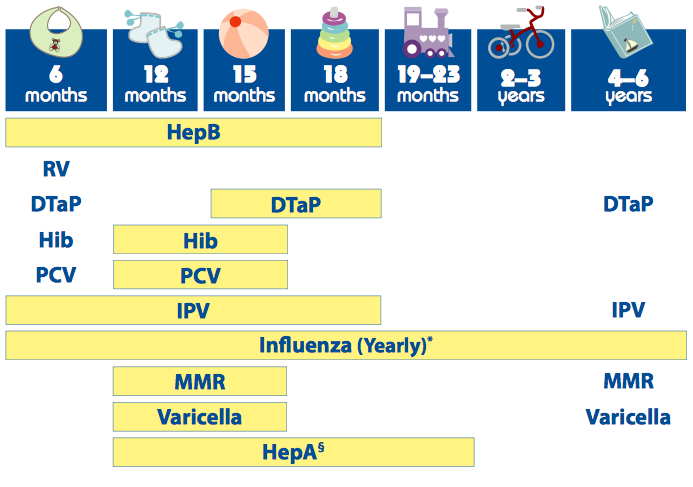
In the United States, routine vaccines are recommended in children between ages 0 and 6 years to prevent a number of serious or even deadly diseases. The recommended schedule is available through the Centers for Disease Control and Prevention.
Hepatitis B;
Although most infants are not at high risk for becoming infected with HBV, immunizing during infancy is the most effective way to ensure lifetime protection.
Timing and dose — HBV vaccination is recommended for all children beginning at birth. The vaccine requires three doses, with the first usually given within 24 hours of birth. The second and third doses are given one to two months later and then at 6 to 18 months of age.
DIPHTHERIA, TETANUS, PERTUSSIS
ming and dose — Combined diphtheria, tetanus, and acellular pertussis (DTaP) vaccine is recommended for all children in the United States. The acellular form of pertussis vaccine (DTaP) has replaced the older form of pertussis vaccine (DTP), known as the whole cell vaccine. A total of five separate doses are recommended, at 2, 4, and 6 months of age, with the fourth dose given at 15 to 18 months and the fifth at 4 to 6 years of age.
POLIOMYELITIS;
All children should be vaccinated against polio to avoid new outbreaks. In the United States, the polio vaccine is made from a killed virus and is injected (called IPV). In other countries, where polio disease is still a major problem, oral polio vaccine (OPV) is given.
Timing and dose — The injected polio vaccine series in the United States includes four doses; the first and second doses are given at 2 and 4 months of age. The third dose is usually given at 6 to 18 months of age, and a fourth dose is routinely given at 4 to 6 years.
ROTAVIRUS
Rotavirus is the single most important cause of severe diarrhea and dehydration in infants and young children. A rotavirus vaccine is recommended for all infants in the United States. Two vaccines are available: RotaTeq (RV5) and Rotarix (RV1).
Timing and dose — The vaccine is in a liquid form and is given by mouth (not as a shot). The first dose of the vaccine should be given between 6 and 15 weeks of age, but not after 15 weeks. The number of doses (two or three) depends upon which vaccine is given:
â—RotaTeq (RV5) – Three doses of RV5 are recommended, given at 2, 4, and 6 months of age. The third dose of the vaccine should be given by 8 months of age.
â—Rotarix (RV1) – Two doses of RV1 are recommended, given at 2 and 4 months of age. The second dose should be given by 8 months of age.
HAEMOPHILUS INFLUENZAE TYPE B (Hib)
Until the mid-1990s, Haemophilus influenzae serotype b (Hib) was the most common cause of bacterial meningitis (inflammation of the covering of the brain) in children. It was also responsible for other serious bacterial infections.
Timing and dose — There are several types of Hib vaccines available in the United States; one is given in three doses at 2, 4, and 6 months of age and as a booster dose at 12 to 15 months. The second type is given in two doses, at 2 and 4 months, and as a booster dose at 12 to 15 months of age.
PNEUMOCOCCAL
Streptococcus pneumoniae (pneumococcus) can cause serious infections, including meningitis and pneumonia, which can be fatal in young children.
Timing and dose — Children should receive a total of four doses of pneumococcal vaccine. Doses should be given at 2, 4, and 6 months of age and 12 to 15 months of age. The first dose can be given as early as 6 weeks of age.
INFLUENZA
Commonly known as flu, influenza is a highly contagious viral infection that occurs in outbreaks worldwide, usually during the winter months in the United States. Young children and those with certain underlying medical conditions are at increased risk for severe or complicated influenza infection.
Timing and dose — There are two types of influenza vaccine; one is an injection (shot), while the other is administered as a nasal spray. In the United States, the nasal spray vaccine is not recommended for the 2016-2017 influenza season.
MEASLES-MUMPS-RUBELLA (MMR)
Measles, mumps, and rubella are illnesses that may be transmitted by airborne droplets released during coughing or sneezing.
â—Measles (also known as rubeola) is a highly contagious viral illness of the respiratory tract that primarily affects children; it causes a distinctive rash, fever, and cough, and may result in complications, including infection of the middle ear, lungs, and brain.
â—Mumps is an acute, usually mild viral infection of childhood that causes painful swelling of the salivary glands. Mumps complications can develop, including inflammation of the brain (encephalitis), the protective membranes of the brain (meningitis) and, in males after puberty, swelling and tenderness of one or both testes (orchitis).
â—Rubella, also known as German measles, is a mild viral infection that causes fever, swelling of the lymph nodes in the neck, and a distinctive rash; however, it can cause severe birth defects (congenital rubella syndrome) if a woman becomes infected during early pregnancy.
Timing and dose — The first dose of MMR is administered at 12 to 15 months of age. A second dose is recommended routinely before school entry (between 4 and 6 years of age).
VARICELLA (CHICKENPOX)
Varicella is a highly contagious viral illness caused by infection with the varicella zoster virus (VZV). The disease causes fever, sore throat, and a distinctive, itchy rash with fluid-filled blisters that later forms scabs. The virus is transmitted by the spread of airborne droplets or direct contact with skin lesions.
Timing and dose — In the United States, VZV vaccine is recommended for all children at 12 to 18 months of age. The recommended schedule is available through the Centers for Disease Control and Prevention. A second dose is recommended at 4 to 6 years of age. A combination measles, mumps, rubella, and varicella vaccine (MMRV, ProQuad) may be used in children between 12 months and 12 years.
HEPATITIS A VACCINE
Hepatitis due to infection with the hepatitis A virus (HAV) is one of the most common viral infections in children and adolescents in the United States.
Timing and dose — The Hepatitis A (HepA) vaccine is recommended for all children between 12 and 23 months of age. Older children and adults also should consider being immunized. In all age groups, two doses are required, given at least six months apart.
advertisement
#3 When to have vaccinations
Here's a checklist of the vaccines that are routinely offered to everyone in the UK free of charge on the NHS and the ages at which they should ideally be given.
If you're not sure whether you or your child have had all your routine vaccinations, ask your GP or practice nurse to find out for you. It may be possible to catch up later in life.
Try to have your vaccinations delivered on time to ensure protection. If you're not going to be able to get to the GP surgery when a vaccination is due, talk to your doctor, as it may be possible to arrange to have the vaccination at a different location.
8 weeks;
6-in-1 vaccine, given as a single jab containing vaccines to protect against six separate diseases: diphtheria; tetanus; whooping cough (pertussis); polio; Haemophilus influenzae type b, known as Hib, a bacterial infection that can cause severe pneumonia or meningitis in young children; and hepatitis B
Pneumococcal (PCV) vaccine
Rotavirus vaccine
Men B vaccine
12 weeks;
6-in-1 vaccine, second dose
Rotavirus vaccine, second dose
16 weeks;
6-in-1 vaccine, third dose
Pneumococcal (PCV) vaccine, second dose
Men B vaccine second dose
One year:
Hib/Men C vaccine, given as a single jab containing vaccines against meningitis C (first dose) and Hib (fourth dose)
Measles, mumps and rubella (MMR) vaccine, given as a single jab
Pneumococcal (PCV) vaccine, third dose
Men B vaccine, third dose
2-8 years (including children in reception class and school years 1 to 4)
Children's flu vaccine (annual)
3 years and 4 months
Measles, mumps and rubella (MMR) vaccine, second dose
4-in-1 pre-school booster, given as a single jab containing vaccines against: diphtheria, tetanus, whooping cough (pertussis) and polio
12-13 years (girls only)
HPV vaccine, which protects against cervical cancer – two injections given 6-12 months apart
14 years
3-in-1 teenage booster, given as a single jab containing vaccines against diphtheria, tetanus and polio
Men ACWY vaccine, given as a single jab containing vaccines against meningitis A, C, W and Y
65 years;
Pneumococcal (PPV) vaccine
65 and over;
Flu vaccine (every year)
70 years (and 78 and 79-year-olds as a catch-up);
Shingles vaccine
#4 Effectiveness
The efficacy or performance of the vaccine is dependent on a number of factors:
the disease itself (for some diseases vaccination performs better than for others)
the strain of vaccine (some vaccines are specific to, or at least most effective against, particular strains of the disease)
whether the vaccination schedule has been properly observed.
idiosyncratic response to vaccination; some individuals are "non-responders" to certain vaccines, meaning that they do not generate antibodies even after being vaccinated correctly.
assorted factors such as ethnicity, age, or genetic predisposition.
If a vaccinated individual does develop the disease vaccinated against (breakthrough infection), the disease is likely to be less virulent than in unvaccinated victims.
The following are important considerations in the effectiveness of a vaccination program:
careful modeling to anticipate the impact that an immunization campaign will have on the epidemiology of the disease in the medium to long term
ongoing surveillance for the relevant disease following introduction of a new vaccine
maintenance of high immunization rates, even when a disease has become rare.
advertisement
#5 Safety
Vaccines are the best defense we have against serious, preventable, and sometimes deadly contagious diseases. Vaccines are some of the safest medical products available, but like any other medical product, there may be risks. Accurate information about the value of vaccines as well as their possible side-effects helps people to make informed decisions about vaccination.
Federal law requires that Vaccine Information Statements explaining vaccine benefits and risks be provided when certain vaccinations are administered (before each dose). Vaccine Information Statements are available in Spanish and many different languages. In addition, more detailed information describing the benefits and risks of vaccines is available in the Licensed Vaccine List from the Food and Drug Administration.
The following sections answer common questions asked about vaccines and how vaccines are tested and monitored to ensure they are safe and effective.
Be Informed
Potential Side Effects
What’s in Vaccines
Who Should and Should Not Be Vaccinated