

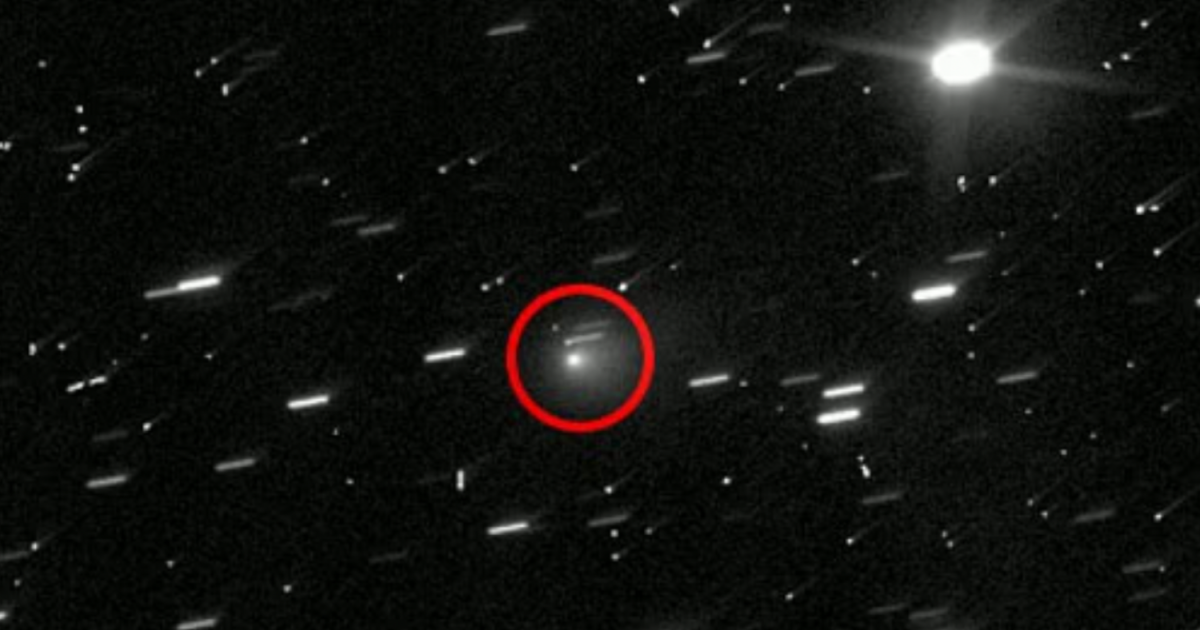
NASA spotted interstellar object 3I/ATLAS flying through space on July 1
Harvard Scientist Says Mysterious Object Headed Toward Earth Might Not Be Natural
By
Khadija Pervez in
Science and Technology
On 8th August 2025
advertisement
A giant object flying toward Earth has left experts scratching their heads as they try to figure out what exactly it could be.
Whenever something massive is seen drifting near our planet, speculation starts almost instantly. People often jump to two possible conclusions, either it's a UFO or just another boring space rock.
These are the usual go-to theories whenever something unexplained is spotted drifting around in deep space.
So naturally, when NASA detected the object named 3I/ATLAS on July 1, questions quickly followed.
But the scientific community can’t seem to agree on what it actually is — and one detail in particular is causing all the confusion.
advertisement
While around 200 scientists and astronomers have already labeled it a comet, not everyone is convinced.
Harvard physicist Avi Loeb shared a paper of his own, where he pointed out that this supposed 'comet' is missing a key feature that most comets have.
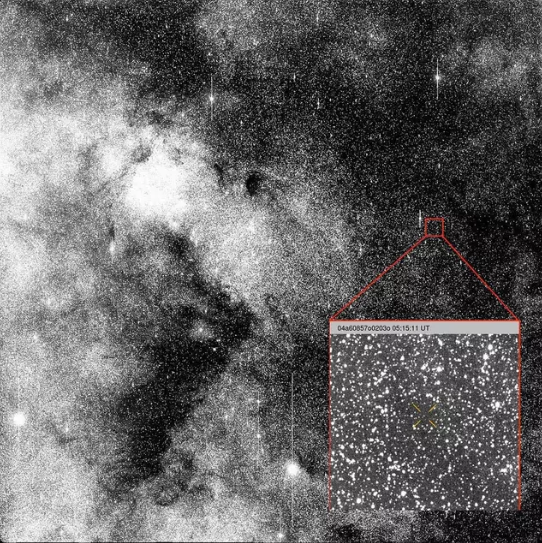
31/ATLAS's origins have been questioned
ATLAS/University of Hawaii/NASA
"There were claims of a tail." Loeb explained, before continuing: "But since 3I/ATLAS is accelerating and its current size is not much larger than the angular resolution of Earth-based telescopes, it is not easy to avoid fictitious elongation of the image as a result of the object's motion."
He also raised some concerns about how it isn’t releasing gas the way a comet normally would. Plus, he pointed out how its path fits almost too perfectly within our solar system.
To assess it, he used something called the 'Loeb Scale,' which ranks how likely an object is to be artificial versus natural. According to his judgment, 3I/ATLAS scored a six out of ten.
advertisement
That score leans more toward the object being a product of engineering rather than a naturally formed comet or asteroid.
Writing on his Medium blog, Loeb said: "I suggested a `Loeb Scale' for interstellar objects where `0' is definitely a natural object (comet or asteroid) and `10' is definitely a technological object (identified by maneuvers or emission of artificial light or signals). Currently, I give 3I/ATLAS a 6 on that scale, but my assessment will change as we get better data on it when it comes closer to the Sun."
One of his boldest theories is that the object might actually be some kind of mothership sent out to release smaller probes toward our planet.

Scientist Avi Loeb thinks it could be a UFO
Anibal Martel/Anadolu Agency via Getty Images
advertisement
"The more likely scenario from an engineering perspective involves a mothership that releases mini-probes which perform a reverse Oberth maneuver to slow down at perihelion and intercept Earth." he explained.
If his math is correct, he believes those probes could be close enough to reach Earth somewhere between November 21 and December 5, 2025.
"It may come to save us or destroy us." he warned. "We'd better be ready for both options and check whether all interstellar objects are rocks."
advertisement
Images of 3I/ATLAS taken on July 4 and again on July 29 haven’t shown any evidence of a tail, which would normally be a clear sign of a comet.
Loeb has suggested that NASA could use its Juno spacecraft to get close to the object when it's near Jupiter next year. That could give us a definitive answer about what this thing really is.
advertisement
He also wrote on his blog: "The best we can do is monitor the sky with telescopes. It may well be that 3I/ATLAS is a natural comet. But even then, we have to check each and every interstellar object that the Rubin Observatory will find in the coming decade for anomalous characteristics, like non-gravitational acceleration with no cometary tail or artificial lights or unusual shape."
In addition to observing it, he believes governments should be actively preparing for the possibility that 3I/ATLAS turns out to be something more than just a chunk of cosmic rock.