It’s the age of information, and we often face new facts that replace our previous views, be it a scientific discovery or an invention.Here are several historical facts we’ve all believed since school which turned out to be false.
advertisement
#1 What happened to the Sphinx’s nose?
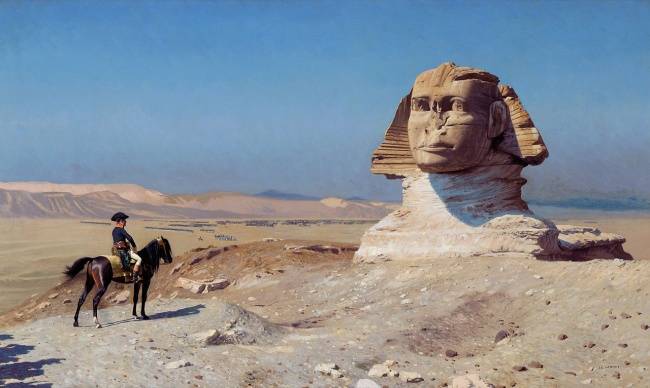
Legends have passed over hundreds of years regarding the simple omission in this photograph of the Sphinx and the Pyramid of Khafre, part of the Giza Pyramid (or Great Pyramid) complex in Egypt. Where is the Sphinx’s nose? Many of us have heard the tale that a cannonball fired by Napoleon’s soldiers hit the nose and caused it to break off. Sketches of the Sphinx by the Dane Frederic Louis Norden were created in 1737 and published in 1755, well before the era of Napoleon. However, these drawings illustrate the Sphinx without a nose and clearly contradicts the legend. So what really happened?
The Egyptian Arab historian al-Maqrīzī wrote in the 15th century that the nose was actually destroyed by a Sufi Muslim named Muhammad Sa'im al-Dahr. In 1378 CE, Egyptian peasants made offerings to the Great Sphinx in the hope of controlling the flood cycle, which would result in a successful harvest. Outraged by this blatant show of devotion, Sa'im al-Dahr destroyed the nose and was later executed for vandalism. Whether this is absolute fact is still debatable.
#2 Van Gogh and his ear
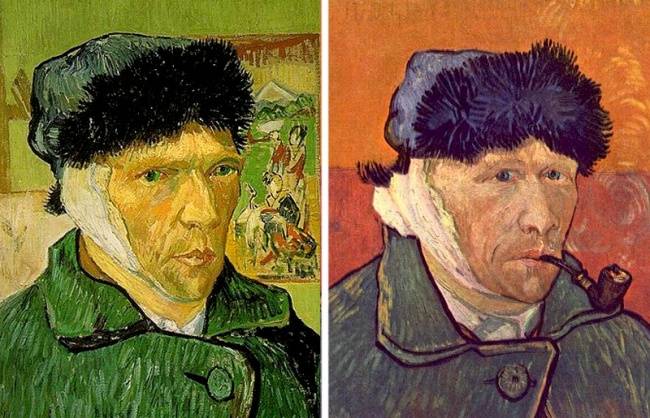
On 23 December 1888 Vincent Van Gogh - following an argument with fellow lodger and artist Gaugin - retreated to his room, where he took a razor to his left ear; severing it, wrapping it in a paper, and delivering it to a woman at a brothel both he and Gaugin used to frequent. He was found unconscious the next morning by a policeman and was taken to the hospital.
A letter from Van Gogh’s doctor, Felix Rey, reveals that the painter did not remove just a section of his ear, after all, but severed it entirely.
The woman he delivered it to was not a prostitute – as previously thought – but a humble maid who had been injured by a dog bite and worked to pay off her medical bills.
Bernadette Murphy, the researcher who discovered the letter and traced the family of the unknown girl, has now speculated that Van Gogh could have been offering his own flesh in a noble but deluded attempt to help heal her.
advertisement
#3 Vikings’ horned helmets
Forget almost every Viking costume you’ve ever seen. Yes, the pugnacious Scandinavians probably sported headgear when they marched into battle, but there’s no reason to believe it was festooned with horns. In depictions dating from the Viking age—between the eighth and 11th centuries—warriors appear either bareheaded or clad in simple helmets likely made of either iron or leather. And despite years of searching, archaeologists have yet to uncover a Viking-era helmet embellished with horns. In fact, only one complete helmet that can definitively be called “Viking” has turned up. Discovered in 1943 on Gjermundbu farm in Norway, the 10th-century artifact has a rounded iron cap, a guard around the eyes and nose, and no horns to speak of.
The popular image of the strapping Viking in a horned helmet dates back to the 1800s when Scandinavian artists like Sweden’s Gustav Malmström included the headgear in their portrayals of the raiders. When Wagner staged his “Der Ring des Nibelungen” opera cycle in the 1870s, costume designer Carl Emil Doepler created horned helmets for the Viking characters, and an enduring stereotype was born.
Malmström, Doepler and others may have been inspired by 19th-century discoveries of ancient horned helmets that later turned out to predate the Vikings. They may also have taken a cue from ancient Greek and Roman chroniclers, who described northern Europeans wearing helmets adorned with all manner of ornaments, including horns, wings, and antlers. But not only did this headgear fall out of fashion at least a century before the Vikings appeared, it was likely only donned for ceremonial purposes by Norse and Germanic priests. After all, horns’ practicality in actual combat is dubious at best. Sure, they could help intimidate enemies and maybe even poke out a few eyes, but they would have been even more likely to get entangled in a tree branch or embedded in a shield.

#4 Stonehenge
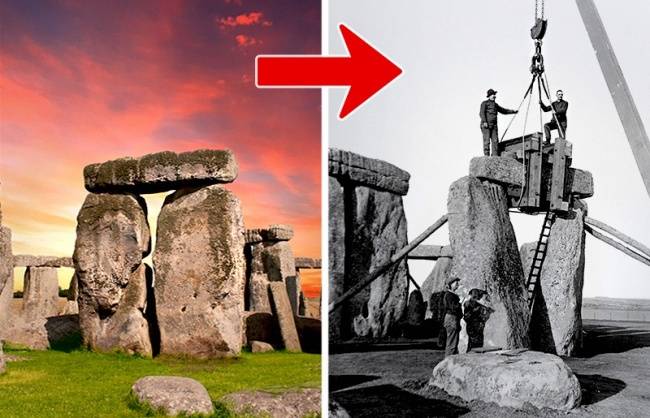
Stonehenge is one of the biggest mysteries of the world, and new hypotheses about it are born regularly. Yet originally it looked nothing like it does today: in 1901, William Gowland initiated his restoration of the monument. Recent photos prove that now it looks quite different than in ancient times.
advertisement
#5 Discovery of America
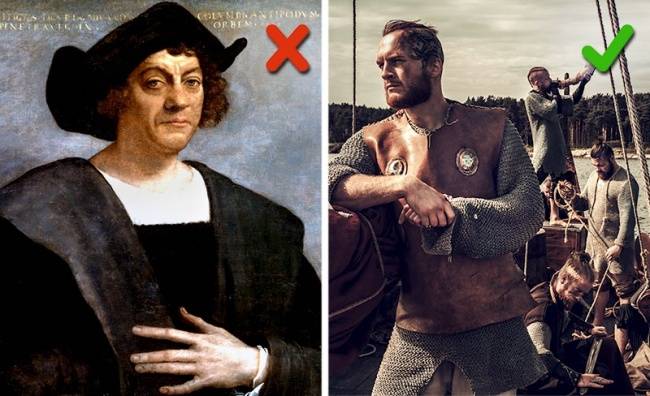
In our history lessons, we were told that Christopher Columbus discovered America in 1492. However, Nearly 500 years before the birth of Christopher Columbus, a band of European sailors left their homeland behind in search of a new world. Their high-prowed Viking ship sliced through the cobalt waters of the Atlantic Ocean as winds billowed the boat’s enormous single sail. After traversing unfamiliar waters, the Norsemen aboard the wooden ship spied a new land, dropped anchor and went ashore. Half a millennium before Columbus “discovered” America, those Viking feet may have been the first European ones to ever have touched North American soil.
advertisement
#6 Ossian’s poems
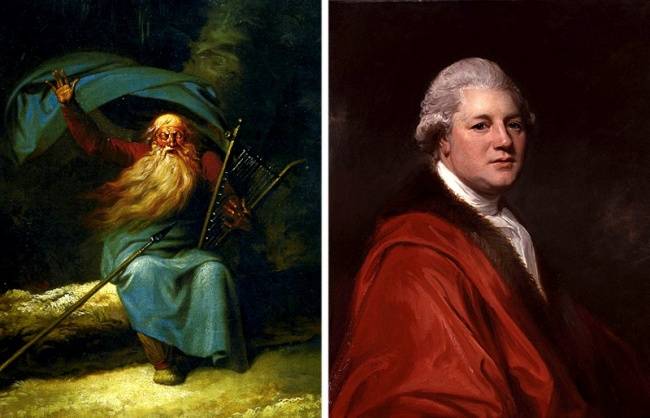
Scottish poet James McPherson was renowned for translating the poems of Ossian, a Celtic bard of the 3rd century, from Gaelic. However, when faced with demands to present the manuscripts, McPherson eluded the subject. The manuscripts have still not been found, and the poems themselves are now considered a mystification.