
Nurturing a child with Attention Deficit Hyperactivity Disorder (ADHD) can be very difficult, as they need distinctive discipline techniques that are not the same as other children. Otherwise, you may risk unnecessarily excusing your child's behavior, or become too severe in punishment; you must perform the intricate task of balancing between these two extremes. Experts in managing children with ADHD confirm that disciplining such children can be a challenging job. However, parents, caregivers, teachers, and others can discipline their children with ADHD based on patience and consistency
advertisement
1. Address critical needs within your family's schedule and organization.
ADHD children have great difficulty in planning, thinking through procedures, managing time, and other daily life skills. A strongly structured organizational system will be critical to your family's daily life. In other words, creating a routine can prevent the need for discipline in the first place because your child will be less likely to misbehave.
Many of child's actions may be rooted in a lack of organization that leads to total chaos. For instance, some of the biggest struggles between a child with ADHD and her parents relates to household chores, cleaning his or her bedroom, and doing homework. Those wars can be prevented if the child is surrounded by strong structure and organization that build good habits which will be the foundation of the child's ability to achieve success.
This typically includes things such as morning routines, homework time, bedtimes, and when things like video games may be used.
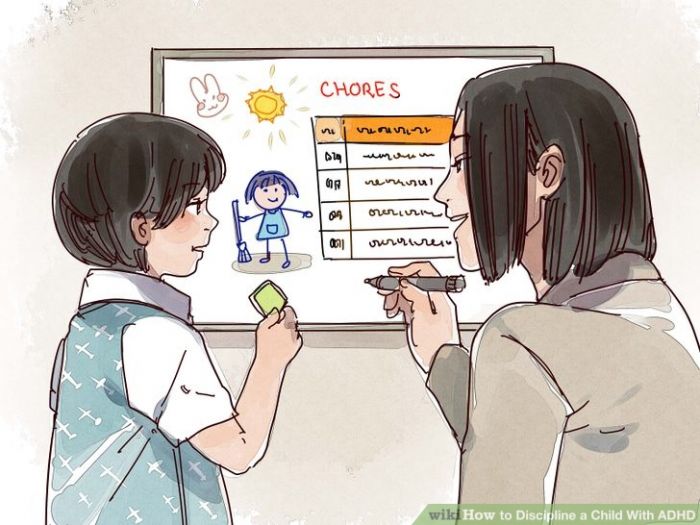
Be sure expectations are explicit. "Clean your room" is vague, and an ADHD child may be confused where even to begin and how to follow through before losing focus. It may be better to break it up into short, clear tasks: "Pick up toys", "Vacuum Rug", "Clean Hamster Cage", "Put Away clothes--in the closet!".

2. Establish clear routines and rules.
Make sure you have a set of clear rules and expectations for your whole family and household. Children with ADHD are unlikely to pick on the subtle hints. Communicate clearly exactly what you expect and what they need to do each day.
Once the household routine for the work week, for example, put up a schedule in your child's room. You can use a white board and make it fun by using colors, stickers, and other decorative aspects. Explain and point out everything on the schedule so that your child can understand it in different ways.
Establish routines for all kinds of daily tasks, including homework, which tends to be a big issue for most kids with ADHD. Make sure your child writes down her homework everyday in a planner and that there is a regular time and place for her to do her homework. Make sure to go over her homework before she begins and review it with her afterward.[2]
advertisement
3. Break large tasks down into small pieces.
Parents need to understand that the disorganization that often accompanies children with ADHD is often the result of being visually overwhelmed.[3] As a result, the child with ADHD needs a big projects, such as cleaning her room or folding and putting away clean laundry, to be broken down into many smaller tasks, given one at a time.
In the case of laundry, for example, ask your child to begin by finding all her socks and putting them away. You can make a bit of a game out of it by playing a CD and challenging your child to complete the task of finding all the socks and putting them in the appropriate drawer by the end of the first song. Once that is accomplished and you praise her for doing it correctly, you can then ask her to pick out and put away her underwear, pjs, and so on, until the task is competed.
Breaking the project into smaller pieces spread out over time not only prevents behavior born of frustration but also gives parents multiple chances to provide positive feedback while allowing children many opportunities to experience success. The more success experiencedand rewardedthe more a child begins to identify himself as a success, giving a much needed self-esteem boost and helping him actually become more successful in the future. After all, success breeds success![4]
You may still need to guide your child's routines. ADHD makes it difficult to focus, not get distracted, and keep going on boring tasks. That does not mean he or she gets to opt out of chores. However, the expectation that he or she can do it independently may or may not be realistic...this depends very much on your child. It is better to work together on such tasks in an accepting way, and make it a positive experience, than to expect too much and make it a point of frustration and argument.

4. Get organized.
Establishing routines develops habits that will last a lifetime, but there also needs to be a good organizational system in place to support those routines.Help your child to organize her room. Remember that children with ADHD are overwhelmed because they notice everything at once, so the more they can categorize their belongings, the easier it is for them to deal with that plethora of stimuli.[5][6]
Children with ADHD do well with storage cubes, shelves, wall hooks and the like to help them separate out items into categories and minimize crowding.[7][8]
Use of color coding, pictures, and shelf labels also helps minimize visual stress. Remember that children with ADHD are overwhelmed because they notice everything at once, so the more they can categorize their belongings, the easier it is for them to deal with that plethora of stimuli.[9][10]
De-Clutter the Stuff. In addition to overall organizing, purging the "stuff" that will distract your child will help make the environment more calming. This does not necessarily stripping the room bare. However, getting rid of outgrown toys, clothing she does not wear, cleaning out shelves of bric-a-brac that does not hold high appeal for the child can go a long way to making a more harmonious environment.

advertisement
5. Get your child's attention.
As the adult, you have to be certain the child is attending before making any demands, directions, or commands. If he or she is not "dialed in" on you, nothing will get accomplished. Once she starts to do the task, don't distract her attention from the job by giving additional commands or starting a discussion that diverts her attention.[11]
Make sure your child is looking at you, and you are making eye contact. While this is not a full assurance of attention, it is more likely your message will get through.
Angry, frustrated, or otherwise negative talk has a way of getting "filtered out". This is often a defense mechanism...ADHD kids tend to get people frustrated with them and they fear being criticized for something they cannot really control. Yelling, for example, may well not get the child's attention.
ADHD kids respond well to fun, the unexpected, and whimsical. Tossing a ball will often get attention, especially if it is thrown back and forth a bit before moving onto a request. Saying, "knock, knock?" and doing a joke may work. A call-and-response pattern or clapping pattern may work, too. These are all playful manners that typically will get "through the fog."
It is difficult for kids with ADHD to focus, so when they do exhibit focus, give them their best chance to keep it by not interrupting them or taking them away from the task at hand.

advertisement
6. Get your child involved in physical activities.
Children with ADHD function much better when they are using their bodies in different physical ways; activity helps them get that brain stimulation they crave.
Children with ADHD should be doing some sort of physical activity at least 3-4 days a week. The best choices are martial arts, swimming, dance, gymnastics, and other sports that use a variety of body movements.
You can even have them do a physical activity on their non-sports days, too, like going on a swing, riding a bike, playing at the park and so on.