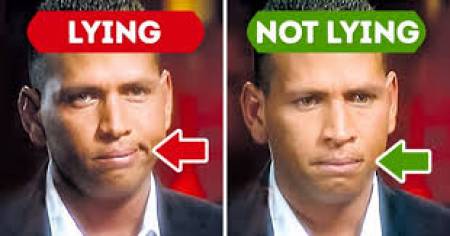
There have been many television shows sprouting up, based around how to tell if someone is lying. Here are a number of ways to detect a liar.

How To Spot A Liar: Here Are Ways To Detect A Liar In Just Seconds
By
Sughra Hafeez in
Life Style
On 29th December 2017
advertisement
Observe micro-facial expressions.
People will often give away a lie in their facial expression, but some of these facial expressions are subtle and difficult to spot. Some people will change their facial coloration to a slighter shade of pink, others will flare their nostrils slightly, bite their lip, perspire slightly, or blink rapidly. Each of these changes in facial expression signifies an increase in brain activity as lying begin

Body Posture.
It’s more important to examine a person’s entire demeanor, as there’s no one feature that’s apt to give away a liar. Honesty is characterized by features that are in sync with one another—so besides posture, note the fit between face, body, voice, and speech. Like an animal avoiding detection, a liar may pull his arms and legs inward or keep his movements to a minimum—anything to appear smaller. Liars often shove their hands behind their back because those fidgety digits might give them away.

advertisement
Gauge Against a Baseline
"One of the most important indicators of dishonesty is changes in behavior," says Maureen O'Sullivan, Ph.D., a professor of psychology at the University of San Francisco. "You want to pay attention to someone who is generally anxious, but now looks calm. Or, someone who is generally calm but now looks anxious."
The trick, explains O'Sullivan, is to gauge their behavior against a baseline. Is a person's behavior falling away from how they would normally act? If it is, that could mean that something is up.

Changing topics
When you try talking about something that tells them that they're going to be caught if they keep talking about it, they'll smoothly just ignore that topic and move on, showing lack of interest in it. That's the first thing you should notice when you're catching a liar. This happens because they're just not comfortable talking about it, they think they'll accidentally spill the truth, hence the topic keeps changing.

advertisement
They often cover their mouth
This is one of the most common and most visual tells of all the general tells that liars have. If someone is trying to tell you something and they frequently raise their hands or their fingers towards the vicinity of their mouth almost as if they are trying not to let the words come out.

advertisement
Overcompensating
A liar will often over-perform, both speaking and gesticulating too much in a bid to be more convincing. These over the top body language rituals can involve too much eye contact (often without blinking!) and over-emphatic gesticulation.

advertisement
Self-comfort touches
The stress and discomfort of lying often produce gestures that are aimed at comforting the liar, such as rocking, hair-stroking or twiddling or playing with wedding rings. We all tend to use self-comfort gestures but this will increase dramatically when someone is fibbing.

advertisement
Become extremely defensive
Someone who's truthful will never need to be defensive while explaining themselves to you because they truly care about you and can't see you suffer, while someone who lies is going to be very selfish when it comes to feelings so don't expect any care when confronting them and prepare for a whole lot of defense.

advertisement
Changes tone
Often when a person is lying they will slightly change the tone and cadence of their speech. They might start speaking more quickly or slowly, and with either a higher or lower tone. Often, the sentences they use become more complex as their brain works on overdrive to keep up with their tale.

advertisement
They provide too many details
They provide too many details about the subject they are trying to lie to you about so that you would be deceived into believing them because they have details. Don’t be deceived; the game has changed, more details equal lies.