

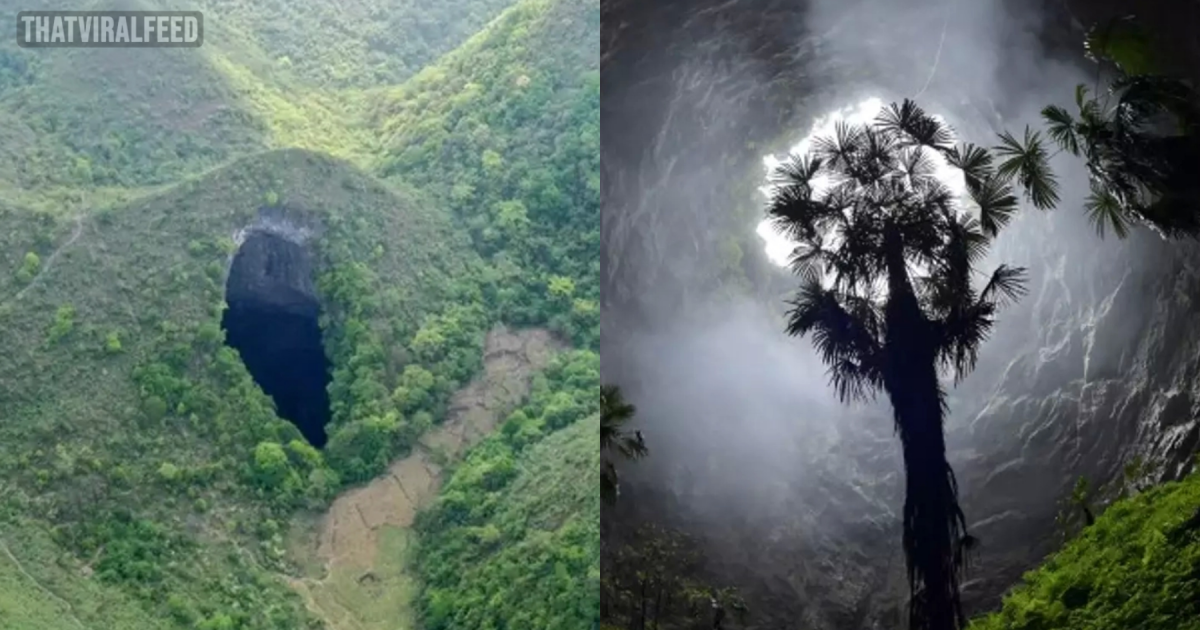
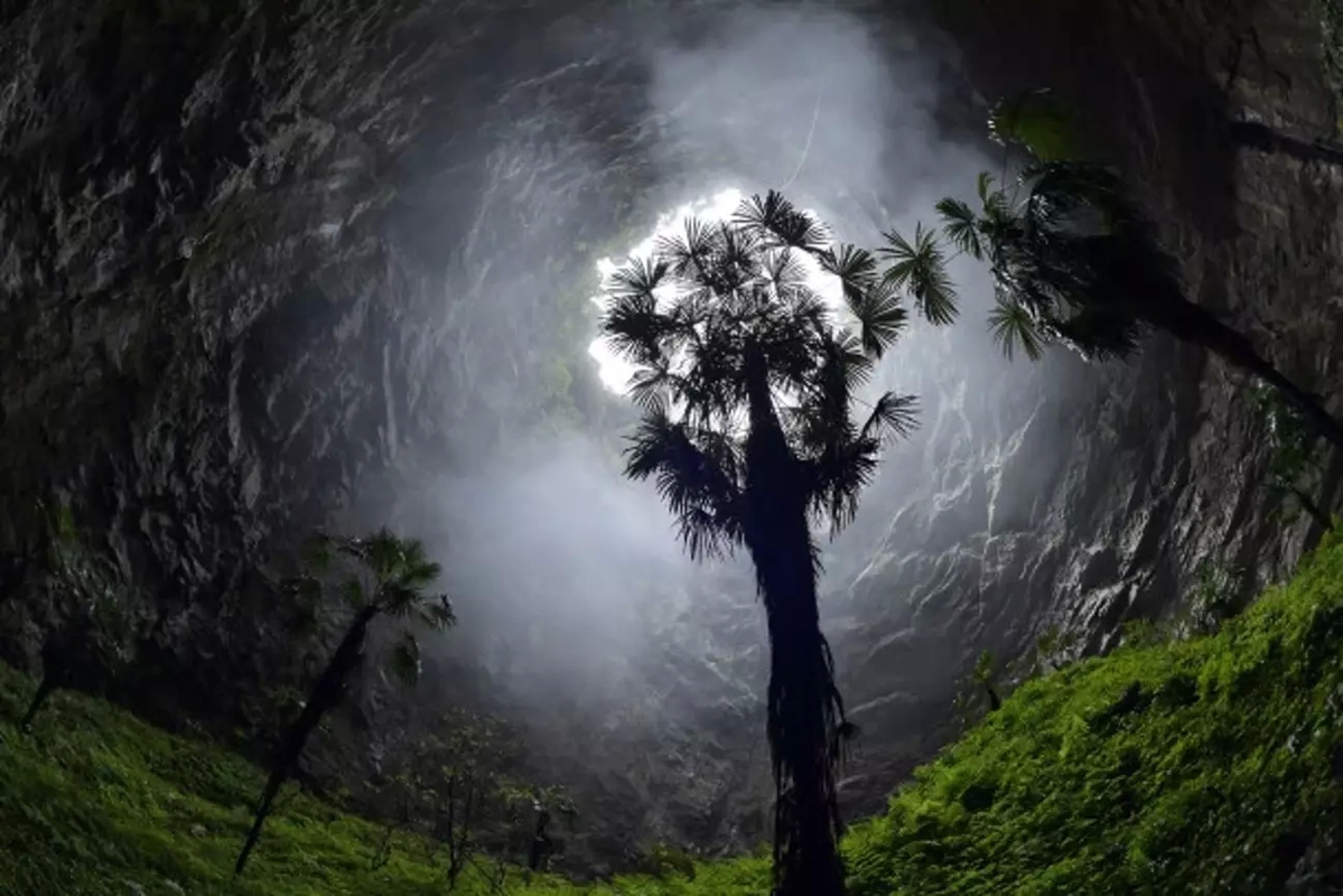
A group of researchers made an incredible discovery of an ancient forest that lies more than 600 feet beneath the earth's surface.
advertisement
This discovery came about after they investigated a sinkhole located in China.
During the year 2022, a surge of explorers were drawn to the Leye-Fengshan Global Geopark, situated in the Guangxi Zhuang Autonomous Region of China, upon hearing about a newly discovered sinkhole.
At that point in time, those who studied the sinkhole closely found that it stretched over 1,000 feet in length, was 490 feet across, and had a depth reaching nearly 630 feet.
In addition to discovering ancient trees, the explorers stumbled upon three massive entrances to caves within the confines of the sinkhole.
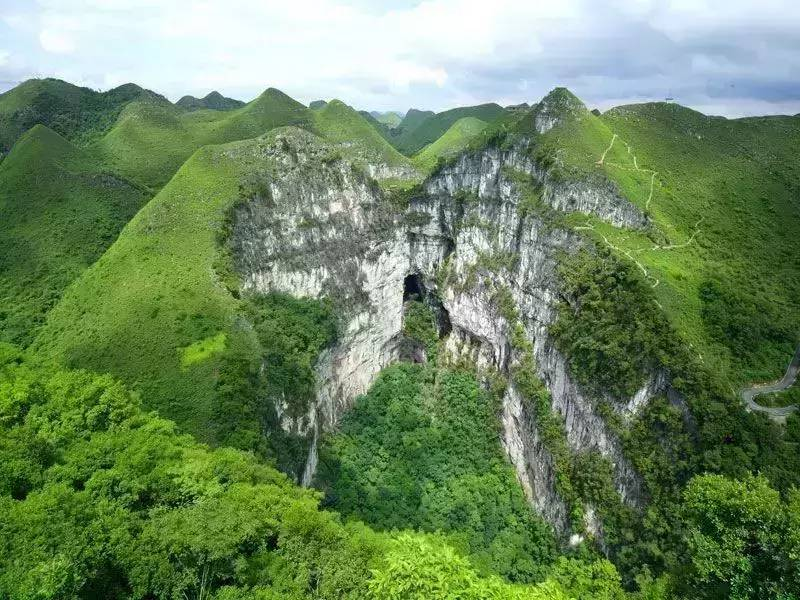
Southern China is home to many sinkholes, forests and caves.
Credit: Leye-Fengshan Global Geopark
The researchers have a strong belief that these caves might be home to species of plants and animals that have yet to be discovered by the scientific community.
advertisement
The reason for this belief stems from the understanding that sinkholes, along with caves, often serve as sanctuaries for various forms of life and can also be beneficial for the cultivation of crops.
The UNESCO describes the Geopark, where this significant sinkhole was found in May 2022, as a 'territory of caves'.
It is noted for featuring the 'world's longest natural bridge'.
According to the official website, "The UNESCO Global Geopark is primarily sedimentary with more than 60 percent of 3000m thick Devonian to Permian carbonate rocks."
"It forms an 'S'-shaped structure and a rhombus configuration in the karst areas of Leye and Fengshan counties respectively, which controlled two large subterranean rivers' development, the Bailang and Poyue."
advertisement
It is also mentioned that the Buliuhe River emerged between these two bodies of water, leading to the formation of various 'karst geosites'.
A 'karst' refers to a type of terrain where the dissolving of bedrock due to erosion from both above and below the ground can result in the creation of sinkholes.
advertisement
Within the confines of the Leye-Fengshan Global Geopark, examples of karst formations include karst springs, karst windows (tiankengs), natural bridges, and extensive cave systems.
Chen Lixin, who led the expedition into the sinkhole, shared with Live Science at the time:
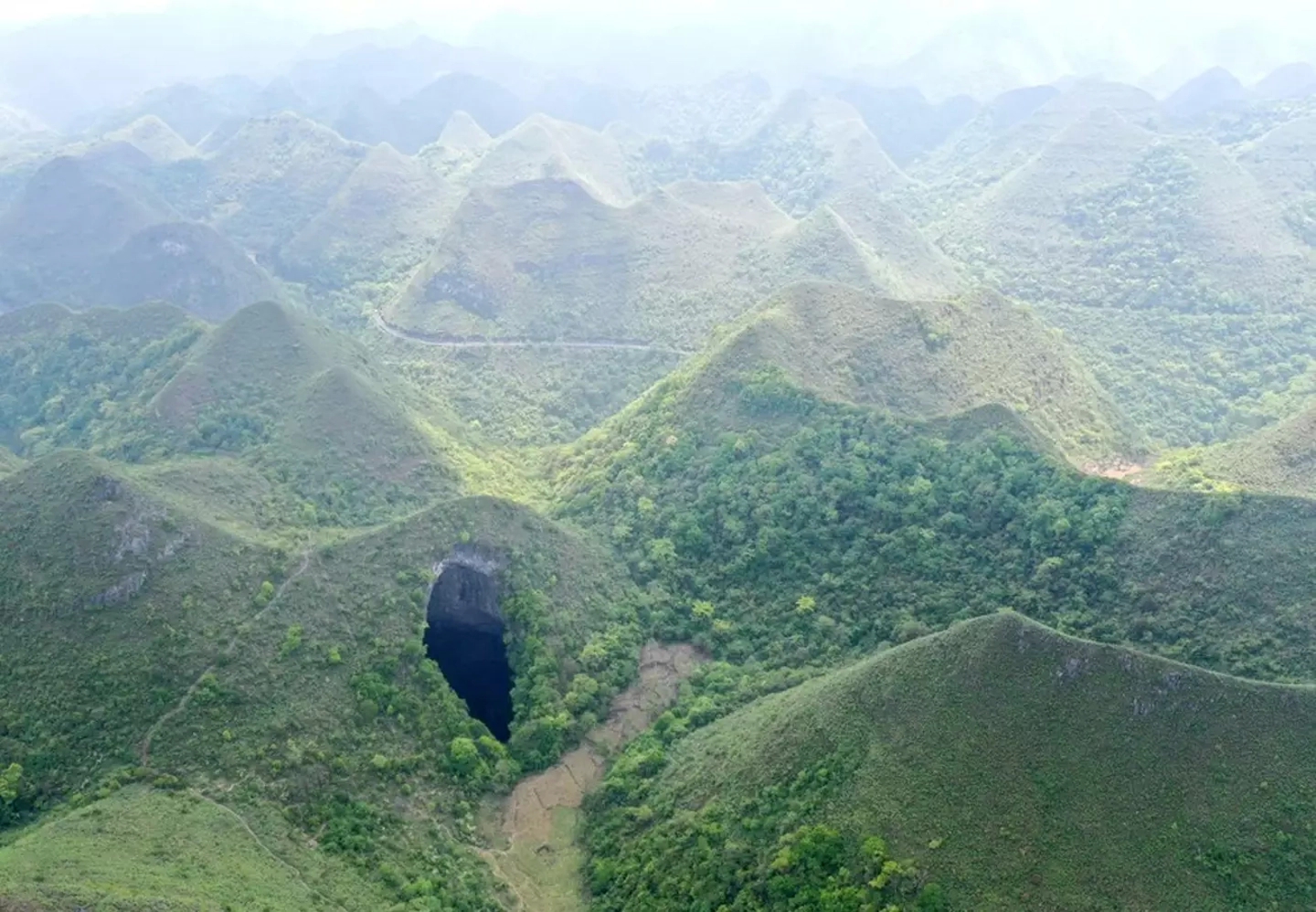
A giant karst sinkhole at Leye-Fengshan Global Geopark.
Credit: Xinhua
"I wouldn't be surprised to know that there are species found in these caves that have never been reported or described by science until now."
advertisement
He also highlighted that some of the trees discovered in this underground ancient forest reached heights of nearly 130 feet.
George Veni, serving as the executive director of the National Cave and Karst Research Institute, also spoke to the publication.
He explained how the characteristics of a karst landscape can vary dramatically depending on its location due to differences in geology, climate, and other factors.
advertisement
"In China, you have this incredibly visually spectacular karst with enormous sinkholes and giant cave entrances and so forth," he detailed.
He contrasted this with other parts of the world where the karst landscape might be less noticeable, with sinkholes being quite small, sometimes only a meter or two across, and cave entrances so narrow that they require squeezing through to enter.
advertisement
He further noted that the karst topography in southern China is so vast that it frequently results in the formation of deep sinkholes and caves that are ripe for exploration.
Veni also mentioned that the process usually starts with slightly acidic rainwater, which begins to dissolve the bedrock in a karst landscape.
He explained that as rainwater absorbs carbon dioxide and percolates through the soil, it becomes more acidic.
advertisement
This acidic water then seeps and flows through cracks in the bedrock, gradually enlarging them into tunnels and voids.
If one of these underground chambers grows large enough, the ceiling may eventually give way, leading to the formation of a potentially enormous sinkhole.
An example of a karst in Hubei Province.
Credit: Xinhua
Interestingly enough, the sinkhole found in the Geopark was the 30th to be discovered in that region, but it does not hold the title for being the largest.
advertisement
That title goes to the Xiaozhai Tiankeng sinkhole, known as 'The Heavenly Pit', which is recognized as the world's largest sinkhole, with a volume of 130 million cubic meters.
'Tiankeng' translates to 'The Heavenly Pit', and this breathtaking natural wonder is home to more than 1200 species of plants and animals.
advertisement
The dimensions of this sinkhole are astonishing, being 2,100 feet deep, 2,000 feet long, and 1,760 feet wide, and it even features a waterfall within its depths.
To describe it simply, the sight of it is truly spectacular.