


The ancient dam in Jerusalem has been traced back to the 9th century BC
advertisement
A group of archaeologists has revealed the remains of a massive dam nearly 2,800 years old in Jerusalem’s City of David. The structure was found close to the Pool of Siloam, the very site tied to one of the New Testament’s most powerful stories, where Jesus is said to have healed a blind man.
The Gospel of John recalls how Jesus instructed the blind man to wash in the Pool of Siloam. This pool, nestled within the Jerusalem Walls National Park, holds enormous biblical importance and was rediscovered in 2004, drawing fresh attention from both historians and believers.
John 9:10–11 describes the miracle in detail: "'How then were your eyes opened?' they asked. He replied, 'The man they call Jesus made some mud and put it on my eyes. He told me to go to Siloam and wash. So I went and washed, and then I could see.'"
The discovery was officially announced on August 30 following a joint dig led by the Israel Antiquities Authority (IAA) and the Weizmann Institute of Science.
Experts have dated the dam back to the 9th century BC, suggesting it was likely constructed during the rule of King Joash or King Amaziah. Its size makes it remarkable, as it is now recognized as the largest ancient dam ever unearthed in Israel and the oldest one known in Jerusalem.
The structure itself is staggering. Made from stone, it measures about 39 feet high, stretches nearly 69 feet in length, and is around 26 feet thick, proving just how advanced ancient engineering was at that time.

'The Healing of the Blind Man and the Raising of Lazarus', fresco from the Hermitage of San Baudelio de Berlanga, Soria, c. 1125.
Pictures from History/Universal Images Group via Getty Images
advertisement
By analyzing twigs and branches that had been preserved in the mortar, researchers were able to narrow down the dam’s construction to somewhere between 805 and 795 BC.
But why was it built in the first place? Experts believe the dam was ancient Jerusalem’s attempt to deal with an early climate crisis that threatened their survival.
"The dam was designed to collect waters from the Gihon Spring as well as floodwaters flowing down the main valley of ancient Jerusalem," the excavation leaders explained.
"All the [studied] data pointed to a period of low rainfall in the Land of Israel, interspersed with short and intense storms that could cause flooding. … It follows that the establishment of such large-scale water systems was a direct response to climate change and arid conditions."
Eli Escusido, the director of the IAA, described the discovery as “one of the most impressive and significant First Temple-period remains in Jerusalem,” and added: "In recent years, Jerusalem has been revealed more than ever before… and many surprises still await us."
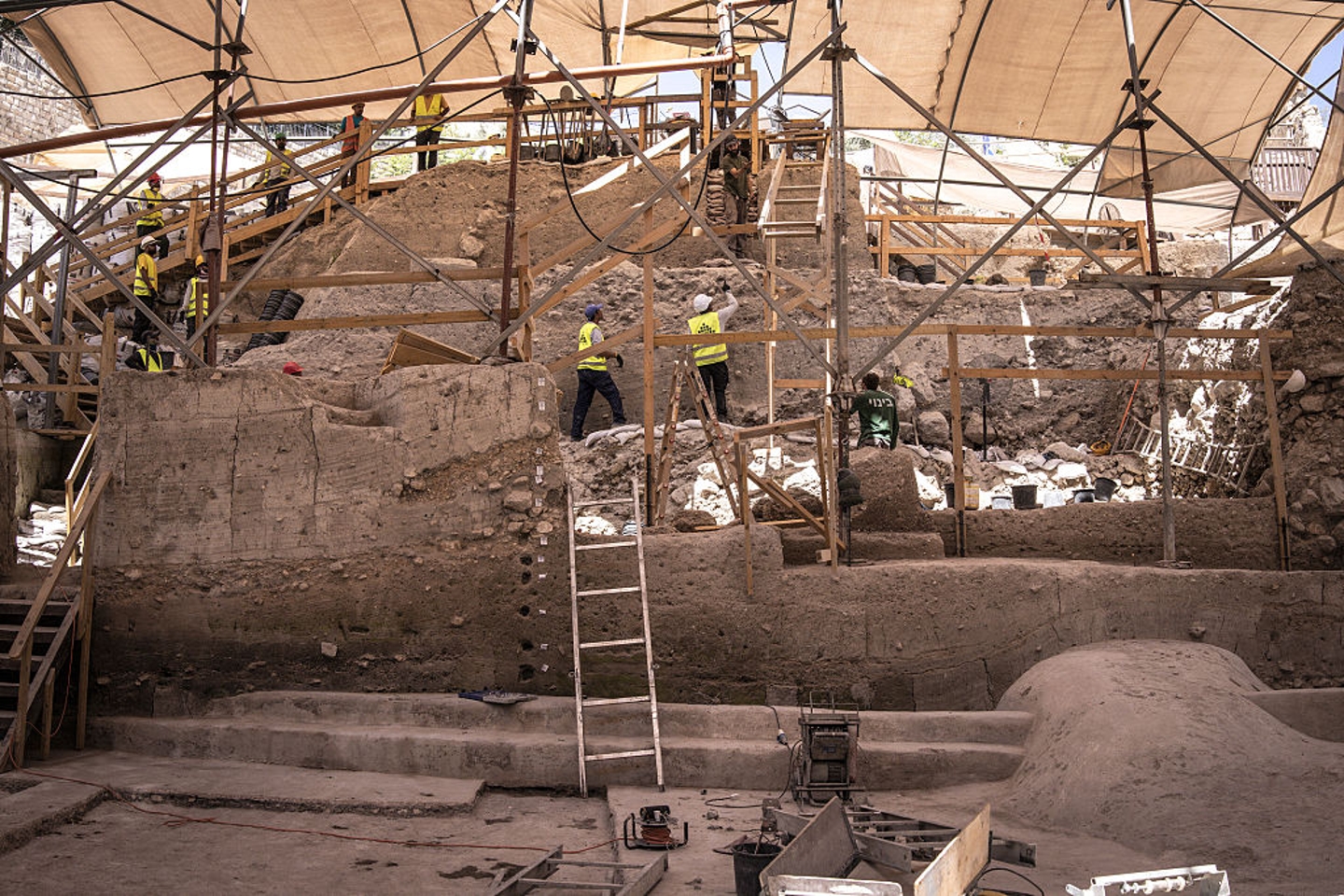
Workers for the Israeli antiquities authority excavate a newly uncovered dam in the city of David national Park in Jerusalem on August 26, 2025
JOHN WESSELS/AFP via Getty Images
advertisement
This find comes not long after another headline-making revelation—a submerged ancient city discovered near the site believed to be the resting place of Noah’s Ark. That discovery has already sparked debates about how it could reshape biblical history as we know it.
The site, often described as Europe’s real version of Atlantis, sits 85 feet below the waters of Lake Van in Turkey, near the town of GevaÅŸ. The lake is located around 150 miles from Mount Ararat, the mountain many believe was where Noah’s Ark came to rest following the Great Flood.