

Researchers say the male G-spot has long been overlooked in sexual medicine and urology
Scientists Pinpoint New Location Of The Male 'G-Spot' That Challenges Previous Beliefs
By
maks in
Health and Fitness
On 6th April 2026
advertisement
After years of research and debate, scientists believe they have finally identified the location of the male G-spot. Interestingly, it turns out to be somewhere different from what many people had assumed for decades.
A team of researchers from Spain carried out a detailed study to better understand male sexual anatomy. Their findings, which surprised many, were later published in the journal Andrology.
For a long time, the male equivalent of the female G-spot was believed to be the prostate gland, which sits a couple of inches inside the rectum. This idea was widely accepted, but it did not tell the full story.
However, the new research suggests that this assumption was not entirely accurate.
Instead of a single point, scientists now describe the area as more of a “zone.” This region is located below the penis head, around an area known as the frenular delta.
The study explains that researchers were able to identify this zone more clearly by examining tissue samples and studying the structure in detail, which helped them map the exact location for the first time.
advertisement
The process involved careful and detailed anatomical analysis, which gave researchers a clearer understanding of how the area functions.
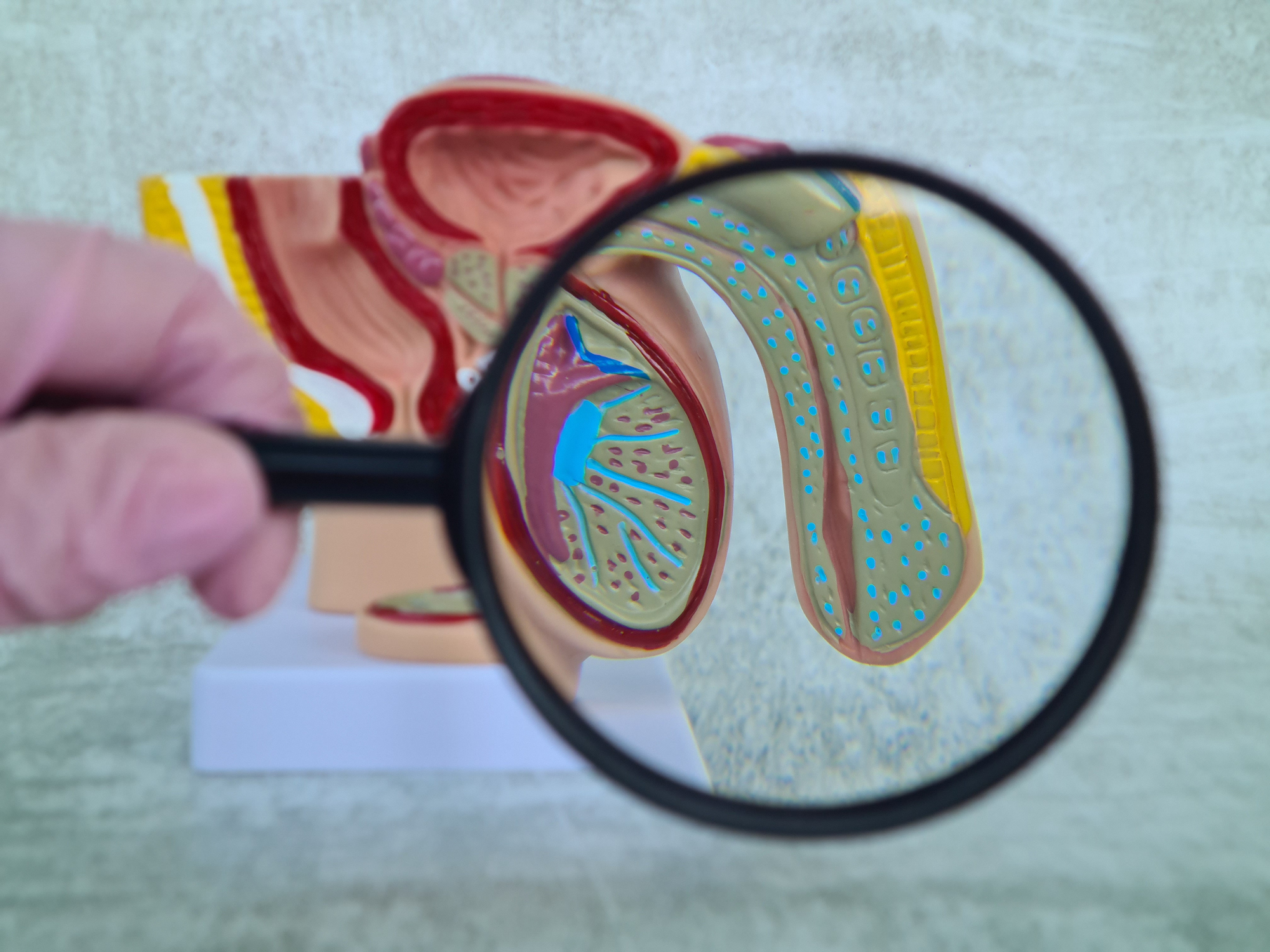
The study found the area that can be considered the male G-spot
Getty Stock Images
The research team examined samples taken from 30 fetuses and 14 adult men who had donated their bodies to science. Through this, they identified a bundle of nerves located in a triangular area on the underside of the penis, right where the head meets the shaft.
The University of Santiago de Compostela, which led the study, explained that this area contains a dense network of nerve endings. These nerves come from both the perineal region, which connects the genitals and anus, and dorsal nerve branches.
Because of this concentration of nerve bundles, stimulation of this zone can lead to strong sensations and, in some cases, intense pleasure. This helped researchers better understand why this area may play a key role in sexual response.

They said it was full of nerves
Getty Stock Images
advertisement
For many people, this discovery might not feel entirely new, especially for those already familiar with their own bodies and what feels good. Still, giving this area a scientific label adds clarity and validation.
"Although this may seem self-evident to anyone attuned to the sensations of their penis during sexual activity, our work scientifically validates the existence of a ventral penile anatomical region that serves as a center of sexual sensation," write the authors of the study, led by Alfonso Cepeda-Emiliani. "In essence, the presence of a sensory center in the penis, akin to a 'G-spot,' emerges as a neuroanatomical reality".
"It is one of the most pleasurable spots for male sexual stimulation," Eric Chung of the University of Queensland in Australia, who was not involved in the research, told New Scientist.
advertisement
Even so, the fact that it has taken until 2026 for this area to be properly studied and described shows how much has been overlooked in this field. Researchers say it highlights the long-standing gaps in sexual medicine and urology, where certain aspects of male anatomy have not been fully explored or understood.