

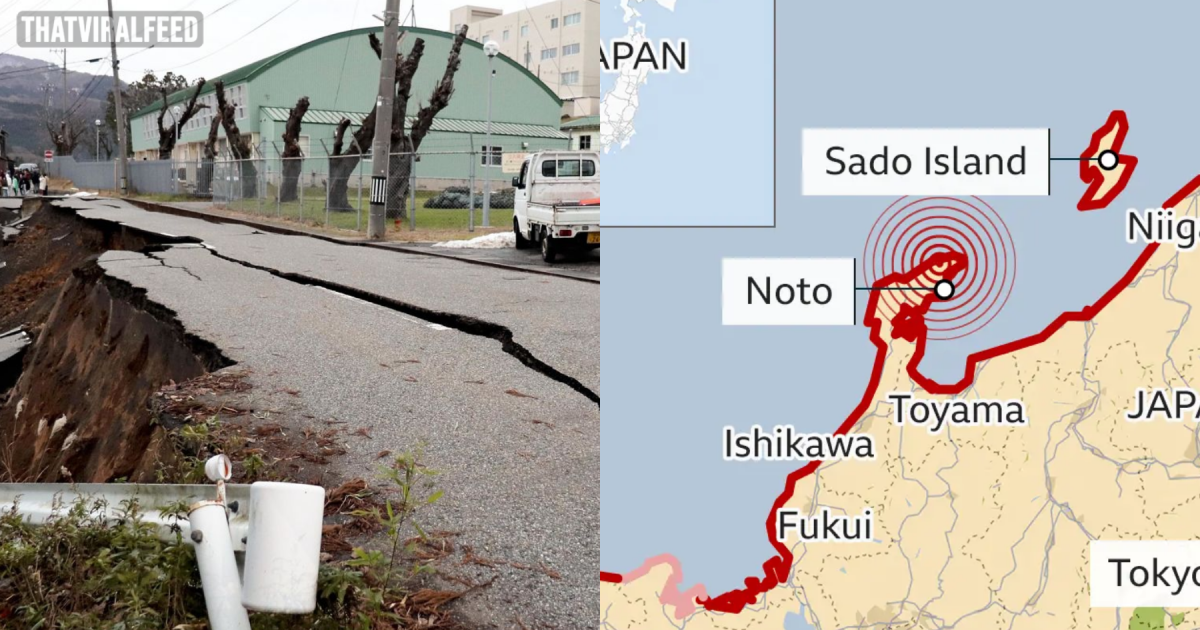
On Monday afternoon, a significant 7.5 magnitude earthquake struck western Japan, leading to tsunami warnings that extended as far as eastern Russia. This prompted urgent evacuation advisories for residents in Japan's coastal regions.
advertisement
On Monday afternoon, a significant 7.5 magnitude earthquake struck western Japan, leading to tsunami warnings that extended as far as eastern Russia.
This prompted urgent evacuation advisories for residents in Japan's coastal regions.
The quake occurred at 4:10 p.m. local time, originating at a depth of 10 kilometers (about 6 miles), approximately 42 kilometers (around 26 miles) northeast of Anamizu in Ishikawa prefecture, as reported by the United States Geological Survey (USGS).
Following the earthquake, the Japan Meteorological Agency issued immediate tsunami warnings along the western Japanese coast.
advertisement
The first tsunami waves were observed hitting the coastline shortly after, within about 10 minutes.
Early reports emerged from Wajima city in Ishikawa prefecture, where tsunami waves measuring around 1.2 meters (nearly 3.9 feet) were recorded at around 4:21 p.m., as per NHK, Japan's public broadcaster. Initially, there were no reports of significant damage.
In Ishikawa's Suzu city, officials communicated to CNN that there was building damage and injury reports.
NHK reported that police in the area indicated people were trapped in damaged houses. Thankfully, there have been no reported fatalities to date.
advertisement
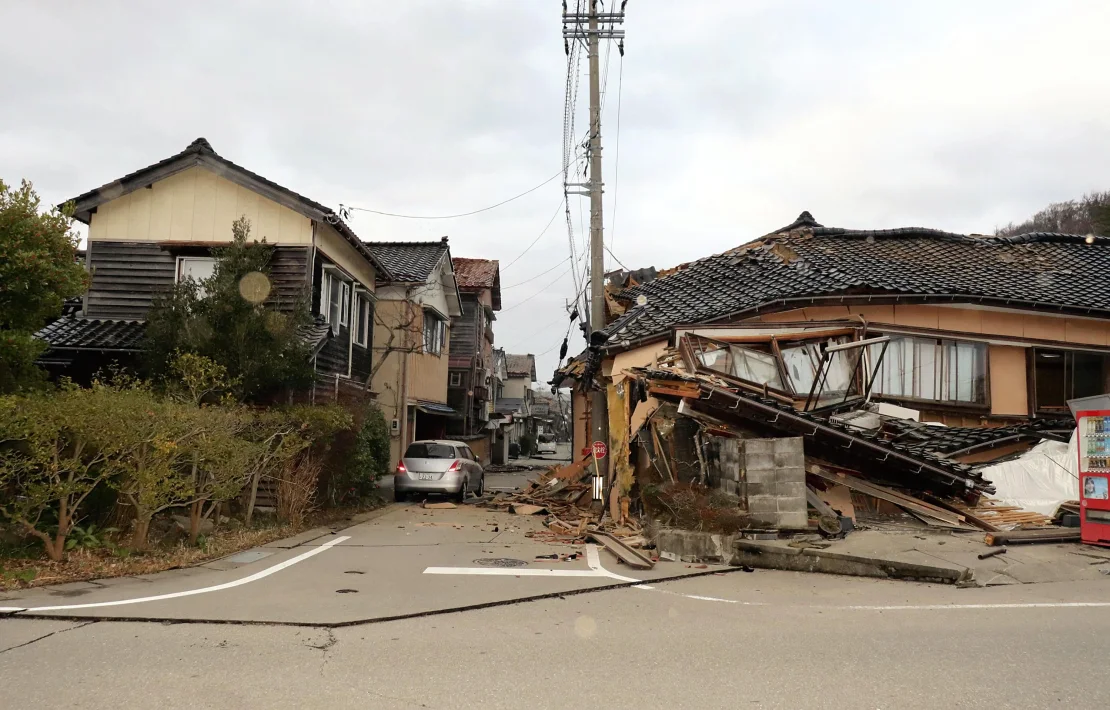
Credit: Yusuke FukuharaThe Yomiuri Shimbun/Reuters
Noto city, also in Ishikawa, faced a major tsunami warning, expecting waves near 5 meters, according to the Japan Meteorological Agency.
This marked the first major tsunami warning since the one issued in 2011, as stated by a representative from Ishikawa prefecture’s disaster management agency.
advertisement
Japan categorizes tsunami threats based on expected wave heights: "tsunami advisory" for waves under 1 meter, "tsunami warning" for those above 3 meters, and "major tsunami warning" for waves expected to exceed 5 meters.
Japan’s Chief Cabinet Secretary, Yoshimasa Hayashi, addressed the nation earlier on television, urging people in areas under tsunami warnings to evacuate to higher ground immediately.
advertisement
NHK's footage showed intense camera shaking and waves crashing along the Ishikawa prefecture coastline when the earthquake struck.
The quake also caused significant disturbances to houses, with images showing collapsed roofs and foundations.
advertisement
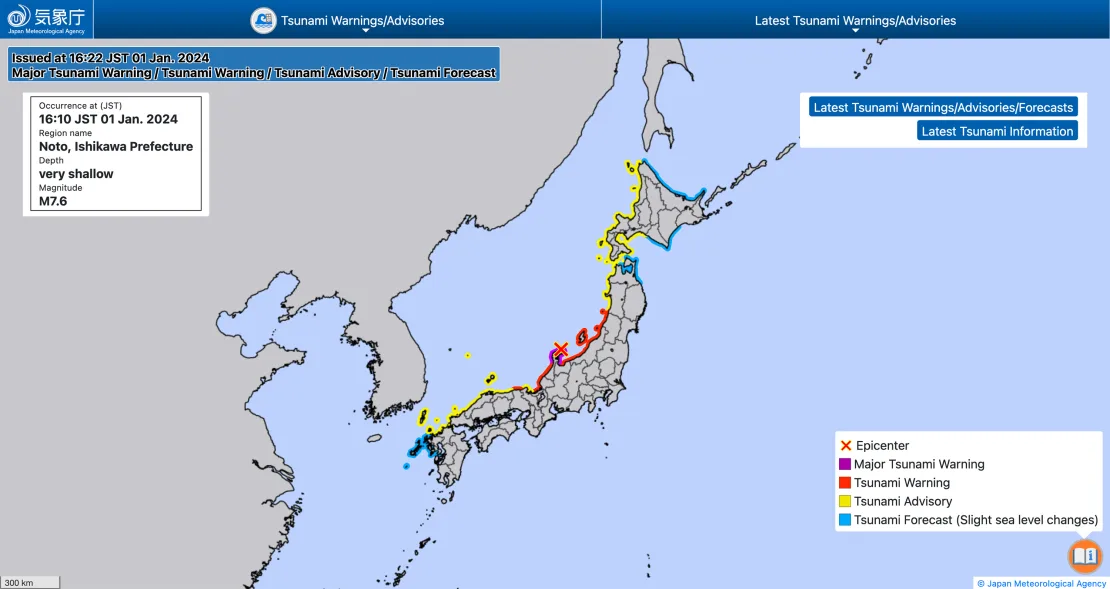
The Japan Meteorological Agency issued tsunami warnings for a large swathe of the country's western coastal areas.
Credit: Japan Meteorological Agency
The earthquake led to the suspension of some services of Japan’s Shinkansen bullet trains.
Videos on social media show the quake's aftermath, with store aisles littered with fallen items.
advertisement
A video shot inside a train captured signposts shaking violently on the platform.
Over 32,500 homes in Ishikawa prefecture lost power due to the quake, as reported by Hokuriku Electric Power Company.
advertisement
Kansai Electric Power Company assured that no abnormalities were detected at nearby nuclear plants, as stated in a company announcement on X.
The USGS reported a series of strong aftershocks following the main quake. A 6.2 magnitude aftershock struck at 4:18 p.m. local time, about 4 kilometers (roughly 2.4 miles) southwest of Anamizu.
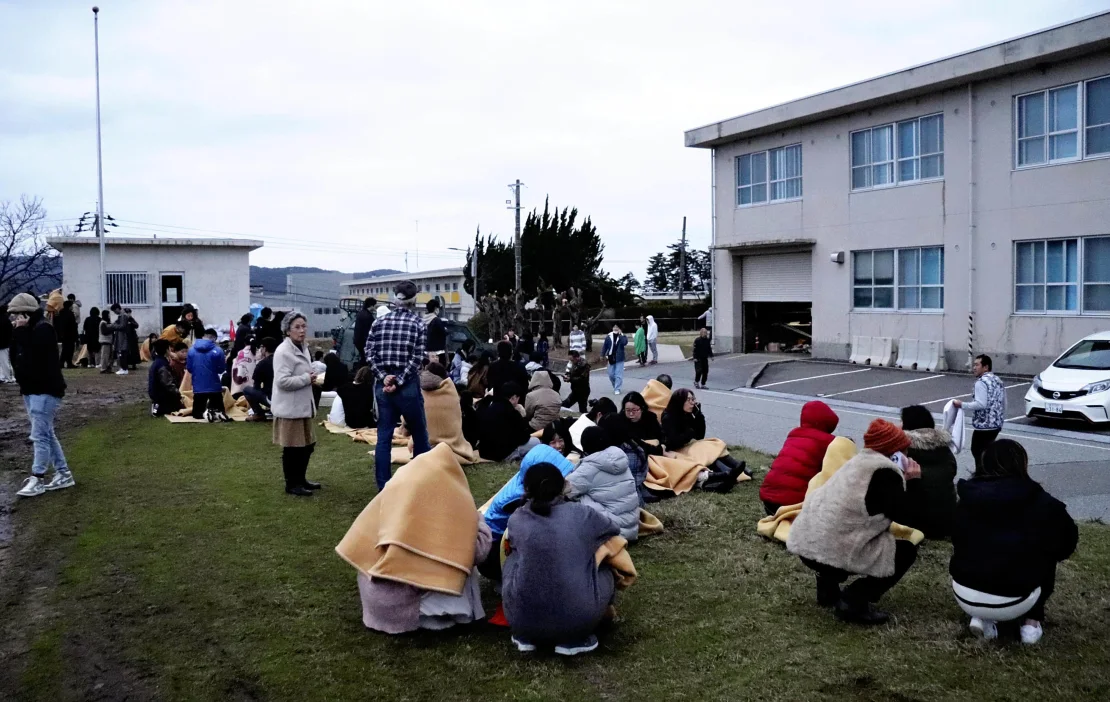
People evacuate following the earthquake in Wajima city on Monday.
Credit: Yusuke FukuharaThe Yomiuri Shimbun/Reuters
advertisement
Additionally, tremors of 5.2 magnitude occurred 58 kilometers (approximately 36 miles) away, with another 5.6 magnitude aftershock closer to the quake's epicenter.
The Japanese weather agency cautioned that powerful aftershocks could persist for the next few days to a week, warning of potential building collapses and landslides.
Japanese Prime Minister Fumio Kishida stated that authorities were diligently assessing damages in the affected areas.
advertisement
"We have immediately set up the Prime Minister’s Office of Response - Disaster Counter Measure HQ. Putting human lives as priority, we are making every effort to assess damages – putting forth all efforts in disaster response," he posted on X, previously known as Twitter, on Monday.
Less severe tsunami waves, under one meter, were reported in various locations along Japan's western coast, including Toyama city, Kashiwazaki, Kanazawa port, Tobishima island, and Sado island.
The South Korean Meteorological Administration monitored potential sea-level changes on the east coast in Gangneung, Yang Yang, Goseong of Gangwon Province, and Pohang City.
In eastern Russia, including Vladivostok, Nakhodka, and Sakhalin island, facing the Sea of Japan, a tsunami threat was reported by Russian state media TASS. So far, no evacuations have been necessary.