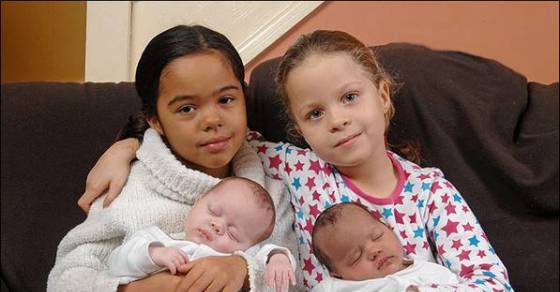
#1: Twins can have different biological fathers
In 2009, Mia Washington gave birth to twins with two different fathers, a one-in-a-billion occurrence. One month, Mia released two eggs instead of one. Her two sexual partners each fertilized one of the eggs, resulting in two babies with two dads. In 2011, there were only 3 known cases of this occurrence.
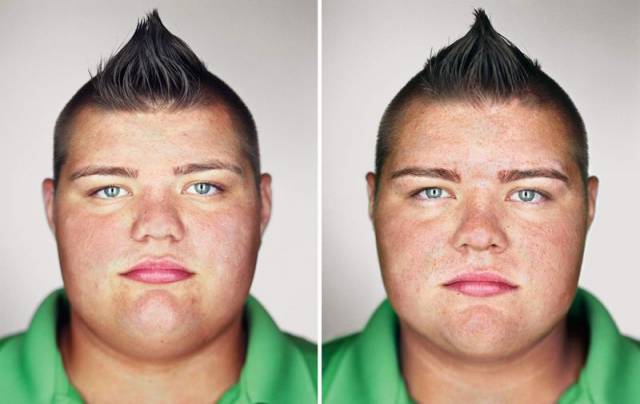
#2: There's a ‘Twin Gene’
Know any families with multiple sets of multiples? There may be a scientific explanation behind all that multiplying hyper-ovulation.
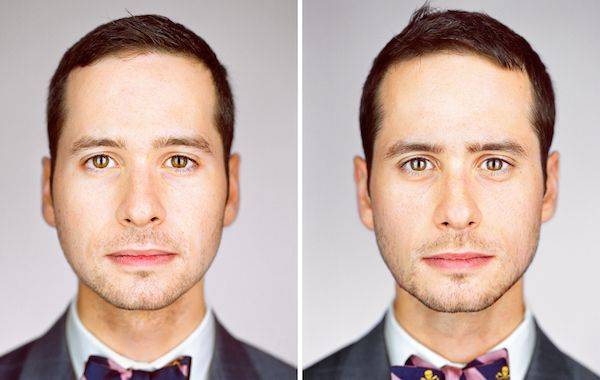
#3: Twins Can Be Born Years Apart
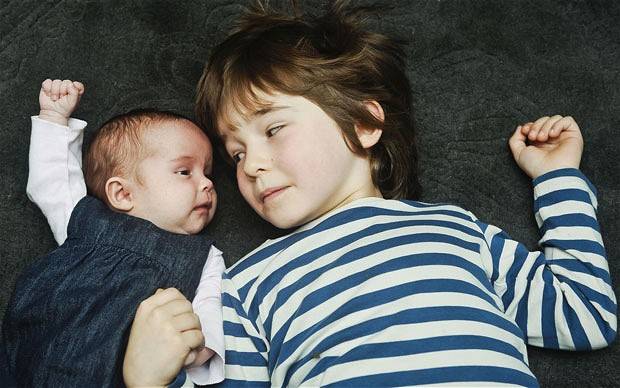
Reuben Blake (pictured left) is 5 years old. His twin sister Floren? She's about 2 months old.
#4: Twins Are Multiplying
According to a recent CDC report, the birth rate for twins has increased a whopping 76 percent since 1980. In fact, one in every 30 babies born in 2009 was a twin (compared to 1980, when the rate was one baby in every 53).
#5: Twin Talk
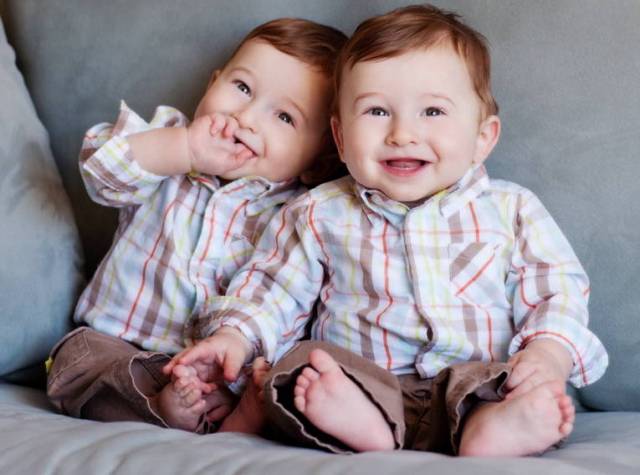
If you've ever seen two young siblings readily conversing in complete gibberish, you likely witnessed idioglossia an autonomous language often created and shared between twins.

#6: Twins Start Bonding in Mom's Belly
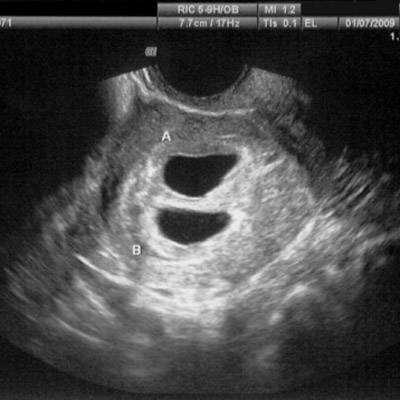
Researchers from University of Padova in Italy recently studied 3D ultrasound videos of five sets of twins in the womb. When the fetuses were just 14 weeks old, the researchers noticed that the pairs seemed to be reaching out for each other, touching head to head and arm to head. At 18 weeks, they were stroking each other more often and were in physical contact about 30 percent of the time.
#7: Separated twins, but too separate
#8: Twins Can Be Different Races
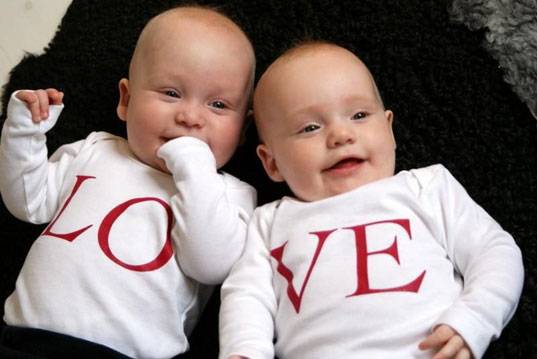
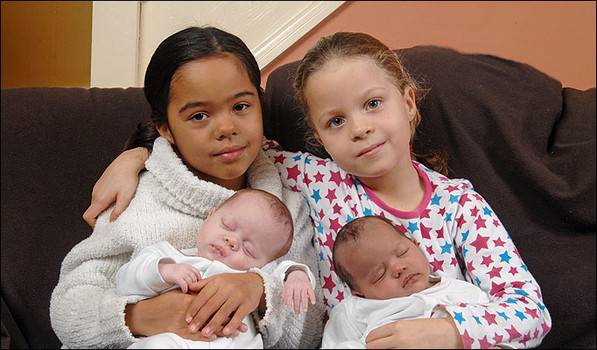
Heteropaternal superfecundation can also be the result of a botched fertilization procedure. In one particularly shocking case, Dutch couple Wilma and Willem Stuart were surprised when they welcomed twin baby boys to the world one was white and one was black. A year and a half later, the couple discovered that another man's sperm had accidently been mixed with Mr. Stuart's during the in vitro process.
#9: Drink Up
Women who eat a lot of dairy are also more likely to have twins. A study in the Journal of Reproductive Medicine compared twin birth rates from vegan and non-vegan mothers. Those who consumed dairy were five times more likely to have twins. Cows, like humans, also produce IGF and release it into their milk, which the women consume.

#10: Mirror Image Twins
Twins that are exact reflections of each other are called Mirror Image Twins. Around 25% of identical twins develop directly facing each other, meaning they become exact reflections of each other. One is often left-handed, while the other is right-handed. They may also have birthmarks on the opposite sides of their bodies.
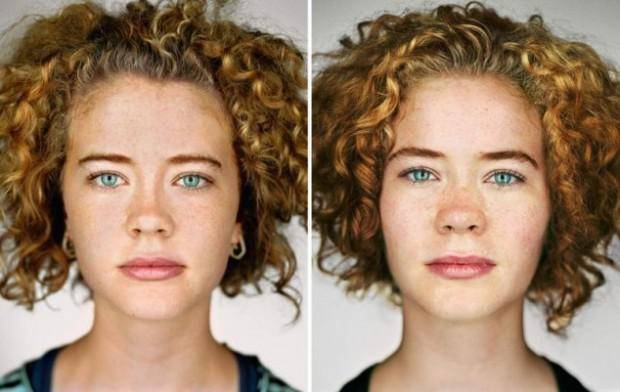
#11: Seeing Double
Some conjoined twins can hear each other's thoughts and see through each other's eyes. Krista and Tatiana Hogan are attached at the head and share a thalamus - the part of the brain that controls physical sensations and motor functions. As a result, the girls can see through each other's eyes and hear each other's thoughts. They can also feel and see what the other one does.
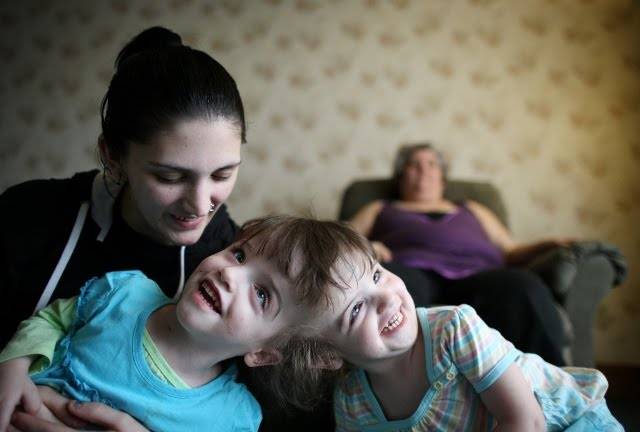
#12: Identical twins have different fingerprints
Some people might think that identical twins are the same right down to those whorls and swirls on their fingerprints, but while identical twins share most of their genetic material, identical fingerprints aren't among them. While the fingerprints may be very similar, on close examination it is possible to tell them apart much like the twins themselves.

#13: Celebration
If you or your children are twins, you can head to this city in Ohio to celebrate the Twins Days Festival. You'll be amid a sea of look-alikes, with twins, triplets and multiples from all over the nation converging on this town to celebrate being a twin.

#14: 27lbs and 12oz
If you think it would be rough to carry around and deliver one 14-pound baby, then imagine doing it with two. That's just what happened in this case, the largest twin birth on record. Of course, it doesn't hold a candle to the largest singleton birth weight of 23 pounds.

#15: Symmetrical Eh?
These facts about twinning are sure to leave you in awe. One third of all twins born are identical, one third are same sex fraternal and one third are male/female fraternal. Of the identical twins, half are male/male and half are female/female. Of the same sex fraternal, half are male/male and half are female/female.