According to the universal law of gravitation, any 2 bodies attract each other, and this is what keeps us attached to Earth. But is it true that there are places on Earth where this law doesn’t apply? But while the Law of Gravitation has not changed a bit, there are actually places that seem to contradict it. It is as if gravity does not really exist in these places. Today, we are going to tell you where they are.

Mysterious Places Where Gravity Doesn’t Seem to Exist
By
Sughra Hafeez in
Cool
On 21st December 2017
advertisement
Mystery Spot, Santa Cruz, California
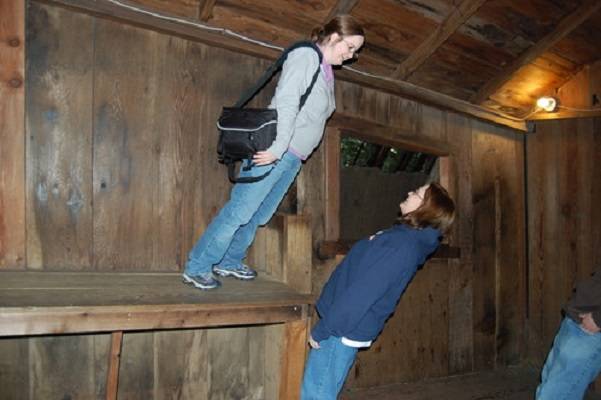
The Mystery Spot is a visual illusion–based tourist attraction near Santa Cruz, California, opened in 1939 by George Prather. Visitors experience demonstrations that appear to defy gravity, on the short but steep uphill walk and inside a wooden building on the site. The Mystery Spot is a popular tourist attraction and gained recognition as a roadside "gravity box" or "tilted house" illusion. At this roadside attraction, the laws of gravity and physics seem to disappear as balls roll uphill and people lean over past their toes without tumbling over. The Mystery Spot is a gravity hill, a tilt-induced visual illusion. The illusion experienced by visitors results from the oddly tilted environment as well as standing on a tiled floor. Inside the tilted room of the Mystery Spot, misperceptions of the height and orientation of objects occur. Even when people are standing outside on a level ground, the slant of the building in the background causes misperceptions as humans judge the height of people using the slant of the roof rather than the true horizon.
Saint Ignace Mystery Spot, Michigan, USA
Back in the 1950s, a number of surveyors found themselves in an odd area in Michigan. As soon as they reached the spot, their equipment started to malfunction. After trying some tests, they found out that the problem was only a circle of about 300 feet in diameter. For some unknown reasons, things here tended to roll up and people can even balance on a wall without falling. Weird, right?

advertisement
Hoover Dam, Nevada, USA
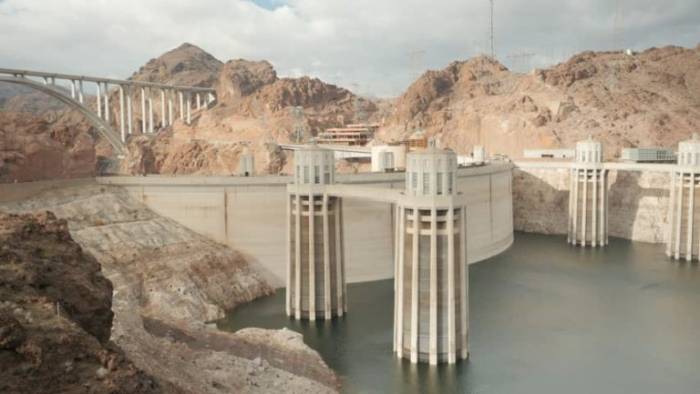
Hoover Dam is a concrete arch-gravity dam in the Black Canyon of the Colorado River, on the border between the U.S. states of Nevada and Arizona. Hoover Dam was recognized as a National Civil Engineering Landmark in 1984. If you ever visit Hoover Dam in Nevada, USA, try to do this experiment: pour water from a bottle over the Dam. You will see that it won’t go down but will flow up. This happens because of the very powerful updraft that the structure of the Dam creates. The water is actually carried upward by the wind. Hoover Dam continues to draw crowds 80 years after its creation. Attracting more than a million visitors a year, Hoover Dam is located in Black Canyon, just minutes outside of Las Vegas. It was listed on the National Register of Historic Places in 1981 and was designated a National Historic Landmark in 1985, cited for its engineering innovations.
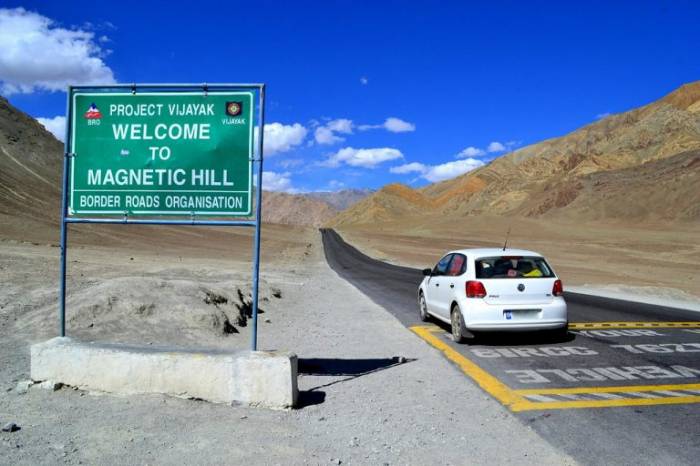
Magnetic Hill, Leh Ladakh, India
Magnet Hill is a "gravity hill" located near Leh in Ladakh, India. The layout of the area and surrounding slopes creates an optical illusion that the downhill road is actually an uphill road. Objects and cars on the hill may appear to roll "uphill" in defiance of gravity when they are, in fact, rolling downhill. What is believed to be at work behind this mysterious phenomenon is a magnetic force so strong that it can pull cars uphill. It is in fact so notorious that even the aircraft that fly over this region increase their altitude in order to avoid magnetic interference. Every tourist driver that passes through here would kill the engine to let the tourists experience how the car still kept moving. Some people are not aware about Magnetic Hill and just pass through here but the ones who do know stop their cars to verify whether what they heard was true or merely a made-up tale.
advertisement
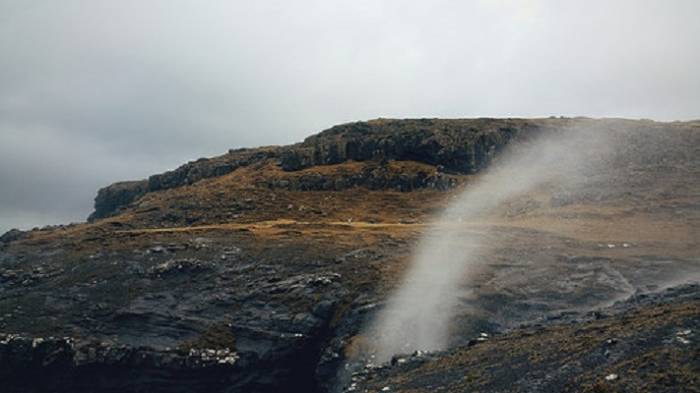
Waterfall, Faroe Islands
Can you imagine a waterfall going upward? There is one on the Faroe Islands, located in the Atlantic Ocean between Scotland and Iceland. Surprised? The Faroe Islands terrain is rugged, and the islands have a subpolar oceanic climate (Cfc): windy, wet, cloudy, and cool. Despite this island group's northerly latitude, temperatures average above freezing throughout the year because of the Gulf Stream.