

You may have come across a study in 2018 that stated (in summary) that money makes you happier up to a point, but once you reach a salary of roughly $60-75,000 in the United States, your happiness tends to level off, and earning more will not increase your mental well-being.

New Study Shows That More Money Buys More Happiness, Even For The Rich
By
Haider Ali in
Real Life
On 15th June 2022
advertisement
The first study used data from the Track Your Happiness app to determine income and happiness ratings. Participants were asked to estimate their happiness during a recent period, which Killingsworth says was less than optimal.
"This requires people to accurately remember how they felt across the various moments of the past and then accurately integrate those memories into a single estimate, an approach that is vulnerable to memory errors and biases in judgment," he wrote in the new study.

Shutterstock
"At the extreme, this leaves open the possibility that, despite its association with remembered feelings, income could have little or no association with people’s actual experienced well-being as they live their lives. Remembered feelings might also introduce noise or forms of bias that artificially mute its association to income, such that experienced well-being could have a stronger association to income."
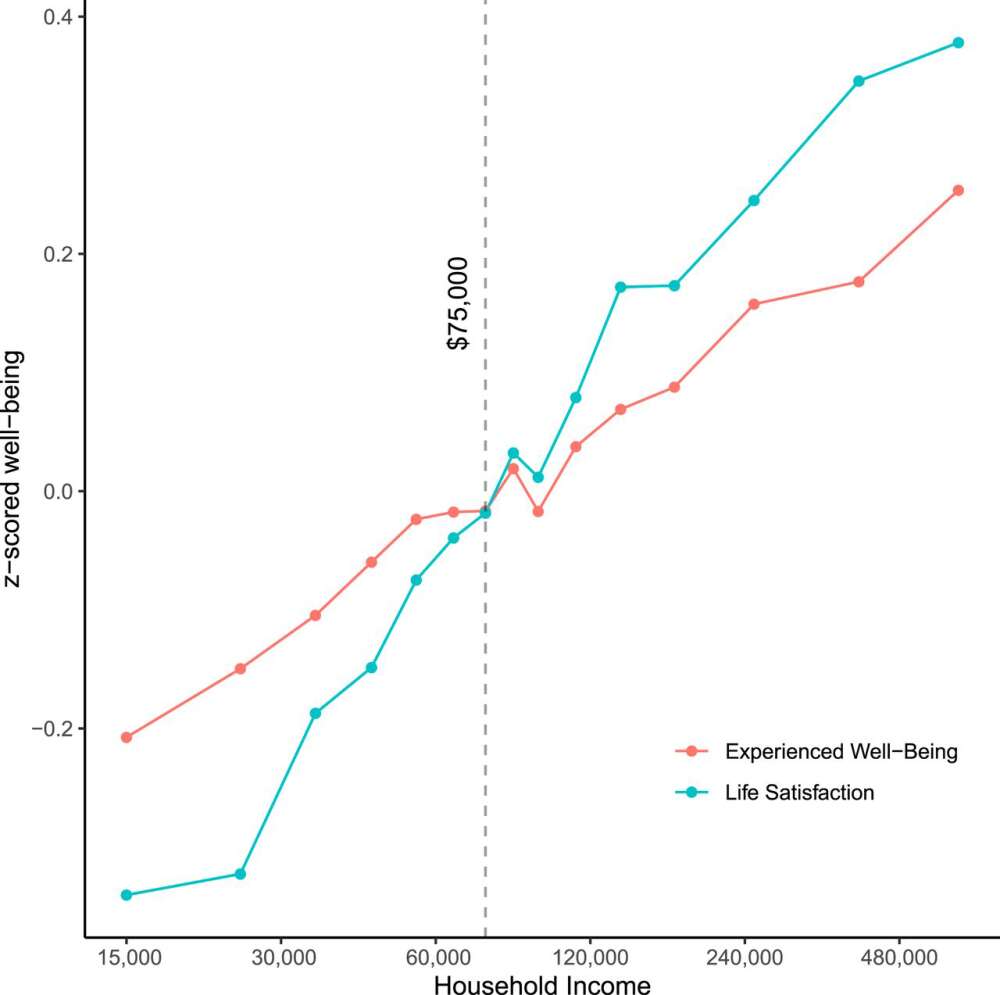
Image credit: Matthew A. Killingsworth/PNAS
advertisement
Killingsworth was able to obtain data for the current study that was free of potential memory bias. The current study used the same app to ask users "how do you feel right now?" throughout the day, and provided them with replies ranging from "very bad" to "very good." On a scale of "not at all" to "extremely," they were also asked "overall, how satisfied are you with your life?"

pexels
He revealed that the correlation between income and happiness levels was pretty linear, both in terms of experienced well-being (based on how they felt when prompted throughout the day) and life satisfaction, after collecting data from 1,725,994 reports of experienced well-being from 33,391 employed, working-age adults in the United States.

pexels
advertisement
Although the research was quantitative, Killingsworth provided several theories for why there is a link between income and happiness and life satisfaction.
"One possibility is that people spend money to reduce suffering and increase enjoyment, and that marginal dollar is differentially deployed against these aims depending on one’s income," he wrote in the study, adding, "compared to variation in incomes above $80,000, larger incomes below $80,000 had a stronger association with reduced negative feelings, consistent with the possibility that moving from low to moderate-income might be especially useful in avoiding (or mitigating) causes of suffering."

pexels
advertisement
To put it another way, the more disposable income you have, the more money you can spend on making yourself feel better (or happier if you prefer a more positive outlook). Worse even for those who do not earn a lot of money, the study was unable to determine a cutoff point for the association between money and happiness.
"There was also no income threshold at which experienced and evaluative well-being diverged; instead, higher incomes were associated with both feeling better moment-to-moment and being more satisfied with life overall," he concluded.
"While there may be some point beyond which money loses its power to improve well-being, the current results suggest that point may lie higher than previously thought."

pexels