


The 75-year-old was scammed over a period of five months.
advertisement
A 75-year-old pensioner has revealed the distressing text messages that led him to lose his entire life savings of $715,000.
Preferring to remain anonymous, the man recounted his ordeal during an interview with The Wall Street Journal.
Scams that end up being successful are often quite intricate, and this particular scam was no exception.
It all started in May 2023, when the scammer, posing as a 37-year-old Chinese woman living in San Francisco, reached out to him on LinkedIn.

Phone scams are certainly common.
Getty Stock Photo
She complimented him, saying she was impressed by his profile.
advertisement
Their initial connection was formed over shared interests in food, travel, fitness, and pets.
In one of her messages, she wrote: "We will be very happy in the future... I really thank God for letting me meet you."

One of the pair's early exchanges
ThatViralFeed
advertisement
She began to paint a picture of a bright future together.
As their conversation progressed, she mentioned her 'uncle’s' company, claiming she had made a considerable amount of money through it.
advertisement
Over several months, she convinced the man to transfer his life savings—a whopping $715,000—into what he believed was a legitimate investment opportunity promising high returns.
She assured him that they would marry and enjoy a prosperous life together with the profits from his investment.
Whenever he showed hesitation, she urged him to 'trust me' and used guilt to manipulate him.
advertisement
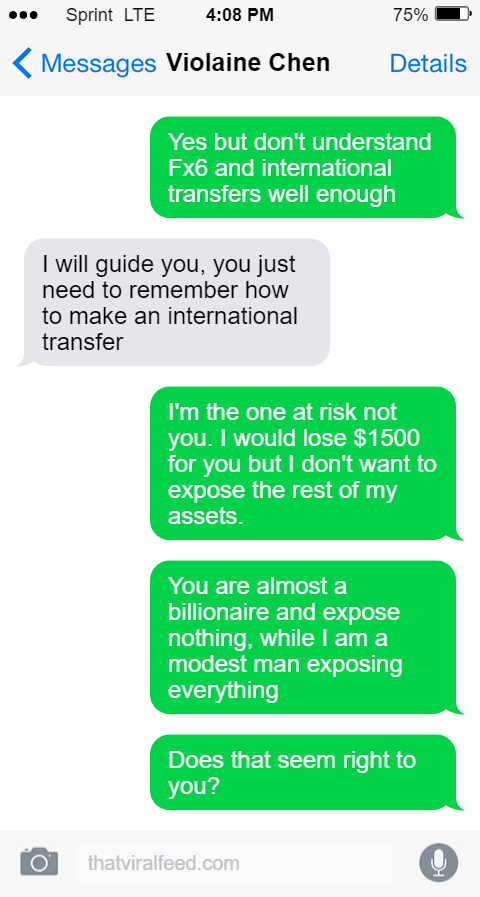
The woman guilt tripped the man into making the transfer
ThatViralFeed
advertisement
For instance, she once texted: "Your distrust of me once again made me feel the fickleness of men."
Another message from her stated: "I think all my good intentions and sincerity has been let down. I just want to complete our future goals and plans."
advertisement

She belittled the man when he had doubts about sending her the money
ThatViralFeed
advertisement
However, after he transferred his substantial fortune, all communication ceased, and he never heard from her again.
The final message he received from her was in September, in which she said she didn’t 'want to have anything to do' with him anymore, and criticized him by saying, 'your mind is horrible'.
advertisement

The final text he received from her
ThatViralFeed
advertisement
This 75-year-old man is among the latest victims of the so-called pig butchering scams that are proliferating across the US.
These scams involve perpetrators who target lonely and vulnerable individuals, build their trust online, and eventually swindle them out of every last cent.
Resigned to his loss, the pensioner acknowledges that his money is likely gone for good and that he was the victim of a scam.
He has reported his case to the Federal Bureau of Investigation's Internet Crime Complaint Center, which will review it and determine whether to forward it to the appropriate law enforcement or regulatory bodies for further action.