

A Ph.D. student at the University of California at Irvine accidentally discovered a rechargeable battery that could last up to 400 years while playing around in the lab. The researchers were working on nanowire technology in chemistry department lab, when an experiment led them to discover a battery with off-the-charts charging capacity.
Researcher Accidentally Creates A Battery That Could Last A Lifetime
By
Zainab Pervez in
Science and Technology
On 20th July 2022
advertisement
#1
Some of the world’s greatest innovations were created by accident, and this is also the case of a Ph.D. student at the University of California, Irvine, who accidentally discovered a rechargeable battery that could last up to 400 years while playing around in the lab.
The study leader, UCI doctoral candidate Mya Le Thai, along with other researchers, invented nanowire-based battery material that can be recharged hundreds of thousands of times, moving us closer to a battery that would never require replacement.
The breakthrough work could lead to commercial batteries with greatly lengthened lifespans for computers, smartphones, appliances, cars and spacecraft. Batteries make use of lithium to carry and hold electric charge, however, there is a major downfall to lithium-ion batteries.
Every time the battery gets charged and discharged, the lithium inside the battery corrodes a little bit more, causing the lithium to become brittle and crack and rendering the battery unusable after a few years.
advertisement
Scientists have long sought to use nanowires in batteries. Thousands of times thinner than a human hair, they’re highly conductive and feature a large surface area for the storage and transfer of electrons.
However, these filaments are extremely fragile and don’t hold up well to repeated discharging and recharging, or cycling. In a typical lithium-ion battery, they expand and grow brittle, which leads to cracking.
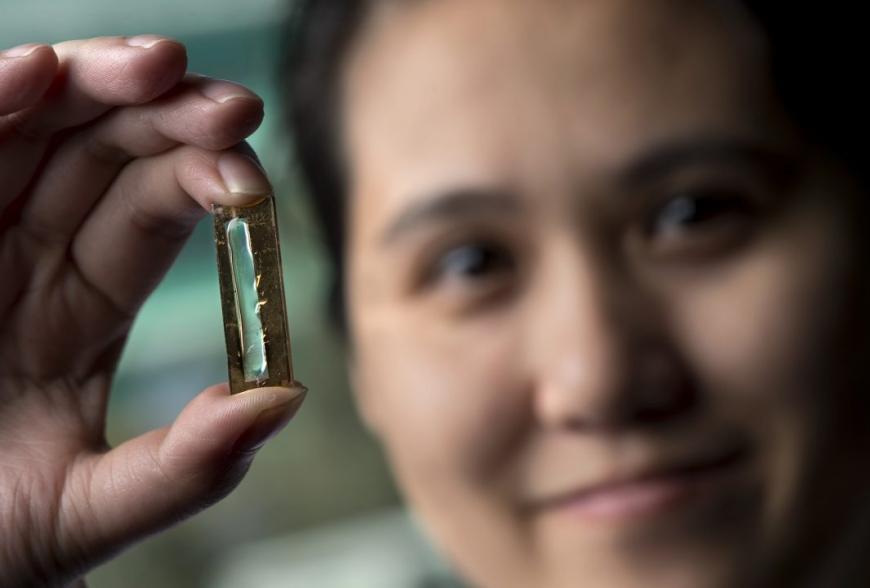
However, Mya decided to change the liquid electrolyte surrounding the nanowires with one that is made of gel. When she began cycling them, the entire team had a huge surprise: The batteries were going through thousands of charging cycles without any signs of wear and tear.
Reginald Penner, chair of UCI’s chemistry department, told:
“Mya was playing around, and she coated this whole thing with a very thin gel layer and started to cycle it,”
“She discovered that just by using this gel, she could cycle it hundreds of thousands of times without losing any capacity.”
“That was crazy,” he added, “because these things typically die in dramatic fashion after 5,000 or 6,000 or 7,000 cycles at most.”
advertisement
A typical laptop battery life is between 300 and 500 cycles. This means that we could have ultra-long lasting batteries so that there will be fewer laptops, phones, and lithium-ion batteries piling up in landfills, thus saving the environment.
The researchers think that coating a gold nanowire in a manganese dioxide shell and encasing the assembly in an electrolyte made of a Plexiglas-like gel plasticizes it and gives it flexibility, preventing cracking. The combination is reliable and resistant to failure. Thai said:
“The coated electrode holds its shape much better, making it a more reliable option,”
“This research proves that a nanowire-based battery electrode can have a long lifetime and that we can make these kinds of batteries a reality.”
advertisement
The surprising part is that the researchers still aren’t sure exactly how their newly developed technology works. "We started to cycle the devices, and then realised that they weren't going to die," Penner told Popular Science. "We don't understand the mechanism of that yet." Since these batteries were made using gold, they would be very expensive to purchase. So the team of researchers are already trying the same experiment using nickel instead of gold, to see whether they can generate similar results.
The study was conducted in coordination with the Nanostructures for Electrical Energy Storage Energy Frontier Research Center at the University of Maryland, with funding from the Basic Energy Sciences division of the U.S. Department of Energy. The findings were published in the American Chemical Society’s Energy Letters.