#1 Chile
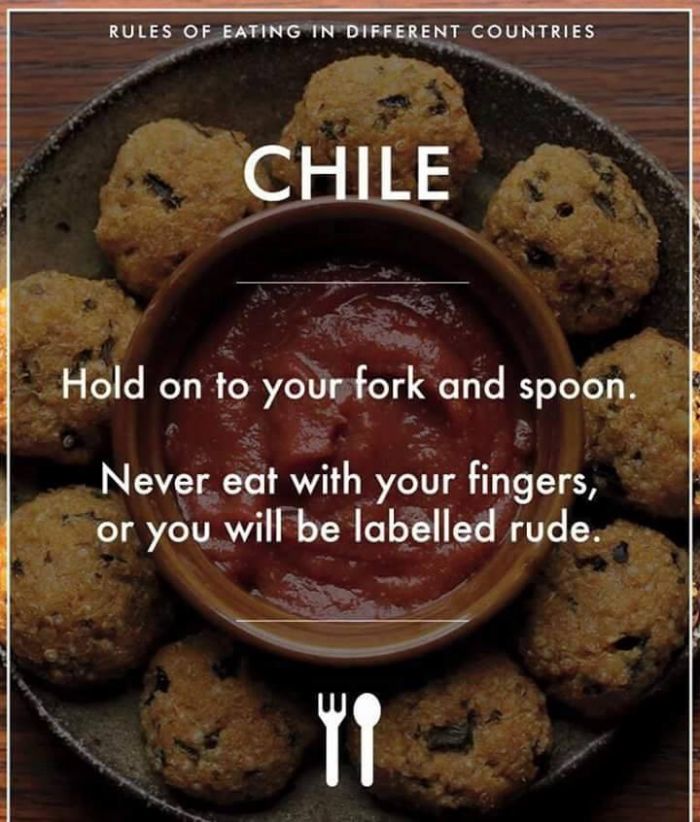
Dining etiquette for utensils: When you are finished with your meal, place your knife and fork parallel to each other on the right side of the plate with the tines of the fork pointing north.
Dining etiquette for seating: The guest of honor is seated usually next to the host or hostess (women to the right of the host, and men to the right of the hostess)
#2 Tanzania
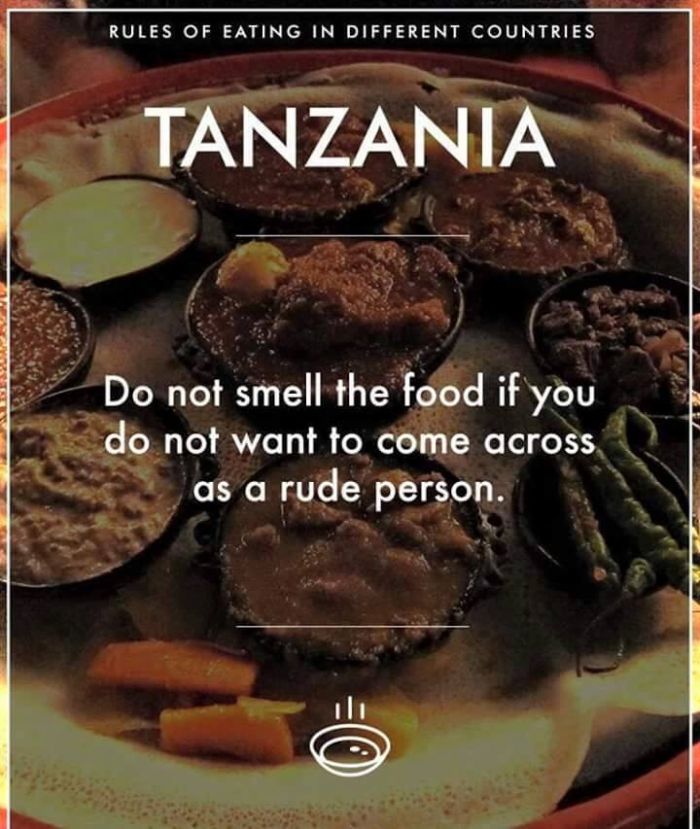
Dining etiquette for using your hands. Eat with the right hand.
Dining etiquette for seating. Diners usually sit on mats on the floor or low stools.
Dining etiquette for communal bowls. Do not put your left hand on bowls or serveware. When one communal bowl is present, eat from the part of the bowl/plate in front of you.
Tanzanian foods. Ugali (porridge-bread), bananas, fruits, and vegetables plus grains.
#3 Portugal
Dining etiquette for beginning to eat. Do not begin eating until the host says, "Bom appetito!".
Dining etiquette for utensils. Portuguese do not switch knives and forks. The knife remains in the right hand, and the fork remains in the left. When the meal is finished, the knife and fork are laid parallel to each other across the right side of the plate. If you put both utensils down on the plate for any real length of time it is a sign to the waitstaff that you are finished, and your plate may be taken away from you. Alternately, if you lay your cutlery down on either side of the plate, it means that you haven't finished.
Dining etiquette for restaurants. You may be required to share a table. Waitstaff may be summoned by making eye contact.
#4 Russia
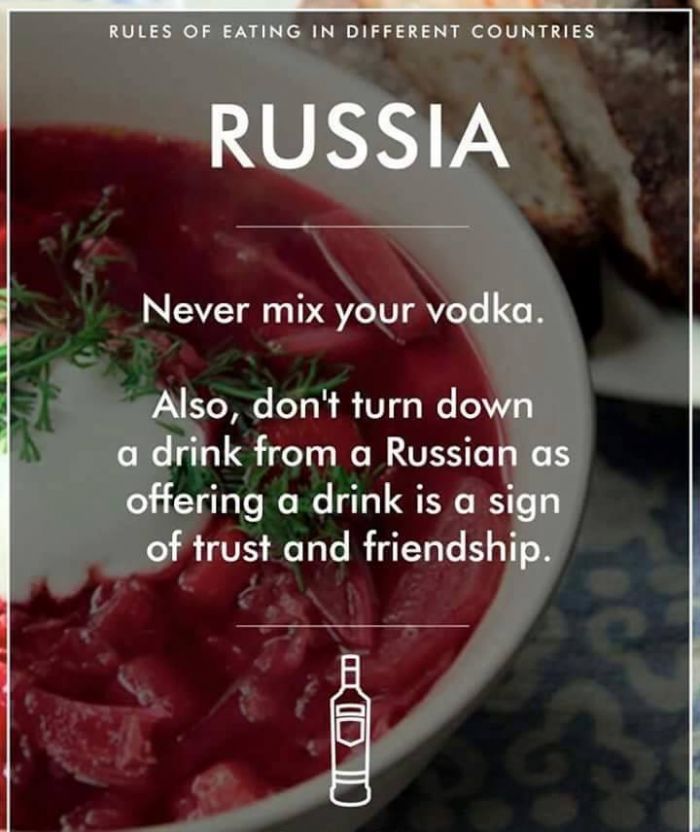
Sometimes it is actual table manners that merit attentiveness. In Russia, putting your hands in your lap while eating is considered impolite (or, as I was asked, "what exactly are your hands doing?"), whereas I was brought up to keep my hands off the tabletop. Word to the wise for those heading to Russia: put your wrists on the edge of the table (not in your lap) while eating.
These small quirks are excellent ways to learn more about a culture and the traditions baked into its food norms.
#5 Thailand
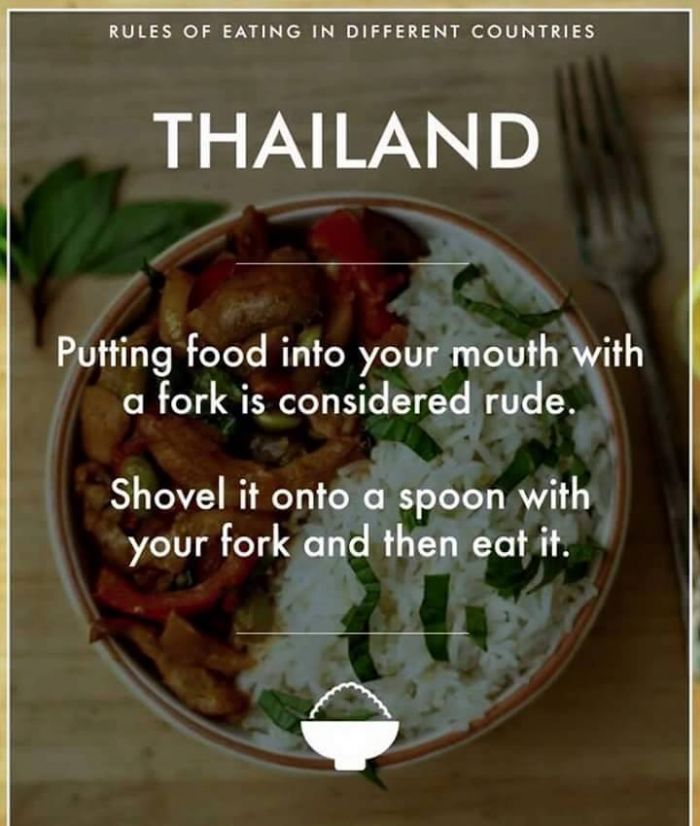
In Thailand, for example, many people will order a pad Thai and ask for chopsticks, incorrectly assuming that people are giving them a fork and spoon because they are foreigners. In reality, however, Thailand's cutlery options include more than we realize a spoon and fork, chopsticks, or your hands, depending on the meal.
Customarily, rice-based and dry noodle dishes in Thailand are eaten with a spoon and a fork, with the spoon as the star of the show. Food is shoveled onto the spoon, which is your primary instrument of deliciousness. In contrast, chopsticks are usually available when eating noodle soups, or when you are in a restaurant from a different Asian country (e.g. a Chinese restaruant). In the Northeast of Thailand (also called Isaan), food is frequently eaten with the right hand and sticky rice is used to scoop up the salad or dips.
#6 France
Dining etiquette for beginning to eat. Do not begin eating until the host says, "Bon appetit!"
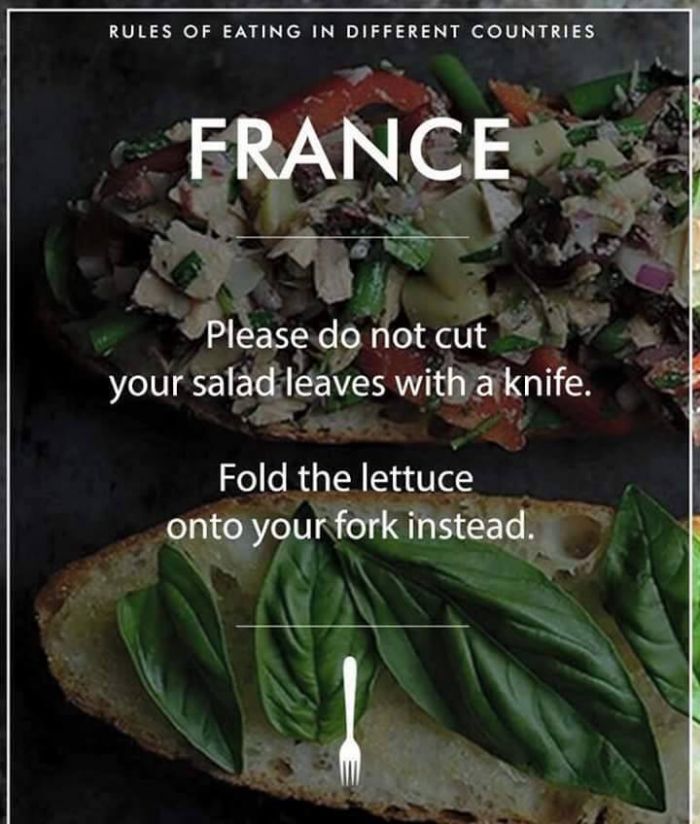
Dining etiquette for utensils. The knife remains in the right hand, and the fork remains in the left. When the meal is finished, the knife and fork are laid parallel to each other across the right side of the plate.
Dining etiquette for the place setting. The knife above your plate is for bread and butter (or it may be a smallish knife laid by the side of the main plate; a bread plate is rare, and bread is usually broken by hand, with a small piece being laid on the left side of the main plate directly on the table). The fork and spoon above your plate are for dessert. Always start from the outside and work your way in, course by course. There will be separate glasses provided at your setting for water, white and red wine, and champagne (after-dinner drink glasses come out after dinner).
Dining etiquette for restaurants. There are many varieties of restaurants, beginning with the formal and elegant establishments serving haute cuisine right on down to the creperie food stand on the street. There are several types in between: the bistros-or, originally, the bar-now usually a family-run establishment offering good, substantial fare that accompanies drinks; the brasserie, offering snacks (not to be confused with fast food) and traditional meals; and less formal restaurants, where reservations may not be necessary. In informal restaurants, you may be required to share a table: if so, do not force conversation: act as if you are seated at a private table.
#7 Italy
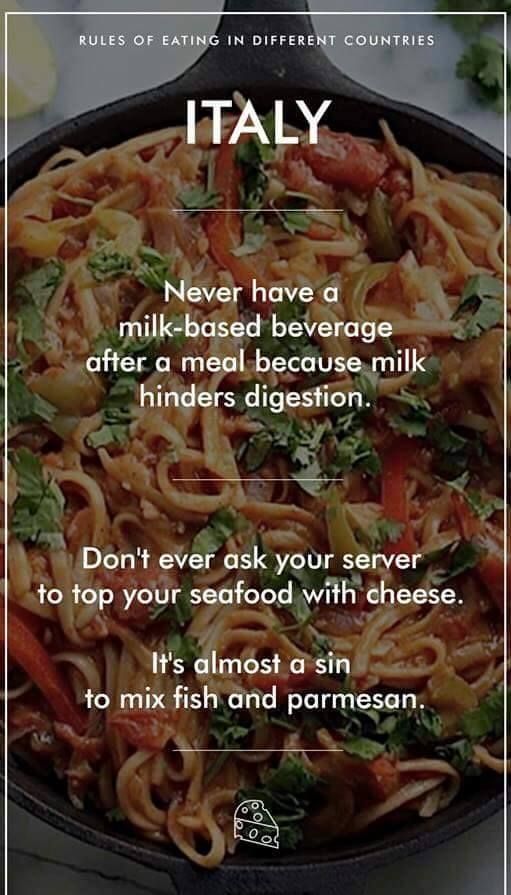
Dinner parties or large lunches often start with an aperitif (cinzano, vermouth, campari, etc.), and end with after-dinner drinks, such as grappa (a brandy made from grape skins and stems) or sambuca (an anise-flavored drink often served with a coffee bean) after coffee.
Formal Italian meals usually follow this order:
antipasto (appetizers, such as prosciutto or pates and fruit)
soup
pasta
main dish
salad
cheese
dessert
fruit
Dining etiquette for beginning to eat. Do not begin eating until the host says. "Buòn appetito!"
Dining etiquette for utensils. Italians do not switch knives and forks. The knife remains in the right hand, and the fork remains in the left. When the meal is finished, the knife and fork are laid parallel to each other across the right side of the plate, with the tines of the fork facing downward. If you put both utensils down on the plate for any real length of time, it is a sign to the waitstaff that you are finished, and your plate may be taken away from you. Alternately, if you lay your cutlery down on either side of the plate, it means you haven't finished.
#8 Korea
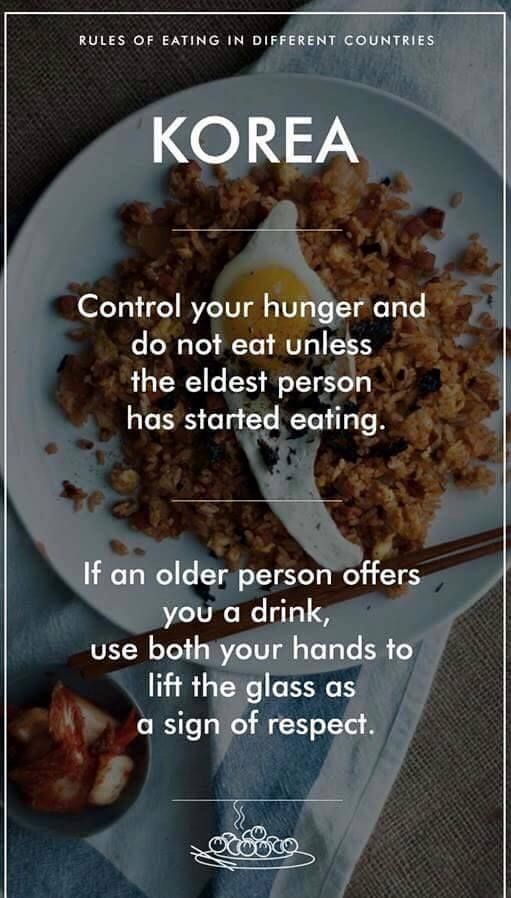
Dining etiquette for beginning to eat. In South Korea, it is expected that you wait until the senior person is served and begins to eat before you begin eating or drinking. Try to follow your colleagues' lead in when to drink, eat, or make a toast.
Dining etiquette in restaurants. You may be required to share a table. If so, do not force conversation; act as if you are seated at a private table your lead from their conversation.
#9 China
Dining etiquette for drinking. Never refill your own glass; always refill your neighbor's glass, and he or she will refill yours.
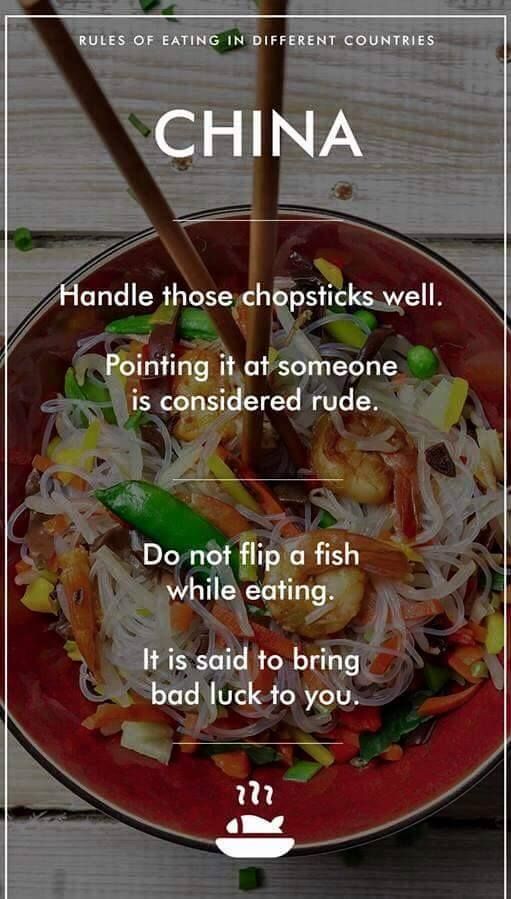
Dining etiquette in a restaurant. In China, it is expected before you begin eating or drinking anything that you say "youyi" (basically, "here's to friendship"), and after the meal that you thank the host. Remember, it's best not to drink or eat until your Chinese host does; in fact, throughout the meal, try to follow the colleague's lead in when to drink, eat, or make a toast.
Dining etiquette for toothpicks. Handle a toothpick by working it away at your teeth with one hand, while keeping the other hand in front of it over the mouth.
#10 Georgia
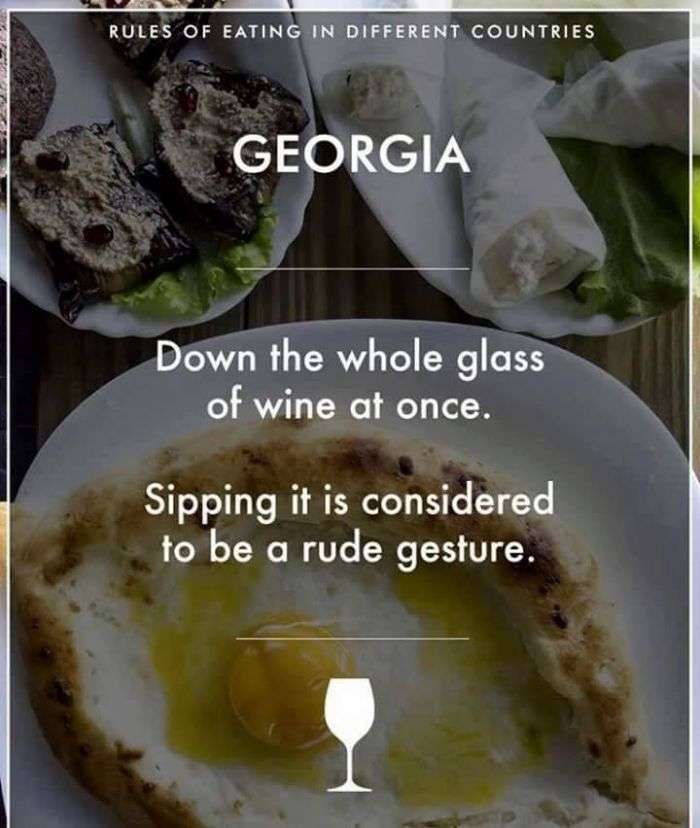
Table manners are generally unfussy and relaxed. If in doubt over proper dining etiquette either watch what others do or simply ask.
Dining etiquette for your hands. Keep your hands above the table at all times during the meal, with your wrist resting on the edge of the table. Do not rest your elbows on the table.
Dining etiquette for order of service. The oldest (or most honoured) guest is usually served first.
Dining etiquette for accepting food. You will be offered second and third helpings and accepting them will please the host. Try, therefore, to take smaller first portions.
#11 India & The Middle East
Alcoholic beverages are becoming more common even in Muslim countries, but Muslims do not drink, so do not ask for alcoholic beverages. Even when drinking is permitted, drunkenness is considered gauche.
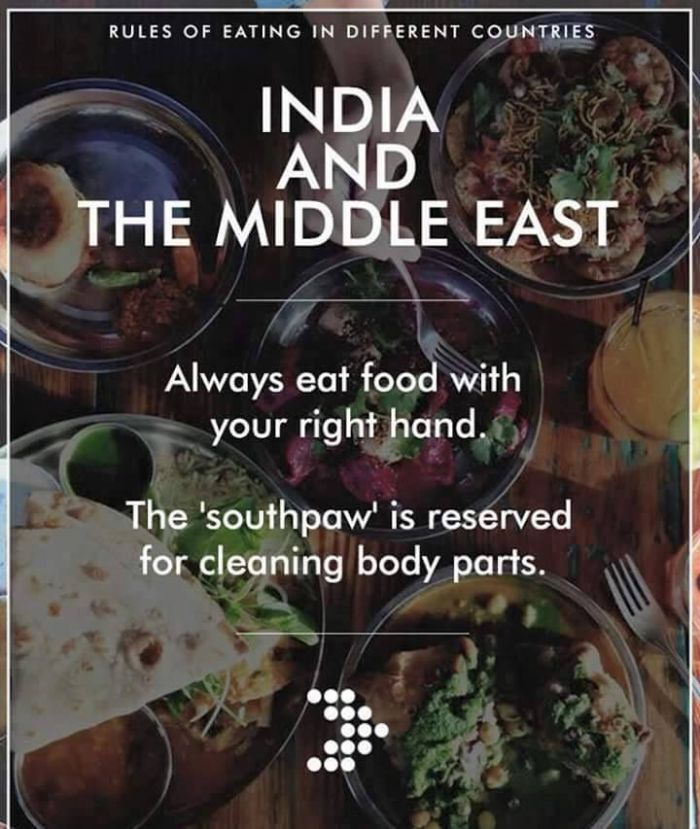
If you eat with your fingers, use only your right hand to eat.
Israeli food is both mid eastern and western. Eating customs are the same, generally, as in the West.
#12 Canada
Dining etiquette for using your hands. You are seldom expected to eat with your hands. If the type of food is easier to eat in that way, be guided by what your host does. Do not rest your elbows on the table.
Dining etiquette for napkins. Keep your napkin in your lap while eating.
Dining etiquette for seating. Wait to be shown to your seat.
Dining etiquette for beginning to eat. Do not begin eating until the hostess starts.
Meals are typically served in courses. Except at a formal dinner, it is common to have two courses, either an appetizer or salad and main dish or a main dish and a dessert. Occasionally meals are served buffet style for medium to large gatherings. It is appropriate to eat everything served to you at a meal, and your host will be pleased if you enjoy it. If you don't like the taste of something, deal with it discreetly, and usually no one will comment about it.
#13 UK
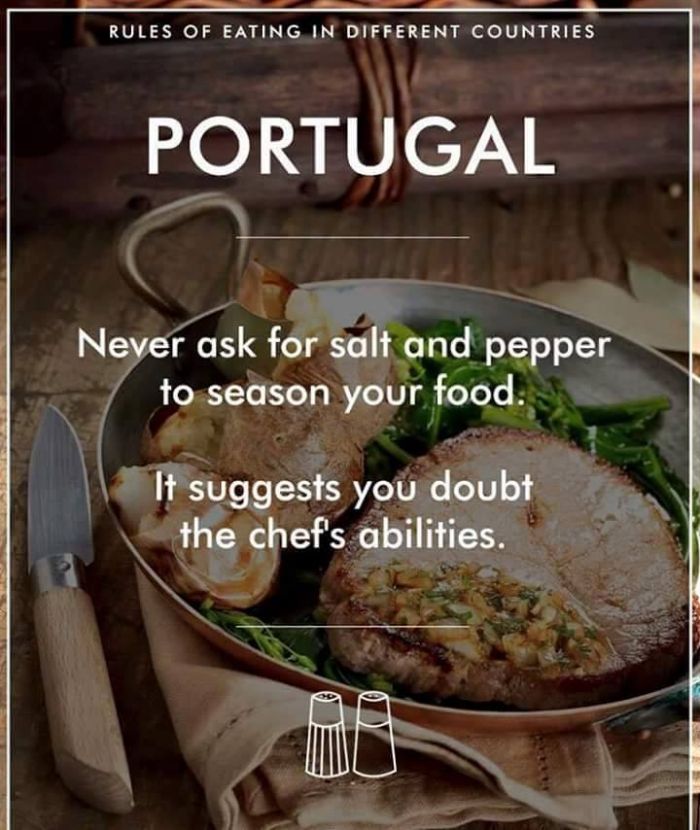
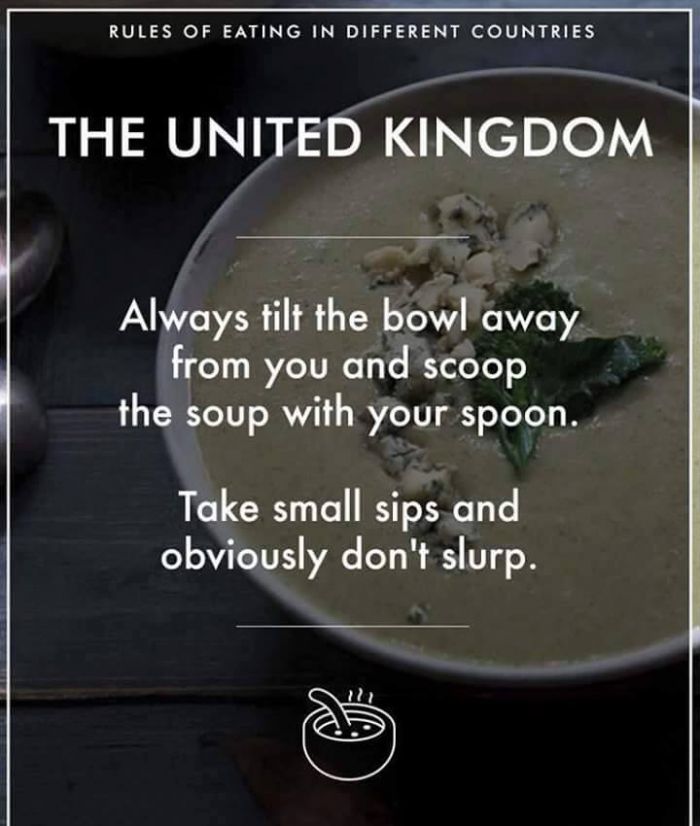
Traditionally in the UK, the host or hostess takes the first bite unless he or she instructs otherwise. The host begins after all food is served and everyone is seated. Food should always be tasted before salt and pepper are added. Applying condiments or seasoning before the food is tasted is viewed as an insult to the cook, as it shows a lack of faith in the cook's ability to prepare a meal.In religious households, a family meal may commence with saying Grace, or at dinner parties the guests might begin the meal by offering some favourable comments on the food and thanks to the host. In a group dining situation it is considered impolite to begin eating before all the group have been served their food and are ready to start. Although table manners are popular they are not set in stone meaning they are opinions which cultures have used as the mandatory.
#14 Mexico
Dining etiquette for the home. It is considered bad form to leave the dinner party or the table. At the table look for place cards, or wait until the host seats you.
Dining etiquette for paying the bill. Usually the one who does the inviting pays the bill. Sometimes other circumstances determine who pays (such as rank).
Dining etiquette for tipping. A 10 percent tip is usually sufficient in restaurants
#15 Japan
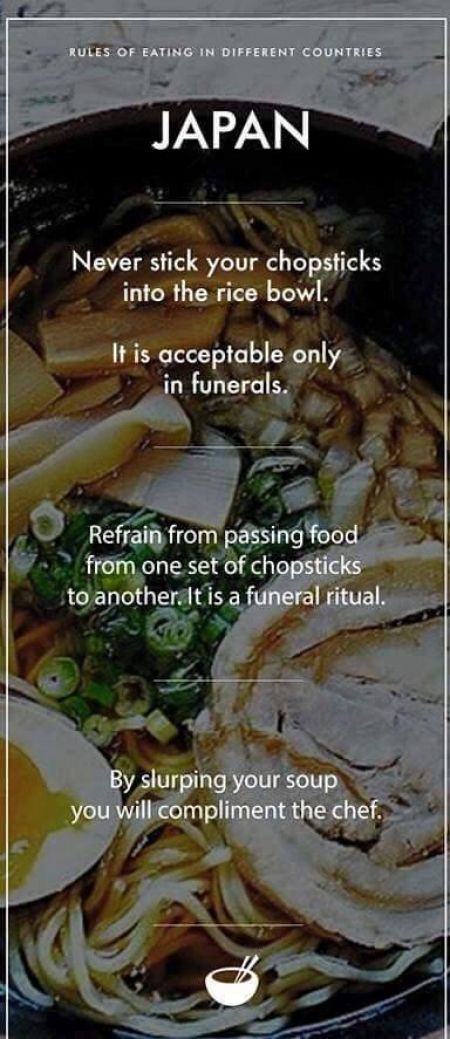
Dining etiquette for toasts. The toast in Japan is kampai which means "bottoms up" or "drain the glass." An honored guest should make a toast soon after the host does or at the end of the meal.
Dining etiquette before the meal. The custom of o-shibori. Wipe your hands with the towel provided, not your face, and you do so before you touch any of the food, not after the meal.
Dining etiquette for seating.
Traditional Japanese meals are taken sitting on the tatami, a reedlike mat inset in the top part of the floor.