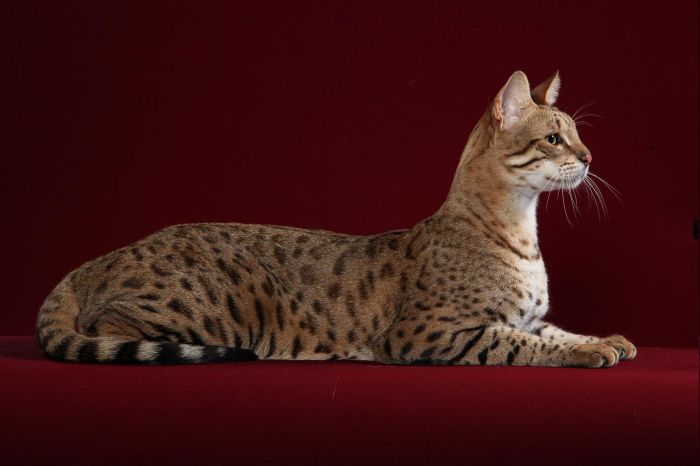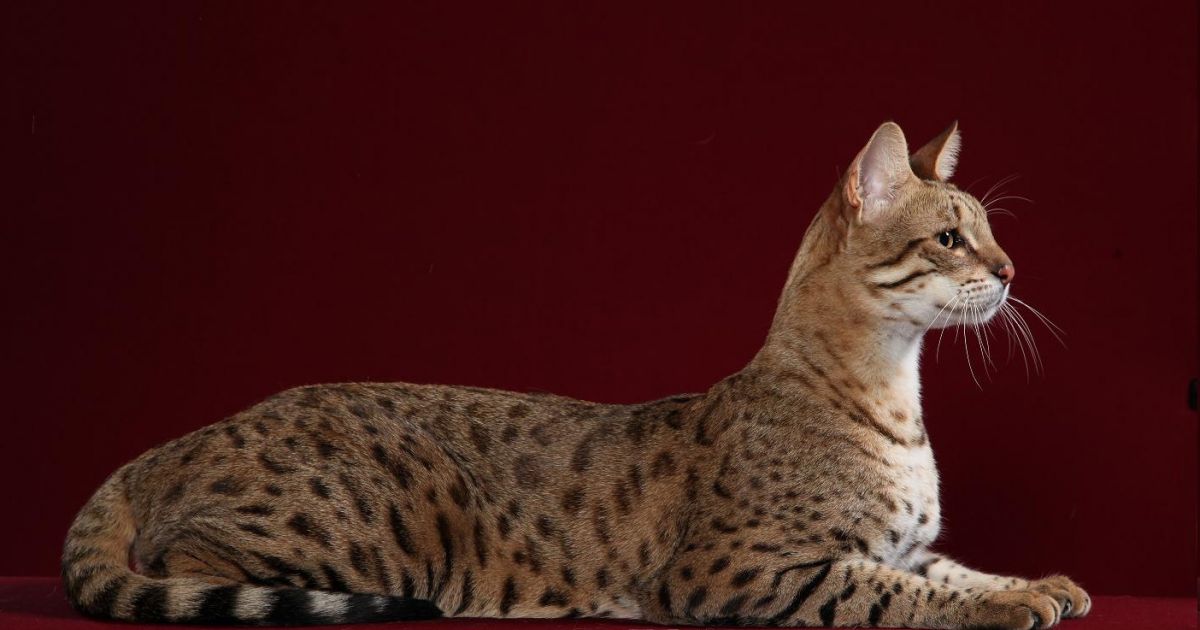
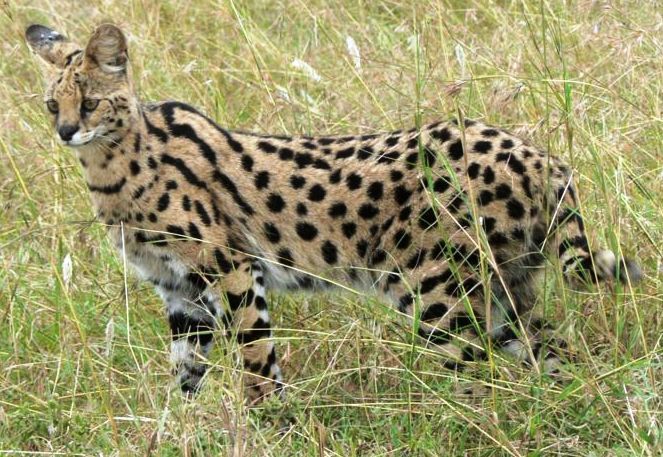
A Savannah cat is a cross between a domestic cat and the serval, a medium-sized, large-eared wild African cat.
advertisement
If the call of the wild is what attracts you to cats, the Savannah is one to consider.
Created by crossing African Servals with domestic cats and then breeding the offspring to cats such as Egyptian Maus, Oriental Shorthairs, Savannahs, Ocicats and others, this cat stands out for his large pointed ears and spotted golden, silver or black smoke coat. The Savannah is a relatively new breed that was recognized by The International Cat Association (TICA) in 2012.
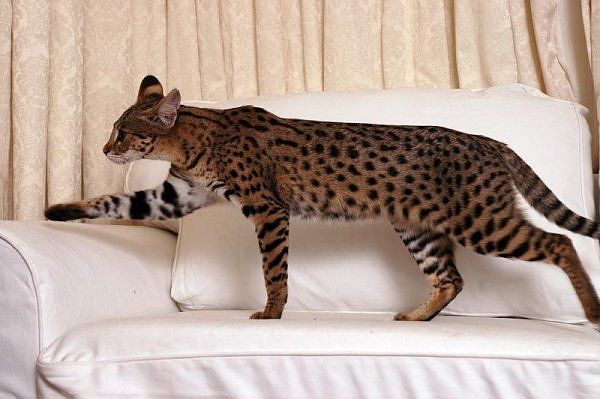
The Savannah is a hybrid domestic cat breed.
It is a cross between the serval and a domestic cat. The Savannah Cat is a new and still fairly rare exotic domestic cat breed that is the result of a cross between an African Serval and a domestic cat. Laws governing ownership of Savannah cats in the United States vary according to state.
advertisement
Physical Caracteristics
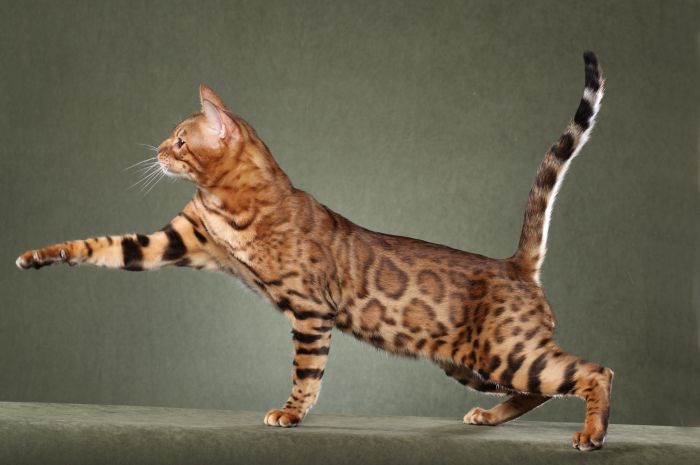
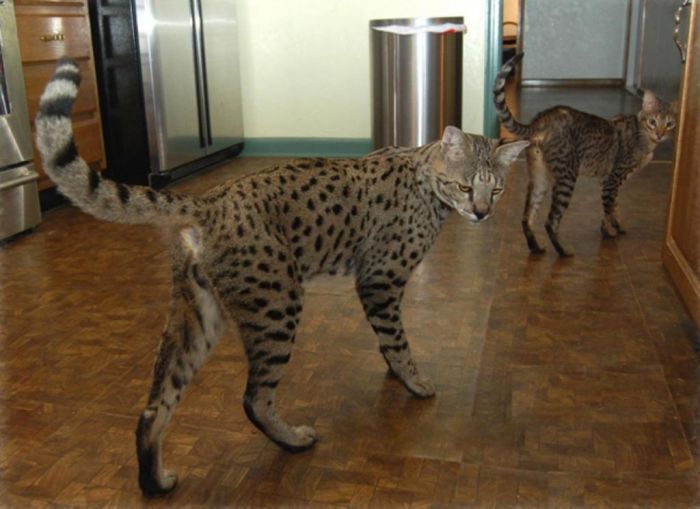
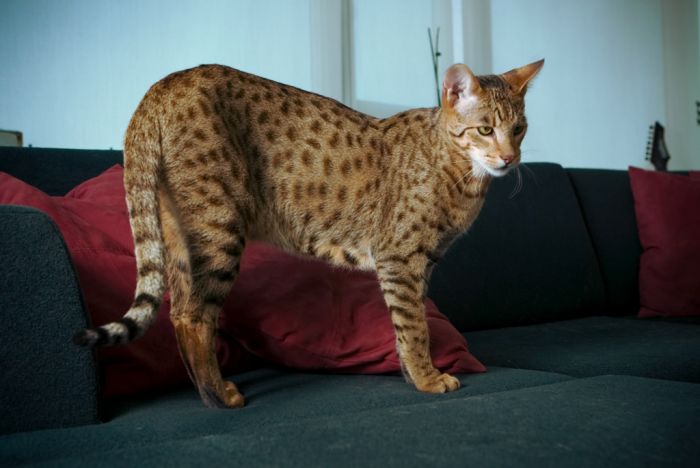
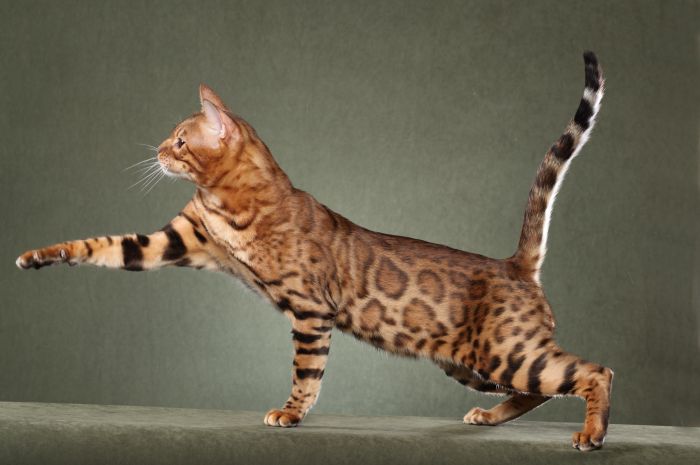
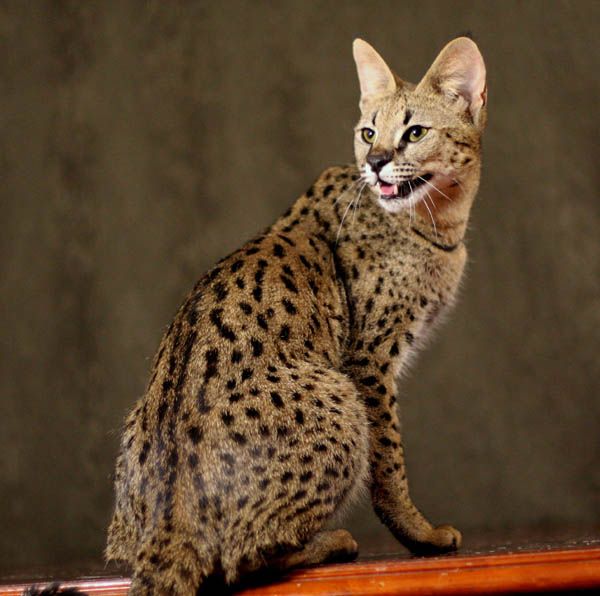
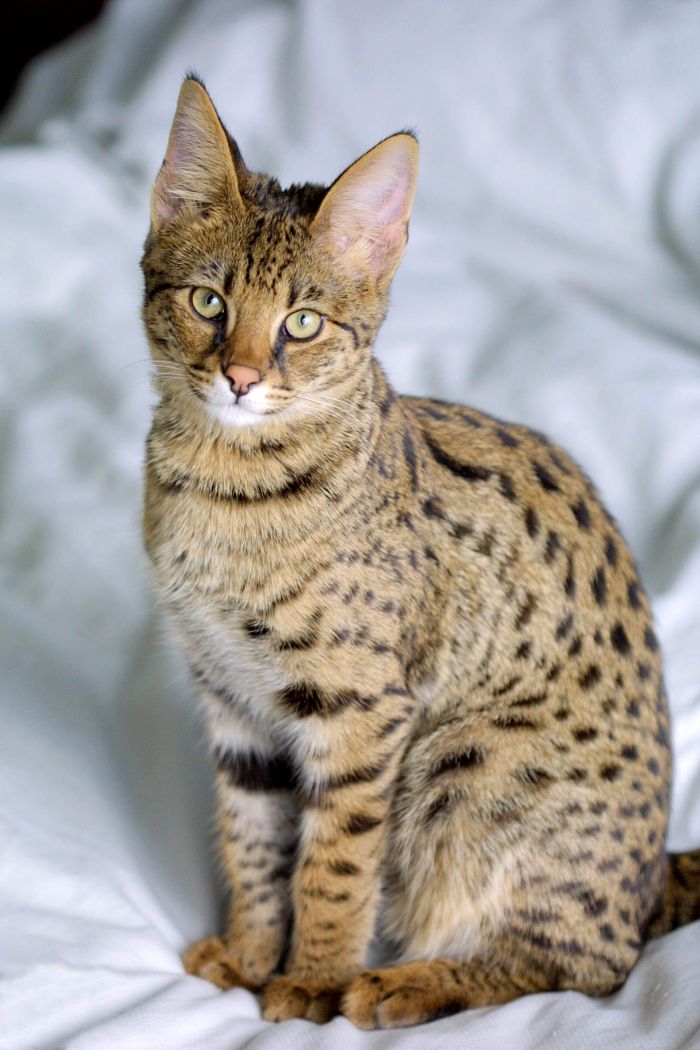
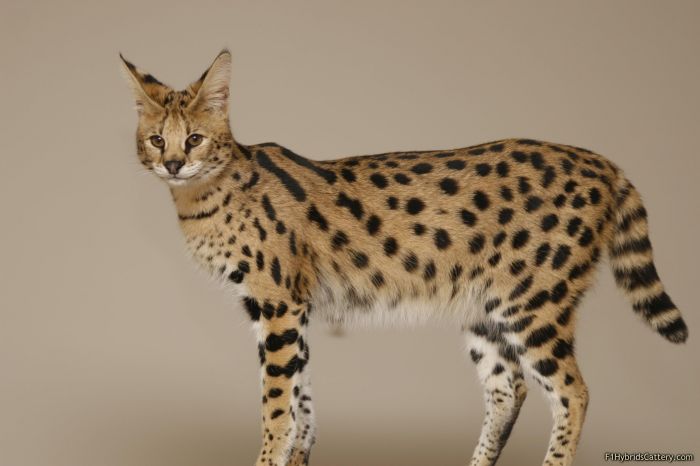
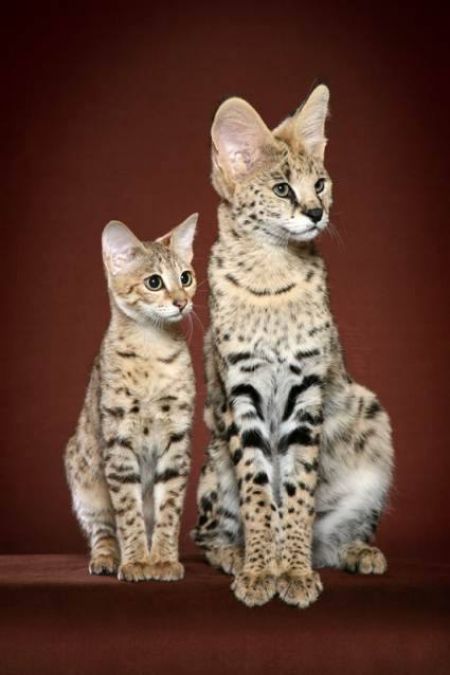
The Savannah is an unusual, exotic breed of domestic cat that looks much like its ancestor, the African Serval, but is smaller in size. One of the features that make this breed so unique is its strikingly bold and spotted coat, which can vary from brown, tan or gold with black or dark brown spots; silver with black or dark grey spots; black with black spots; and black tipped silver with black spots.
The Savannah's fur can also have the classic marble pattern, snow coloration, and other diluted colors. Their overall look depends greatly on generational breeding and genetic dilution.
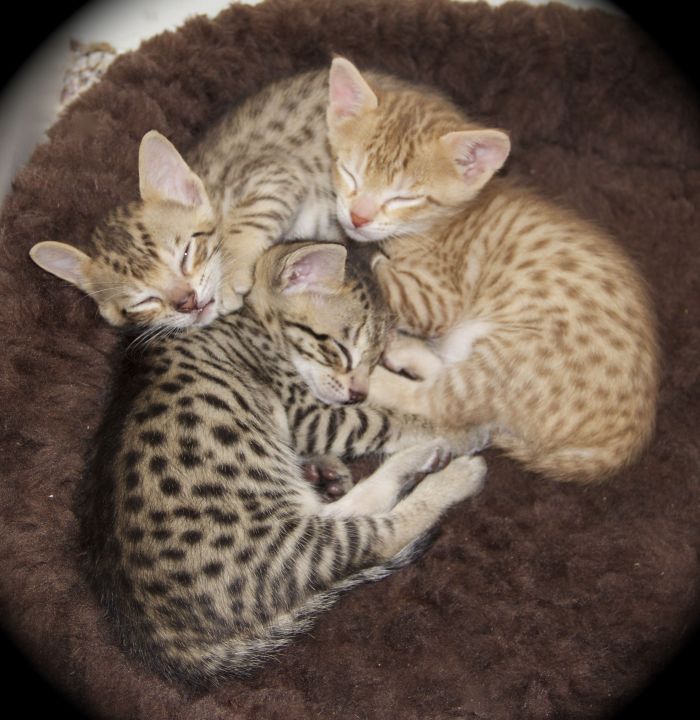
As Savannahs are produced by crossbreeding servals and domestic cats
each generation of Savannahs is marked with a filial number. For example, the cats produced directly from a Serval/domestic cat cross are the F1 generation, and they are typically 50% serval (although if you use a F1 Savannah as the domestic cat, the percentage of serval blood can jump to 75%). The F2 generation, which has a serval grandparent and is the offspring of the F1 generation, is 25% serval. The F3 generation has a serval great grandparent, and is 12.5% serval. They can be very expensive to purchase because of their scarcity.
advertisement
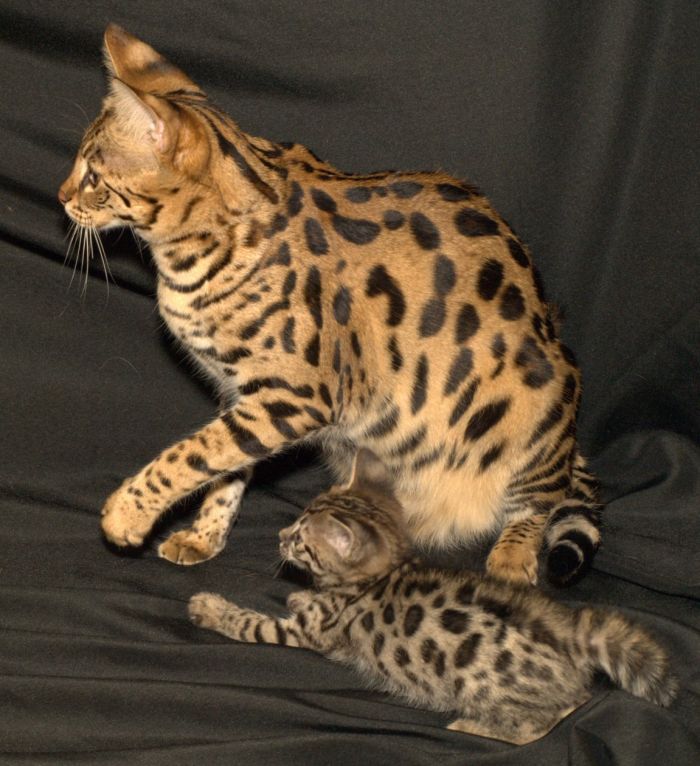
Male Savannah cats are typically sterile until the F5 generation or so
although the females are fertile from the F1 generation and on. Savannahs tend to be one of the larger breeds of cats, ranging up to 32 pounds (most other domestic cats range in the area of 5.5 and 16 pounds). The earlier generations, F1's to F3's or so, tend to be larger than the later generations. Also, the males are often larger than the females.
advertisement
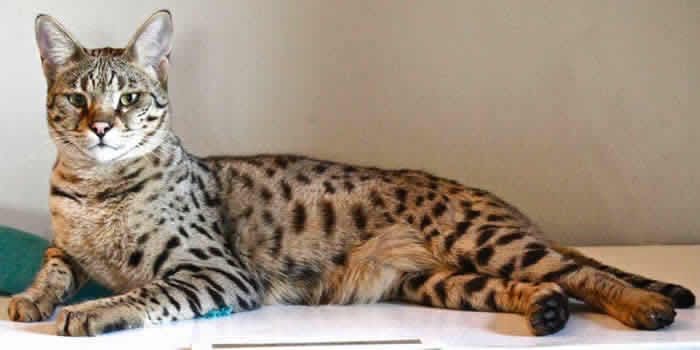
The Savannah has a lean muscular build, a short, thick tail, a long neck and long legs.
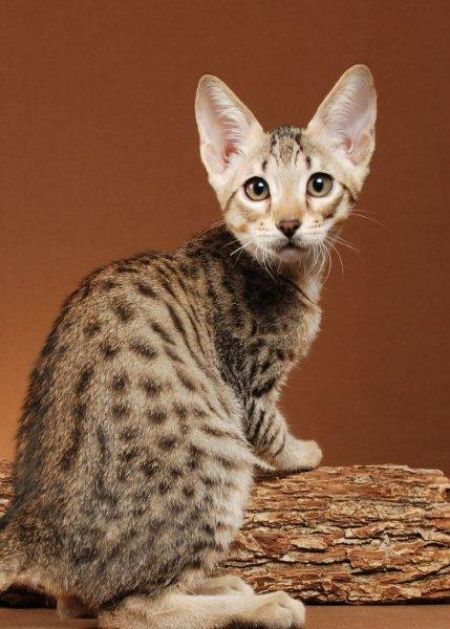
These features give the feline a tall appearance, but it is actually medium sized and tends to weigh less than other similarly sized domestic cats. One of its other most striking features is the shape of its hooded eyes, which are flat on top, and its large, tall ears that are situated right at the top of its head.
advertisement
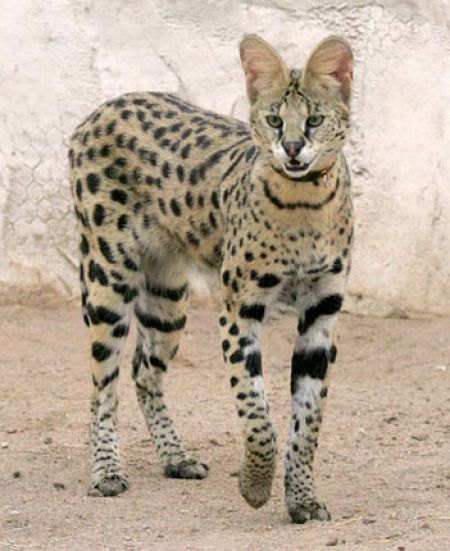
A Savannah's exotic look is often due to the presence of many distinguishing serval characteristics.
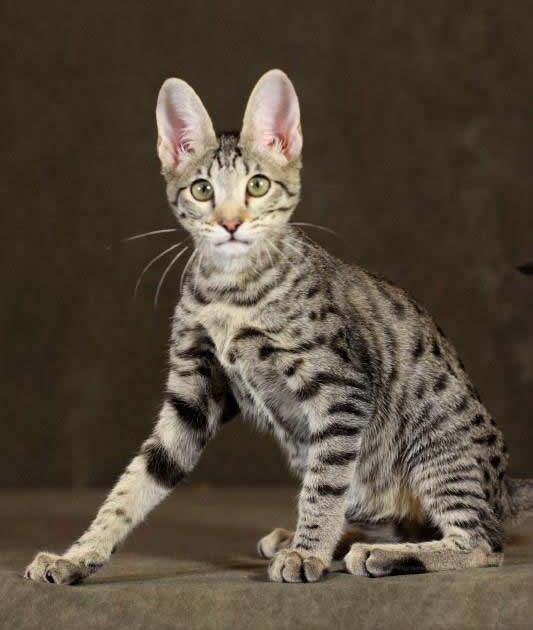
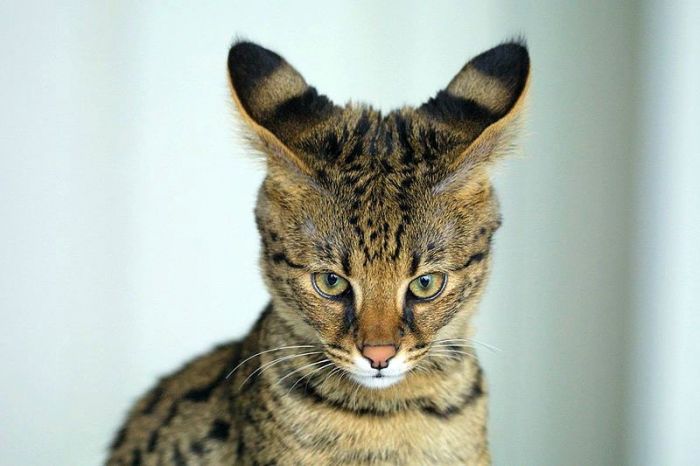
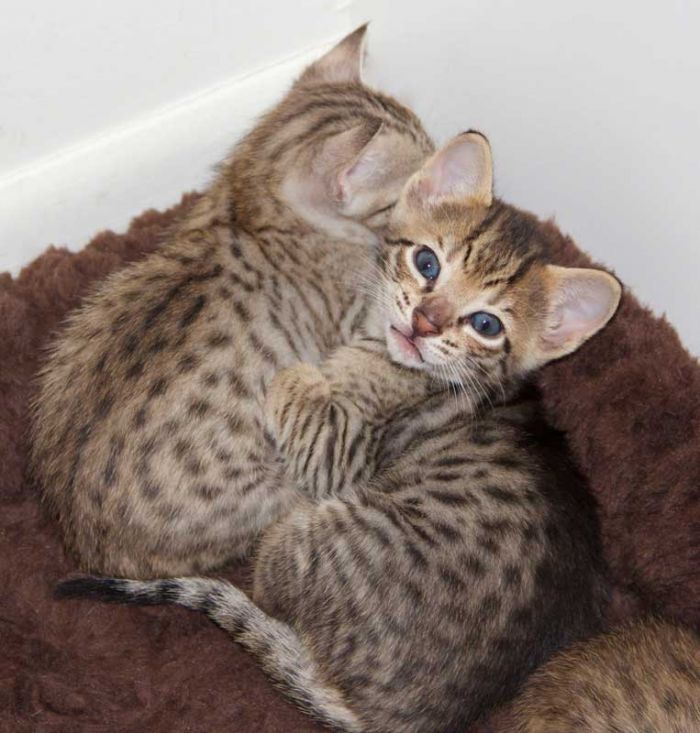
Most prominent of these include the various color markings; tall, deeply cupped, wide, rounded, erect ears; very long legs; fat, puffy noses, and hooded eyes. The bodies of Savannahs are long and leggy; when a Savannah is standing, its hind-end is often higher than its prominent shoulders. The small head is taller than wide, and it has a long, slender neck. The backs of the ears have ocelli, a central light band bordered by black, dark grey or brown, giving an eye-like effect. The short tail has black rings, with a solid black tip. The eyes are blue as a kitten (as in other cats), and may be green, brown, gold or a blended shade as an adult. The eyes have a "boomerang" shape, with a hooded brow to protect them from harsh sunlight. Ideally, black or dark "tear-streak" or "cheetah tear" markings run from the corner of the eyes down the sides of the nose to the whiskers, much like that of a cheetah.
advertisement
This very active cat is curious, assertive, and an adventure-seeker.
It requires a lot of interaction and attention on a daily basis, either with its companion human(s) or other companion cats. This cat is also very loyal, and will develop a strong bond with people.
The Savannah is not a lap cat, but will show affection to its human family by following them around the house and giving them frequent head butts. They love to play in water, and are easily trained to walk on a leash with a harness. They also love to play active games such as fetch. Because of these traits, Savannahs are thought to have "dog-like" personalities.
advertisement
Despite their exotic appearance
Savannah cats are one of the healthiest breeds and have no known established health problems. Due to their direct lineage from Servals, care should be taken to establish whether they have inherited the Serval's tendency to have a proportionately small liver for their body size.
Care should also be taken by veterinarians to not administer ketamine during medical treatment, as ketamine is metabolized through the liver and has been known to cause potentially serious health complications for this breed.
advertisement
Special attention should be given to the Savannah's diet
to guard against a deficiency of taurine, a particularly dangerous condition resulting from lack of the amino acid taurine, which is found in meats and fish and to which the Savannah is believed to be especially prone. Because of this, it is recommended the Savannah cat be provided with a high protein, low or no grain diet (especially corn). High concentrations of taurine can be found in meat, poultry (which can be partially boiled), fish, and premium cat foods.
Overall, Savannah cats are healthy, hardy and athletic, and are considered to be one of the healthiest of the domestic feline breeds.
advertisement
Some Savannah breeders recommend raw meat diets while others recommend only a premium domestic cat food.
Unlike purebred Servals, Savannah cats can be treated by any small animal veterinarian. While there is some evidence that suggests that Savannahs tend to inherit the smaller sized liver of the Serval, this has not been unanimously agreed upon. They may, however, be more sensitive to certain anesthetic drugs. Also, some breeders believe that only killed virus vaccines should be used in Savannahs.
advertisement
The cats are commonly compared to dogs in their loyalty, and they will follow their owners around the house like a canine.
They can also be trained to walk on a leash and to fetch.[4]
Some Savannahs are reported to be very social and friendly with new people and other cats and dogs, while others may run and hide or revert to hissing and growling when seeing a stranger. Exposure to other people and pets is most likely the key factor in sociability as Savannah kittens grow up.
An often-noted trait of the Savannah is its jumping ability.
They are known to jump on top of doors, refrigerators and high cabinets. Some Savannahs can leap about 8 feet (2.5 m) high from a standing position. Savannahs are very inquisitive. They often learn how to open doors and cupboards, and anyone buying a Savannah will likely need to take special precautions to prevent the cat from getting into trouble.
Many Savannah cats do not fear water, and will play or even immerse themselves in water. Some owners even shower with their Savannah cats. Presenting a water bowl to a Savannah may also prove a challenge, as some will promptly begin to "bat" all the water out of the bowl until it is empty, using their front paws.
advertisement
Another quirk Savannahs have is to fluff out the base of their tails in a greeting gesture.
This is not to be confused with the fluffing of fur along the back and full length of the tail in fear. Savannahs will also often flick or wag their tails in excitement or pleasure.
Vocally, Savannahs may either chirp like their serval fathers, meow like their domestic mothers, both chirp and meow, or sometimes produce sounds which are a mixture of the two. Chirping is observed more often in earlier generations. Savannahs may also "hiss"a serval-like hiss quite different from a domestic cat's hiss, sounding more like a very loud snake. It can be alarming to humans not acquainted to such a sound coming from a cat.
There are three basic factors that affect the nature of the Savannah cat behavior:
lineage, generation and socialization. These three factors follow the nature vs nurture argument with nature being breed lines combined with generation and nurture being social upbringing. As of 2014 the Savannah breed development is still in its infancy and most Savannah cats have a very broad range of behaviors.
If a breed line has a tendency for a specific behavior over other behaviors it is likely to be passed to the breed lines offspring. As outside lines are used there is a merging effect of the base behaviors
advertisement
When breeding lines starting from early generations
such as first filial and second filial generations (F1 and F2 Savannahs), behavior stemming from the wild out cross, the Serval, is more apparent. Behaviors like jumping, fight or flight instincts, dominance, and nurturing behaviors are more noticeable in early generations. Since fertile males that are F5 and F6 are used in most breeding programs, later generation Savannah cats behaviors tend to act more like traditional domestic cats. Overlying behavior traits for all generations are high activity and high curiosity.
Probably the most influential factor is early socialization.
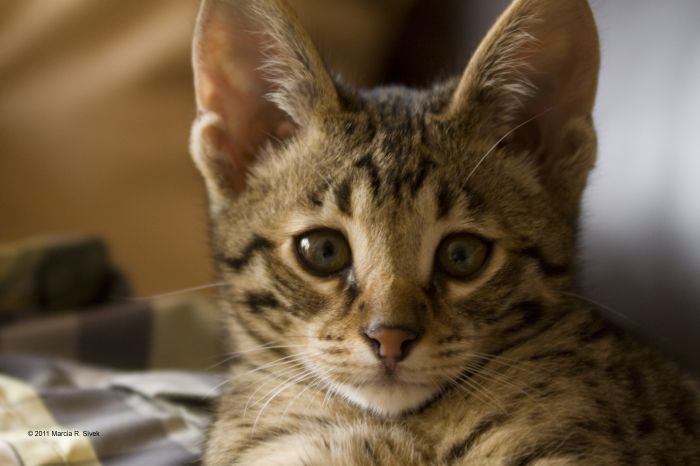
Kittens socialized with human contact from birth and human interaction each day reinforces kitten and cat human interaction behavior that lasts throughout the cats life span. Kittens within litters will tend to have varied social skills with some that like human interaction and others that fear it. If kittens that fear humans never grow past that fear they will tend to exhibit a more shy behavior and are likely to hide when strangers are present. Kittens that look forward to human visits and likely to engage in play with humans tend to grow to cats that are more welcoming of strangers and less frightened of new environments. These cats tend to become the life of the party versus a cat that will find a hiding place until the party is over. Human cat socialization should be practiced each day with positive reinforcement for a kitten to grow into a well rounded social Savannah cat. Kittens that go for long periods of time without human interaction and only interact with their mothers or siblings usually do not develop a strong bond with humans and tend to be less trusting of humans. These kittens tend to be shy and are likely to hide when unknown people are present.
advertisement
Savannah's are prone to any and all diseases that other cats get
and they need the same vaccines that other domesticated cats require (Rhinotracheitis, Calicivirus, Panleukopenia, and Rabies are the current core vaccines). But there are of course some diseases that pure bred cats get more frequently than mixed breed cats.
Hypertrophic cardiomyopathy (HCM) is prevalent in all pure bred cats, not specifically Savannah's, but should be monitored for regardless. Testing is available but is not able to detect all HCM in cats. Therefore feeding a balanced diet with appropriate levels of taurine in it is crucial to health of your cat's heart.
Getting a Savannah Cat
There are a number of reputable Savannah cat breeders out there but you should be prepared before bringing one home. Find out what kind of food the breeder feeds, if they've tested for HCM, what vaccines they've already had, and what generation of Savannah is the cat you are looking to purchase or adopt (F1, F2, F3, etc.). Next, make sure there is a veterinarian near you who will treat your wild looking cat (some vets will not see hybrids) and get your new cat a quality cloth harness specifically made for cats (they are very quick, agile, and excellent jumpers).
advertisement
While Savannah cats are considered a domestic breed
some cities, states, and countries have laws and regulations against owning a hybrid cat breed. Therefore, check your local laws before acquiring a beautiful Savannah cat.