
Shakespeare's skull may have been stolen by grave Robbers.
Ground-penetrating radar scan of the bard’s grave finds a headless skeleton.


Shakespeare's skull may have been stolen by grave Robbers.
Ground-penetrating radar scan of the bard’s grave finds a headless skeleton.
An archaeologist has conformed Shakespeare's skull is missing from his grave, confirming rumors which have swirled for years about grave-robbers and adding to the mystery surrounding the Bard's remains.

The researchers were allowed to scan the grave of England's greatest playwright with ground-penetrating radar.
Four hundred years after his death and burial when the researchers scanned the area under the church floor where the Bard's skull was expected to be, they found signs of interference.
"We have Shakespeare's burial with an odd disturbance at the head end and we have a story that suggests that at some point in history someone's come in and taken the skull of Shakespeare," said archaeologist Kevin Colls from Staffordshire University.
"It's very very convincing to me that his skull isn't at the church at all."

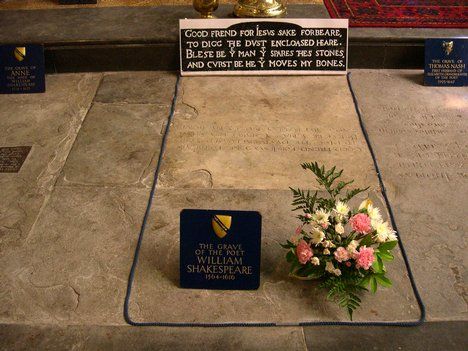
The Shakespeare's grave is located inside Holy Trinity Church at Stratford-upon-Avon, central England, the church in which Shakespeare was baptised and where he was buried in the chancel two days after his death.
The grave does not bear his name, merely this warning rhyme: "Good friend, for Jesus' sake forbear, to dig the dust enclosed here. Blessed be the man that spares these stones, And cursed be he that moves my bones."
The story of Shakespeare's missing skull appeared in The Argosy magazine in 1879, which blamed the removal on trophy hunters from the previous century when grave-robbing was common.
At the Jerusalem Centre an actor performs during William Shakespeare's theatre play "Hamlet" for the Performing Arts in this file photograph dated December 11, 2008.