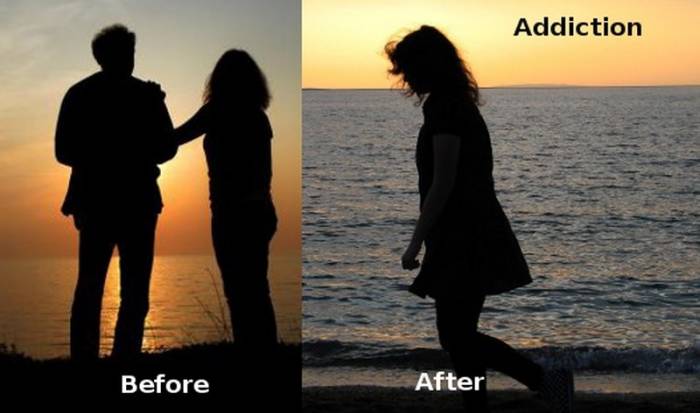
Signs That You Might Be In An Addictive Relationship
By
Sughra Hafeez in
Life Style
On 19th July 2017
An addictive relationship is usually evident to outsiders, but when you are in the middle of it, seeing the situation can be difficult. An addictive relationship is almost always unbalanced. Instead of a 50/50 split in joy and responsibilities, it is more like 90/10. One person is doing all the giving and the other all the taking. It can produce feelings and problems just like a drug addiction, the belief it will get better, denial, compulsion, and obsession.
An addictive relationship has the same hallmark as any other addiction. It is an experience that is increasingly unstable, where you start to lose sight of who you are and stop taking care of yourself in favor of what you are addicted to – in this case, another person and the way you relate to each other.If several items of the below list sounds close to home, you might be in an addictive relationship.
#1 You look for the other person to fulfill you, or 'make' you content and happy.
If you're not in a relationship, you may feel depressed, and that depression lightens when you start a new connection with someone else. "Any relationship is better than none".
#2 Things Are Difficult More Than They Are Smooth.
It’s healthy for all relationships to at times feel difficult. You might feel anger or frustration towards your partner, and you will experience conflict – these are all a normal part of learning each other's boundaries.
But if you are constantly talking about the relationship instead of your lives and interests, and if conflict and drama seem to happen almost every time you are together, there’s a good chance your relationship is an addictive one.
#3 Your Relationship Leaves You On Top Of The World One Day, Really Low The Next.
Addictive relationships can be like drugs in the sense that when the two of you have good moments, it’s so good it’s like nothing else matters. Of course, when you fight or you try to leave, there will then be the inevitable crash followed by feeling awful.
You might even feel physically sick if you try to walk away from an addictive relationship, manifesting similar symptoms to someone withdrawing from a drug.
#4 Knowing the relationship is not good for you, but making no effort to end things.
You’re capable of knowing that things are not right; yet, it’s you can’t bring yourself to end things for whatever reason.
#5 Attempting but failing, to come up with a rational reason for staying in the relationship.
Attempting but failing, to come up with a rational reason for staying in the relationship. This is quite often because there is no logical reason to stay – and your anxiety and fear of being alone take center stage.
#6 Refusing to acknowledge or ignoring any thoughts that the relationship is risky.
This is a phase when the precariousness of the relationship is brought to the forefront of your attention, and you refuse to engage in any interpersonal examination.
#7 You're more concerned about what pleases your partner than what makes you happy, both in bed and outside the bedroom.
#8 You have a hard time believing you deserve a good relationship.
This kind of self-doubt may lead to controlling behavior, jealousy, and possessiveness.
#9 Your Mind Thinks About The Relationship Non-Stop.
You will find that you are constantly running over in your head what is and isn’t working with your relationship (if not increasingly making your friends listen to this conversation, which in itself can be addictive).
You might start to get behind at work as your mind is not focussed or find yourself less interested in being around your friends because you are preoccupied.
Watch out for a list of excuses you add to and replay. As with any addiction, one part of you will know you are involved in something that is not good for you. This means you will then give a lot of headspace over to excuses like “it just needs more time” or, ‘maybe she’s not as bad as I think and I’m being too picky”.
#10 Feeling over-anxious and over-stressed when thoughts of ending the relationships arise (see “abandonment anxiety” in the introductory section.)
#11 You’re in denial about any adverse effects the relationship is having; this may include any emotional, psycho
#12 You Just Never Feel Your Best Self In This Relationship.
It’s odd, as you are usually so funny/ warm/ kind/ laid back, but in this relationship, it’s like you are someone else. You are uptight, sour, nitpicking, you can’t relax – and you don’t know why.
In fact, sometimes you might not feel yourself at all. And if you do try to be yourself, you are criticized or teased. So you find yourself instead working to be someone or something else
#13 You Have Begun To Question Who You Really Are.
strengthens your values and helps you move forwards towards your goals. An addictive relationship tends to throw off your inner compass because it does not support who you are.
Another thing that goes in addictive relationships is personal boundaries. This sees you often doing things you used to not even like, always going along with what the other person says, and letting them make all the decisions instead of tapping into what you think and feel.
You might find yourself questioning not just your values, but also your hobbies and interests, the future you want, and even who your friends are.
#14 Misinterpreting sex for genuine, lasting romance.
Following the act, further repression of painful emotions and thoughts is common. Of course, your partner never changes after their immediate needs are met.
#15 Accepting your partner’s criticism as “normal” behavior.
Make no mistake; this behavior is anything but normal – it’s a chronic, sick, mind game is almost always to keep you under their control.
#16 When you try to end the relationship, you quickly feel a sense of withdrawal – including physical discomfort and tension.
Psychological symptoms, including depression and anxiety, often accompany the physical signs.
#17 Your Self-Esteem Is Not What It Was.
Not only do addictive relationships tend to be full of conflict or put downs that lower your self-esteem, but the inner conflict between the part of you that knows you should leave and the other part that feels helpless can lead to a lot of inner criticism and negative thoughts about yourself that are very damaging.
#18 You Seem To Always Be Tired Or Sick Lately.
Addictive relationships create an ongoing stress that leaves your cortisol levels raised, which can leave you tired and with a lowered immune system, always catching colds and flu.The anxiety addictive relationships cause can also cause sleep problems.
#19 You Feel Oddly Lonely Despite Being With Someone.
Addictive relationships often happen between people who actually have little in common beyond the drama they create between them. You might have different values and world views, not be on the same wavelength, and not really share many hobbies. This leads to feeling misunderstood and alone.
#20 Desperately trying to reestablish contact immediately after the other person ends things.
In most cases, the other person will terminate the relationship before you do. This is when rationality goes AWOL, and one kicks into desperation mode.
#21 Expert Advice for Recovery
Ann Smith, a renowned relationship therapist of over 30 years, provides six different steps one can take to break the pattern of relationship addiction
#22 Begin to observe your own behavior.
This requires taking an honest look at all past and current relationships, taking a personal inventory of your shortcomings and dysfunctions, and refraining from romantic behavior for at least six months.
#23 Notice any commonalities in your relationship experiences with those of your childhood (abuse, fear of abandonment, neglect, etc.)
Should there be a link between your relationships and childhood experiences, this may require the help of a therapist.
#24 If you’re in a non-abusive relationship, abstain from making any significant decisions or requests until you’ve settled things.
If you’re not in any romantic relationship – or in an abusive relationship – please consider getting some help. (The latter requires the intervention of authorities and the legal system.)
#25 Most importantly, Smith says:
“Ask yourself how life would be if you took responsibility for your own happiness, successes, and failures and loved yourself the way you want to be loved.”