Space Researchers Confirm They Have Discovered A Second Earth
By
Editorial Staff in
Facts
On 24th August 2016
Delivering on the big announcement they promised, ESO space researchers confirmed at a press conference today the existence of a planet with distinctly similar characteristics to Earth.
Speculation was running rampant on social media as it was widely believed the announcement regarded the existence of a ‘second earth’ and the possibility that it could support life.
#1 Proxima B
Dr. Guillem Anglada-Escude of Queen Mary University of London, who led a team of around 30 astronomers in researching the planet, had this to say:
"Succeeding in the search for the nearest terrestrial planet beyond the solar system has been an experience of a lifetime, and has drawn on the dedication and passion of a number of international researchers.
We hope these findings inspire future generations to keep looking beyond the stars. The search for life on Proxima b comes next."
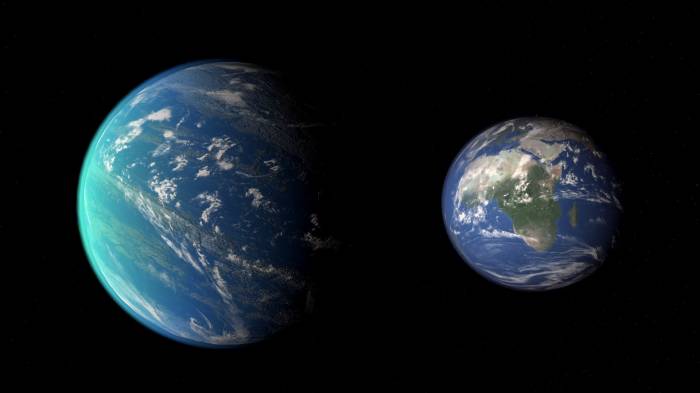
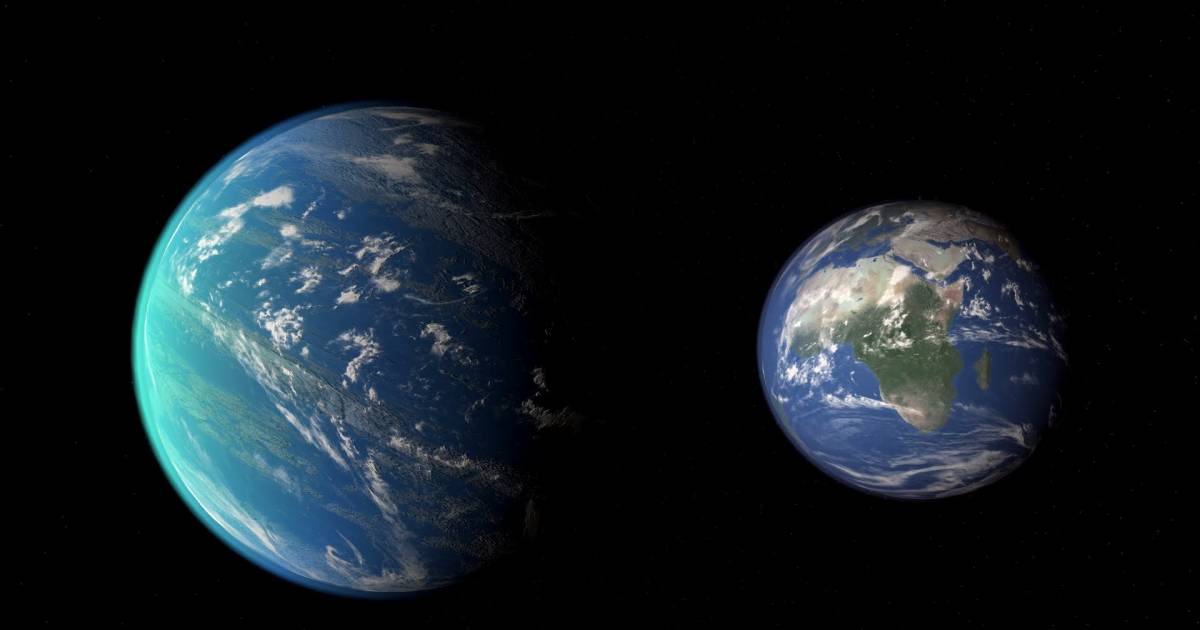
#2 Kepler-452b is similar to Earth.
Humanity would need to overcome a few obstacles to start inhabiting the new planet, because Ultraviolet rays and X-rays are blasted at the planet by its star (similar to our sun), meaning that any life already living there would somehow be need to be protected from radiation.
About a dozen habitable zone planets in the Earth-size ballpark have been discovered so far -- that is, 10 to 15 planets between one-half and twice the diameter of Earth, depending on how the habitable zone is defined and allowing for uncertainties about some of the planetary sizes.
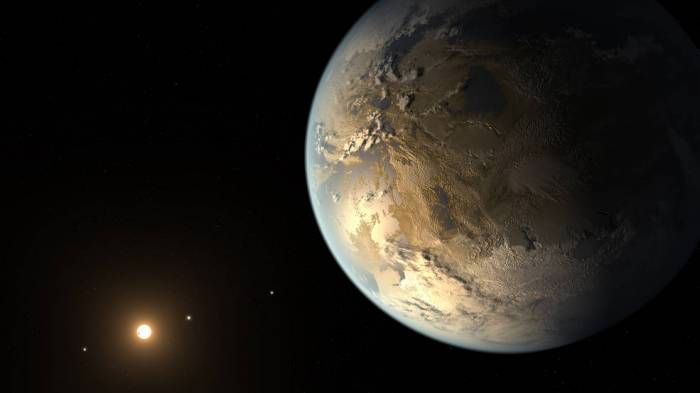
The new discovery, Kepler-452b, fires the planet hunter's imagination because it is the most similar to the Earth-sun system found yet: a planet at the right temperature within the habitable zone, and only about one-and-a-half times the diameter of Earth, circling a star very much like our own sun. The planet also has a good chance of being rocky, like Earth, its discoverers say.
Kepler-452b is more similar to Earth than any system previously discovered. And the timing is especially fitting: 2015 marks the 20th anniversary of the first exoplanet confirmed to be in orbit around a typical star.
#3 ESOcast 84: The New E-ELT Design Unveiled
As ESO signs a contract to begin building the European Extremely Large Telescope (E-ELT), this ESOcast takes a close look at this mammoth instrument and outlines some of the scientific advances we can expect from it. The ESOcast features amazing computer generated images of the E-ELT, showing in remarkable detail what the monster telescope will look like on top of Cerro Armazones in the Chilean Andes.
On 25 May 2016, ESO signed a contract with the ACe engineering consortium of Italy, to build the dome and main telescope structure of the E-ELT. With a main mirror 39 meters across, and a protective dome almost 80 meters high, this will be one of the biggest astronomical projects ever undertaken. The light-gathering power of the E-ELT will exceed that of all the professional telescopes currently operating, and its adaptive optics systems will permit it to produce images far sharper than any other telescope. These features will take it into a new era of observational astronomy, an era in which we will answer some of the most pressing questions about the Universe, and in which the E-ELT will undoubtedly surprise us with undreamed-of new discoveries.
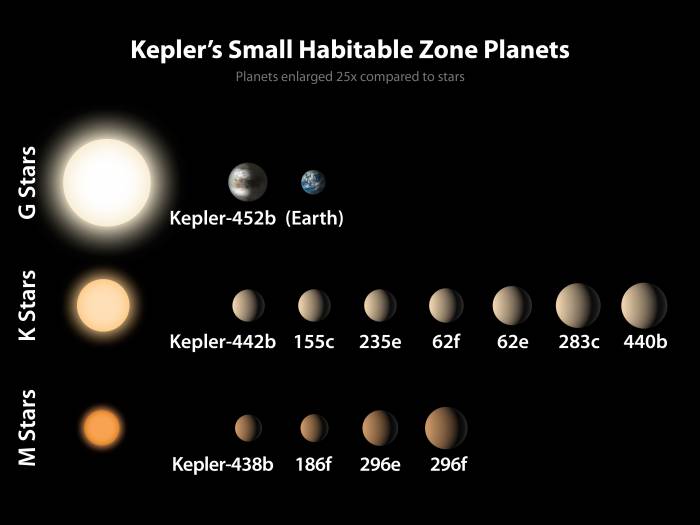
#4 Discovered Planets Comparison With Earth.
Of the 1,030 confirmed planets from Kepler, a dozen are less than twice the size of Earth and reside in the habitable zone of their host stars. In this diagram, the sizes of the exoplanets are represented by the size of each sphere. These are arranged by size from left to right, and by the type of star they orbit, from the M stars that are significantly cooler and smaller than the sun, to the K stars that are somewhat cooler and smaller than the sun, to the G stars that include the sun. The sizes of the planets are enlarged by 25 times compared to the stars. The Earth is shown for reference.
#5 M dwarfs are the most numerous stars," said Quintana. "The first signs of other life in the galaxy may well come from planets orbiting an M dwarf.