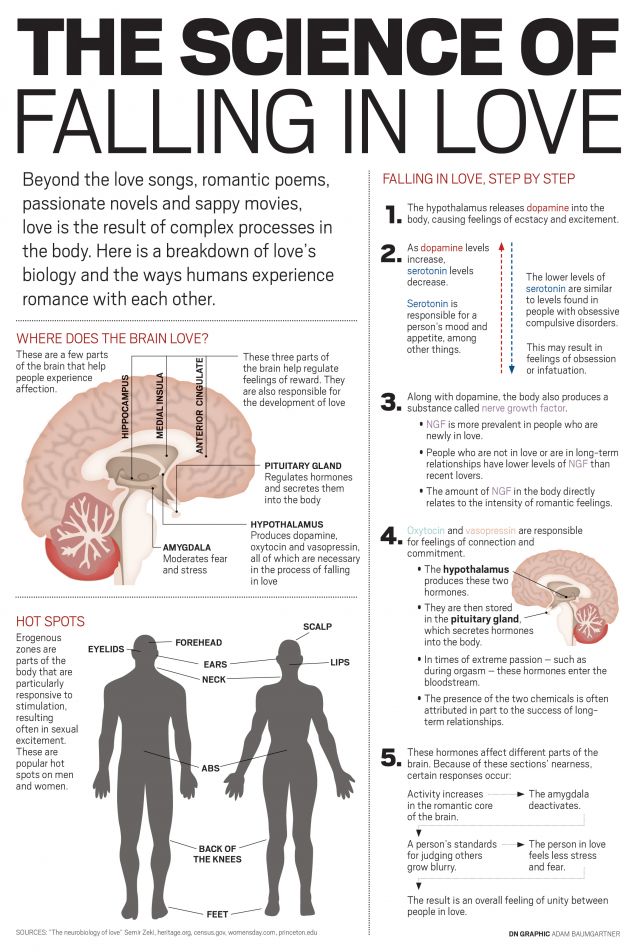
It's a feeling we're all familiar with. We've felt it, we've seen others experience it, and often tried to explain it. On that note, let's have a glance at the interesting science behind Love.
advertisement
#1 It's chemical !
It starts with Dopamine, the same hormone that helps you relish a tasty meal or any other intensely pleasurable experiences. This hormone enhances the flow of Testosterone and Estrogen, the primary sexual hormones in men and women, hence fueling strong attraction.

#2 There's more to that !!
After this step, the neurotransmitters norepinephrine and PEA (phenylethylamine) lead to focused attention. Individuals start to ‘zero-in' on the person they desire, and at the same time, often have a feeling of euphoria.

advertisement
#3 Adrenaline
The initial stages of falling for someone activates your stress response, increasing your blood levels of adrenalin and cortisol. This has the charming effect that when you unexpectedly bump into your new love, you start to sweat, your heart races and your mouth goes dry.
#4 Does love change the way you think?
A landmark experiment in Pisa, Italy showed that early love (the attraction phase) really changes the way you think.
Dr Donatella Marazziti, a psychiatrist at the University of Pisa advertised for twenty couples who'd been madly in love for less than six months. She wanted to see if the brain mechanisms that cause you to constantly think about your lover, were related to the brain mechanisms of Obsessive-Compulsive Disorder.

advertisement
#5 Butterflies?
By analysing blood samples from the lovers, Dr Marazitti discovered that serotonin levels of new lovers were equivalent to the low serotonin levels of Obsessive-Compulsive Disorder patients.
advertisement
#6 Obsession
Serotonin is also responsible for infatuation or obsession we might feel towards a romantic interest.
advertisement
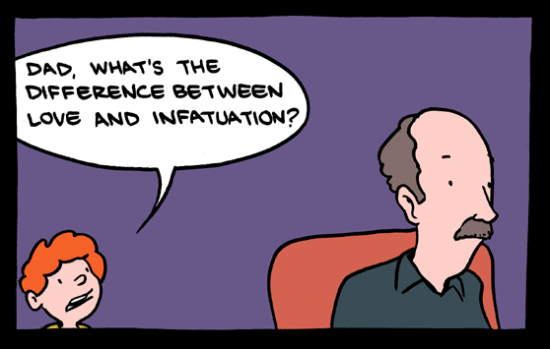
#7 So is infatuation the same thing?
Infatuation can be the precursor to love in some cases, but isn't necessarily the same thing. Let's just say, it's not as strong a chemical cocktail as love is.
advertisement
#8 Interesting !!
During the initial stages of love or lust, this reward system is stimulated through very simple means; a lover's touch, seeing their photograph, or even just thinking about this person can increase elevated mood and focused attention.

advertisement
#9 Does it really matter though?
Some people who have had bad experiences in love might have bitter feelings associated with it. But, for those people who still are madly in love with each other, the Science behind it might be irrelevant.
advertisement
#10 Still serious?
Here's an infographic which explains everything in detail.