Thirty percent of patients who take the SAGE Test discover cognitive problems they weren’t aware of.
This Is A Do-It-Yourself Alzheimer’s Test Called SAGE - It Can Help Reveal Early Signs Of The Disease
By
Editorial Staff in
Puzzle
On 21st March 2016
advertisement
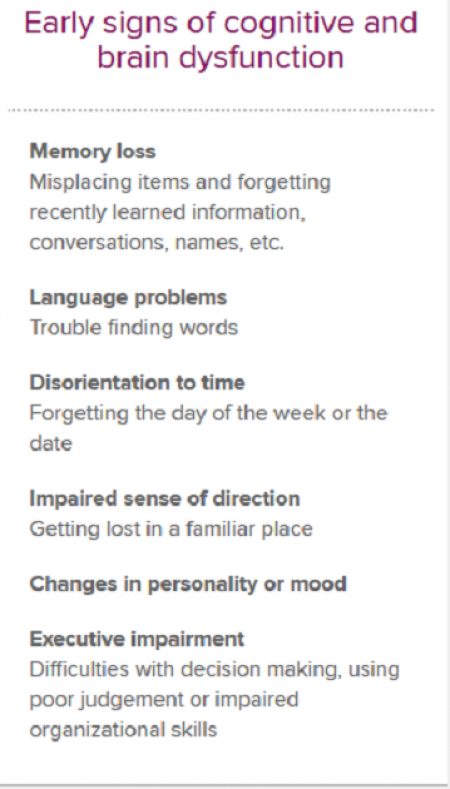
Early Signs of Cognitive and Brain Dysfunction
If You Answered YES to ANY of these, please grab a piece of paper and pencil and proceed further.
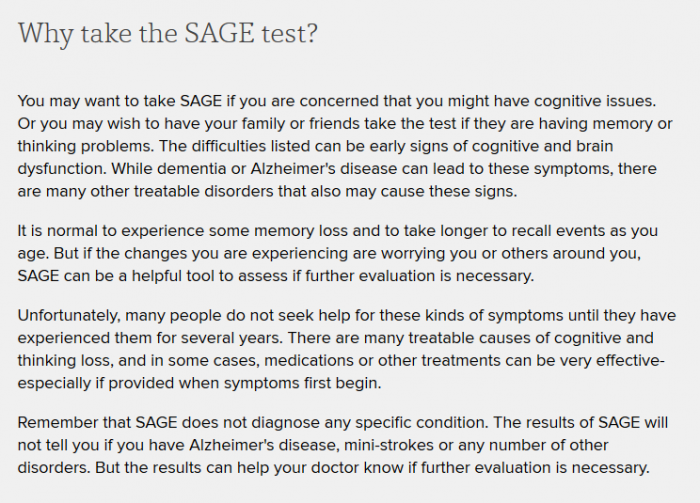
Why take the SAGE Test?
You may want to take SAGE if you are concerned that you might have cognitive issues. Or you may wish to have your family or friends take the test if they are having memory or thinking problems. The difficulties listed can be early signs of cognitive and brain dysfunction. While dementia or Alzheimer's disease can lead to these symptoms, there are many other treatable disorders that also may cause these signs.
It is normal to experience some memory loss and to take longer to recall events as you age. But if the changes you are experiencing are worrying you or others around you, SAGE can be a helpful tool to assess if further evaluation is necessary.
Unfortunately, many people do not seek help for these kinds of symptoms until they have experienced them for several years. There are many treatable causes of cognitive and thinking loss, and in some cases, medications or other treatments can be very effective-especially if provided when symptoms first begin.
Remember that SAGE does not diagnose any specific condition. The results of SAGE will not tell you if you have Alzheimer's disease, mini-strokes or any number of other disorders. But the results can help your doctor know if further evaluation is necessary.
advertisement
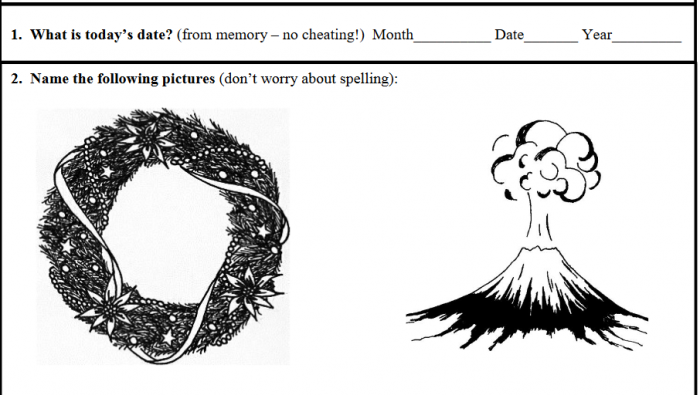
#1 Lets Begin with Today's Date
Once you have written down Today's date, Name the 2 Pictures you see (Don't worry about spelling):
How Well Are You Thinking? Answer These Questions:
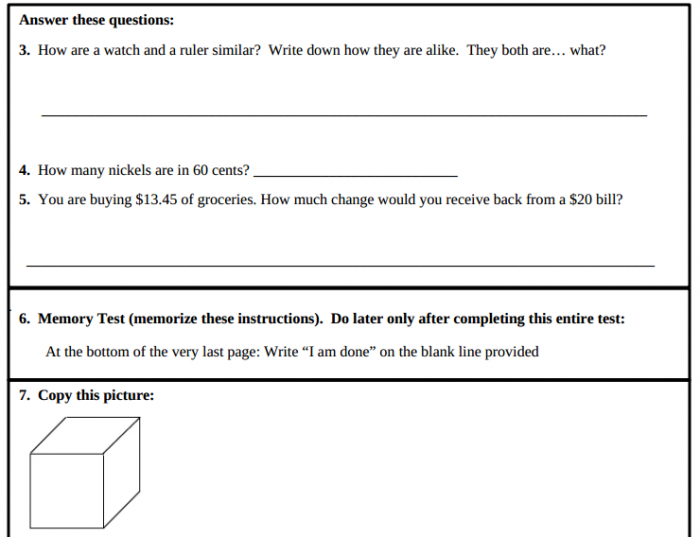
How are a watch and a ruler similar? Write down how they are alike. They both are... what?
How many nickels are in 60 cents? ___________________________
You are buying $13.45 of groceries. How much change would you receive back from a $20 bill?
6. Memory Test (memorize these instructions). Do later only after completing this entire test:
At the bottom of the very last page: Write "I am done" on the blank line provided.
7. Copy this picture you see...
advertisement
Last Question ...
Have you finished? __________________________________

advertisement
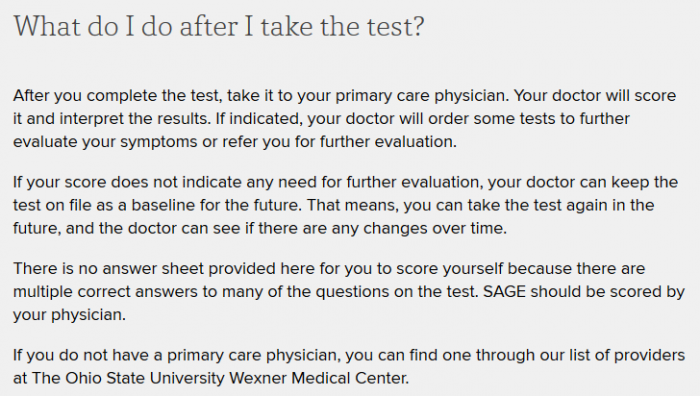
What do I do after I take the test?
After you complete the test, take it to your primary care physician. Your doctor will score it and interpret the results. If indicated, your doctor will order some tests to further evaluate your symptoms or refer you for further evaluation.
If your score does not indicate any need for further evaluation, your doctor can keep the test on file as a baseline for the future. That means, you can take the test again in the future, and the doctor can see if there are any changes over time.
There is no answer sheet provided here for you to score yourself because there are multiple correct answers to many of the questions on the test. SAGE should be scored by your physician.
advertisement
Please be sure to Read the Disclaimer Regarding the SAGE Test
The Instrument cannot substitute for medical advice, diagnosis or treatment by a trained medical professional. Diagnosis and treatment of human illness should be based collectively on medical history, including family medical history, and a physical examination along with a doctor's professional judgment and review of all test results. The material contained in the Instrument does not contain standards that are meant to be applied rigidly and followed in virtually all cases. Physicians' judgment must remain central to the selection of diagnostic tests and therapy options of a specific patient's medical condition.
Permission is granted to use and redistribute this Instrument for individual clinical or noncommercial educational use only, provided that The Ohio State University and authors of the Instrument are acknowledged in any publications reporting its use, and the name of The Ohio State University or any of its officers, employees, students or board members is not used in any advertising or publicity pertaining to the use or distribution of the Instrument without specific, written prior authorization. Permission to modify or otherwise create derivative works of the Instrument, or redistribute any derivatives of the Instrument is not granted. Those desiring to utilize the instrument for research purposes, incorporate the Instrument into commercial products or use the Instrument for promotional purposes should contact, Technology Licensing and Commercialization, The Ohio State University, 1960 Kenny Road, Columbus, Ohio, 43210-1063, (614) 292-1315.
The Instrument is provided AS IS, WITHOUT REPRESENTATION AS TO ITS FITNESS FOR ANY PURPOSE, AND WITHOUT WARRANTY OF ANY KIND, EITHER EXPRESS OR IMPLIED, INCLUDING WITHOUT LIMITATION THE IMPLIED WARRANTIES OF MERCHANTABILITY AND FITNESS FOR A PARTICULAR PURPOSE. No guarantees are made with respect to accuracy, completeness, errors, or omissions of content. The Ohio State University has no obligation to provide support, updates, enhancements, or other modifications. In no event will the Ohio State University be liable for any decision made or action taken in reliance upon the information provided through the Instrument. THE OHIO STATE UNIVERSITY SHALL NOT BE LIABLE FOR ANY COMPENSATORY OR NON-COMPENSATORY DAMAGES, INCLUDING BUT NOT LIMITED TO SPECIAL, INDIRECT, INCIDENTAL, OR CONSEQUENTIAL DAMAGES, WITH RESPECT TO ANY CLAIM ARISING OUT OF OR IN CONNECTION WITH THE USE OF THE INSTRUMENT, EVEN IF IT HAS BEEN OR IS HEREAFTER ADVISED OF THE POSSIBILITY OF SUCH DAMAGES.