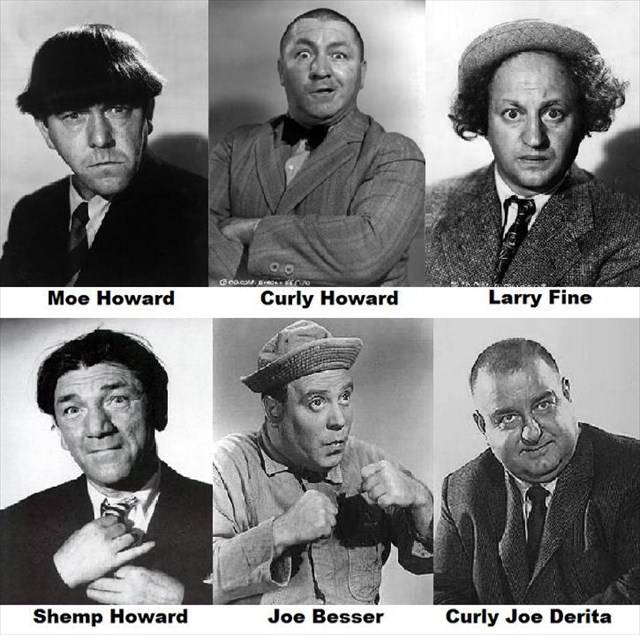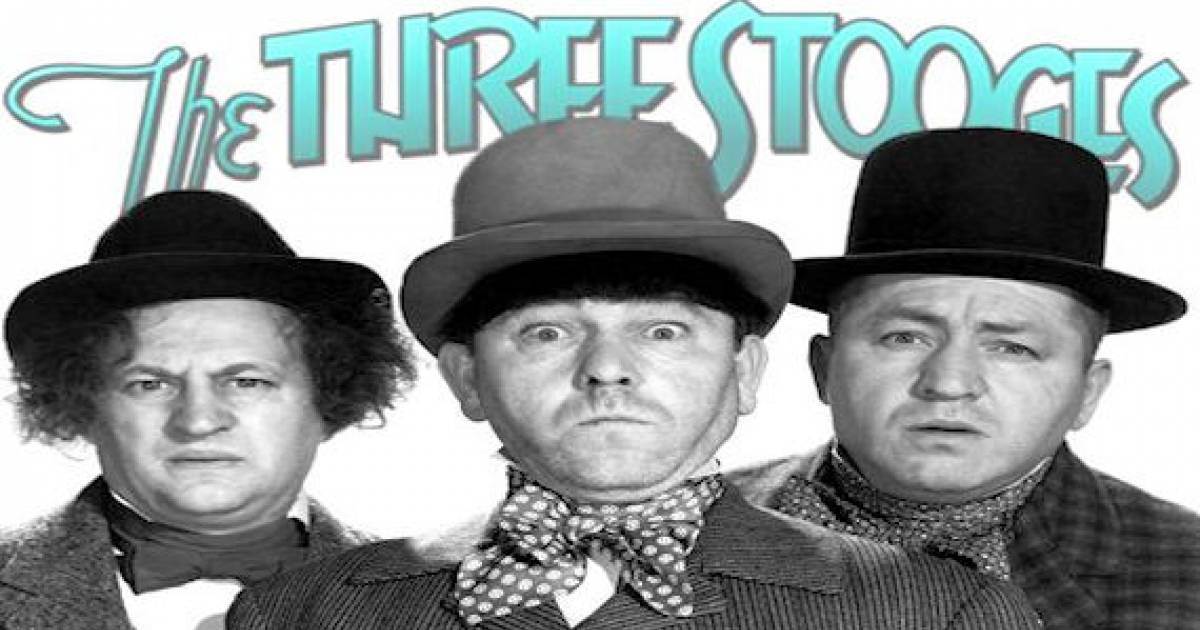
They were one of the most iconic comedy teams in history, helping to shape early Hollywood along with the likes of The Marx Brothers, Laurel & Hardy, and Abbot & Costello. The Three Stooges are known primarily for their slapstick style of humor, but much has been forgotten about their contribution to society during the USA’s darkest times. The following facts not only focus on this historical aspect but also the trials and tribulations these men endured in their professional and personal lives while still trying to make people laugh.
advertisement
#1 The Great Depression
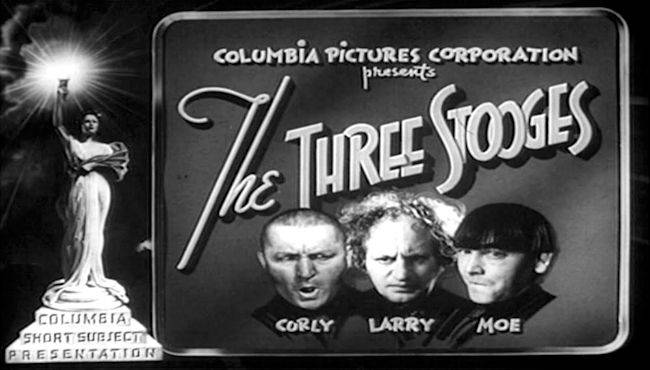
During the darkest period in America's history, the Great Depression, The Three Stooges were signed by Columbia Pictures to star in a series of slapstick short films. As the country and the world were falling deeper into despair, the Stooges forced a smile in the hopeless with their dim-witted antics, their relating to the common man. People still found a nickel to go to the movies and they were treated to a short cartoon or film before the main feature. The silly and nonsensical antics of the Three Stooges was just what people needed to help them escape. Often mimicking the wealthy and wee-to-do, they would slap a pie in the face of those who were pretentious, which the audiences loved. The vaudeville act was only paid a total of $600 for the entire year no matter how much they worked.
#2 Curly Joe VS Moe Howards Heirs
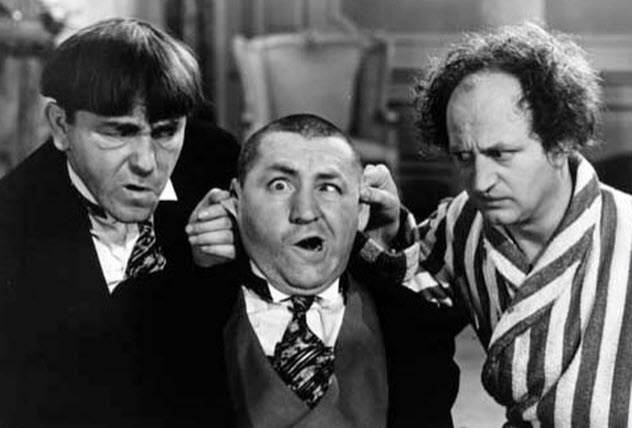
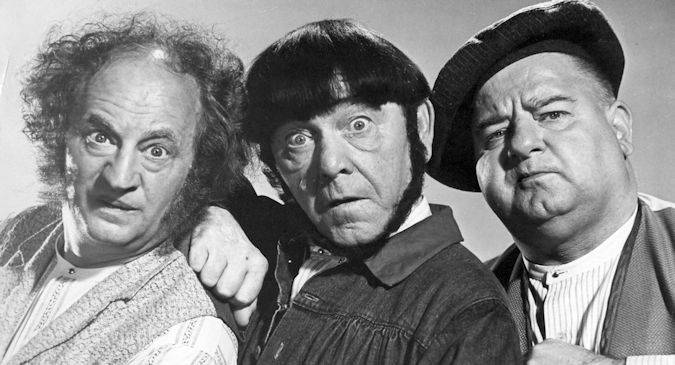
The last Stooge was Joe DeRita, who was signed on in 1958 and lasted until 1968, going by the name of Curly Joe because of his resemblance to original Stooge, Curly Howard. While an ailing DeRita lay on his deathbed in 1993, his share of the merchandising profits he had continuously received for over 25 years suddenly dropped. His wife and the family of Larry Fine sued the estate of Moe Howard over the missing $5 million they were owed. The families of the trio began a bitter and public feud, with DeRita and Fine seeking a court injunction to freeze all funds until Moe's heirs accounted for the missing profits. In a funny turn of events, Bela Lugosi Jr., son of the famed vampire, was the attorney for the plaintiffs and he won. Ultimately, Moe's grandson and daughter were found guilty of a breach of contract and ordered to pay $2.6 million.
advertisement
#3 Unceremonious Exit
Columbia basically said, "Here's the door and don't let it hit you on the way out" They released the comedy troupe from their contract in 1957 and the Stooges were blindsided. After 24 years of making low-budget shorts for low income in comparison to the millions of dollars their comedies reaped for the studio, there was not so much as a "farewell" or "thank you." A few weeks later when Moe Howard went to the studio to pick up his belongings, he was rejected and turned away at the studio gates. They never told them the reason for the release but Columbia Pictures had enough film in their vaults to produce 2 years worth of Three Stooges shorts, which they did.
#4 Manipulation And Greed
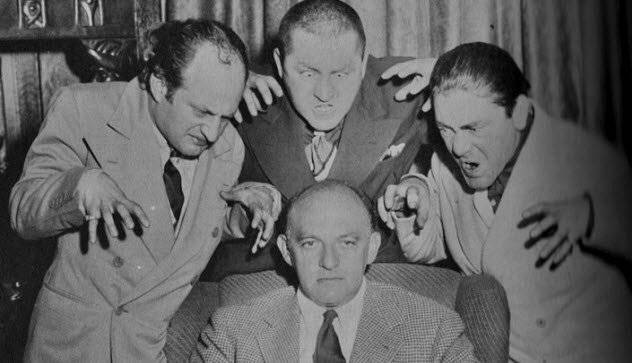
Harry Cohn was well known in Hollywood for making Columbia Pictures the powerhouse studio of the day. He pushed out one enormous hit movie after another and was responsible for the Three Stooges. However, he was also known to be greedy and mean-spirited, often pushing his talent to the extremes. Even after Curly suffered multiple strokes, Cohn forced the debilitated comic to continue working with no regard for his well-being. He enjoyed taking advantage of the Stooges financially, keeping them underpaid throughout their entire careers. When the Stooges shorts became television favorites, he kept them out of the negotiations and they never received any payment for the new found audience even though Columbia made millions.
advertisement
#5 Unnecessary Violence
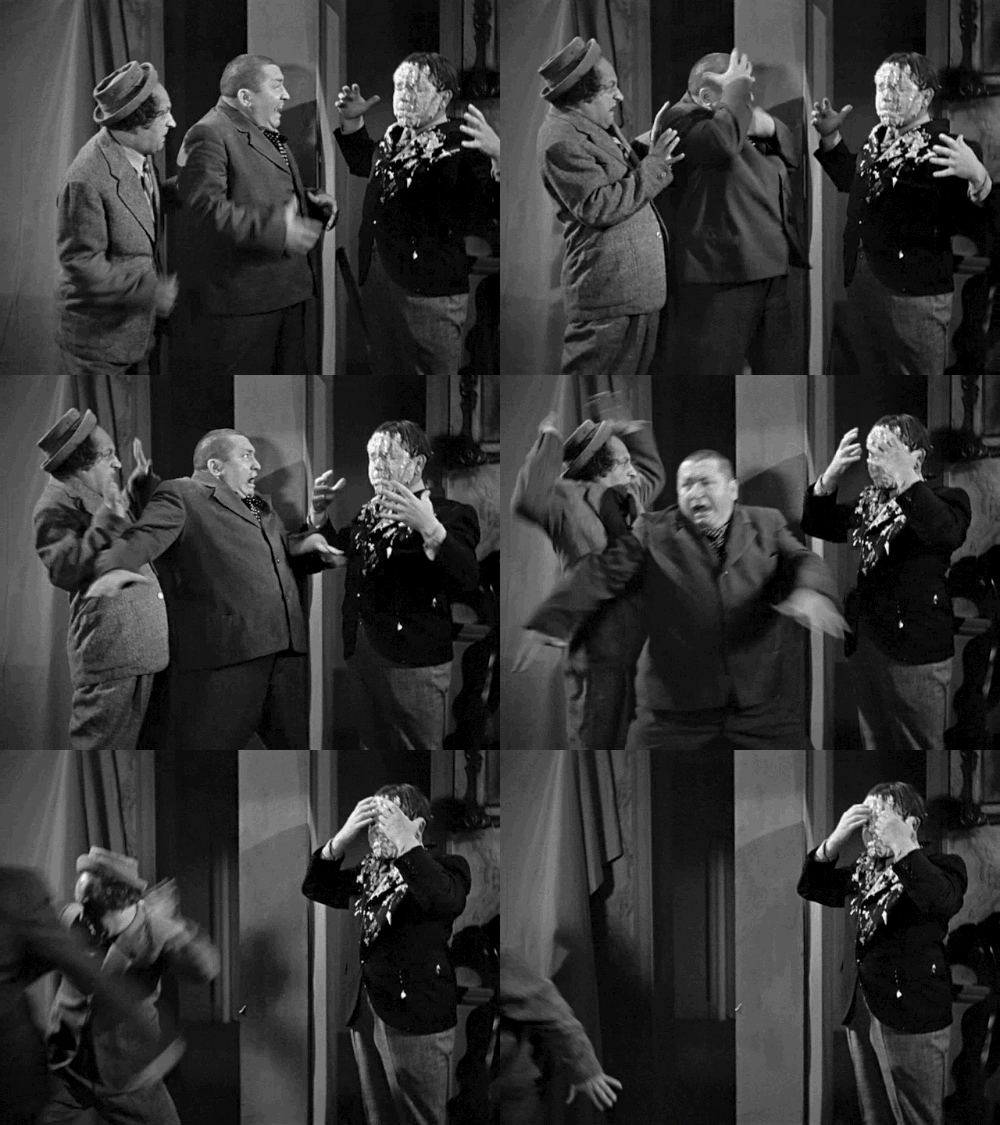
Although The Three Stooges will forever be remembered for their slapstick humor, few know of the true violence that actually took place on set. In fact, the director making the two-reeler at the time determined the violence quota per film and he was backed by studio head, Harry Cohn. They believed that the more violence involved, the more the audience thought it was funny. At Chon's insistence, mallets, scissors, and saws were frequently incorporated to heighten the measure of violence in a scene. These selfish and brutal demands were often met with physical injuries such as sprained ankles, fractured ribs, broken bones, and cracked teeth. According to Moe Howard, who broke his nose during a take, such injuries were commonplace on set. There most dangerous scene can be found on YouTube at https://youtu.be/jocRd-aajW0
advertisement
#6 Hitler vs. The Stooges
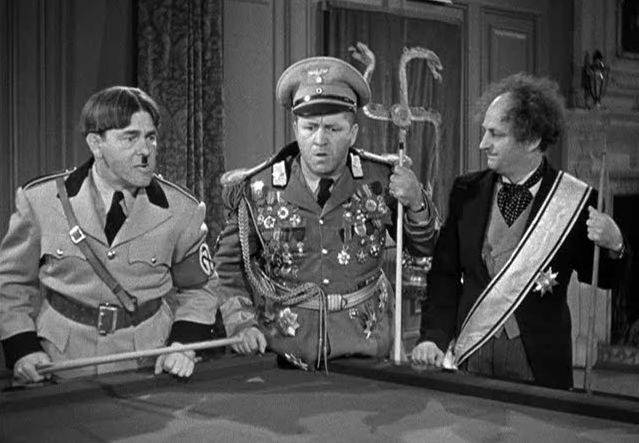
During the 1930s, the Nazis and Hitler had a big role in Hollywood. They often screened movies and rejected them because of the content. Studios like MGM, Warner Brothers, and 20th Century Fox, were being financed by the Germans and were under their influence. Unfortunately for Nazi Germany, The Three Stooges were among the very first in cinematic history to expose Hitler for who he was. Columbia was not under the Nazi control and had a blast satirizing Hitler, often making The Three Stooges the foil for the dictator in their short films. Eventually, the Stooges, along with Charlie Chaplin and Jack Benny, ended up on Hitler's hit list.
advertisement
#7 Food, Booze, And Women
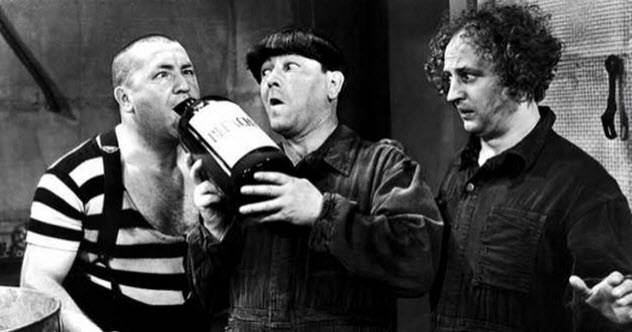
Curly was undoubtedly the most popular Stooge. His fame also led him to depression and he suffered from esteem issues. He could not manage his income and often spent days in hiding. He drank heavily, blowing nearly all his income on wine, cars, dogs, and houses but his biggest weakness was women. Given his immense insecurity, he unknowingly allowed himself to be taken advantage of in return for companionship. He got married in 1945 to a woman who already had a son. He spent a fortune on jewelry and fur coats in an attempt to keep her happy, but nothing worked. They divorced nine months later in a very public and bitter legal battle. Soon after, Curly's health rapidly declined as he fell into his old habits. His obesity worsened as did his hypertension, leading to retinal hemorrhages and ultimately a stroke that eventually left him in a wheelchair. More on that later.
advertisement
#8 Larry Fine
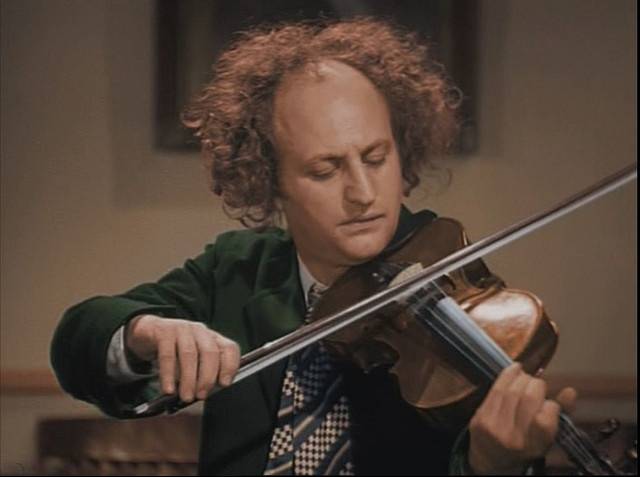
Larry Fine was complicated. Many don't know that he was a classically trained violinist. And like Curly, he had a serious gambling addiction as well as reckless spending habits that nearly forced him into bankruptcy following his termination from Columbia Pictures in 1957. His entire life was marred by sadness even though he managed to make so many people laugh and smile. As a child, he was in and out of hospitals due to acidic burns to his arm that caused muscle damage. Then in 1961, his son was killed in a car accident. Six years later, his beloved wife, Mabel, had a heart attack and died while the Stooges were on tour. He suffered a massive stroke three years later, ending his career for good and leaving him confined to a wheelchair in a nursing home, all alone, where he died in 1975.
advertisement
#9 The Murder Of The Stooges’ Founder
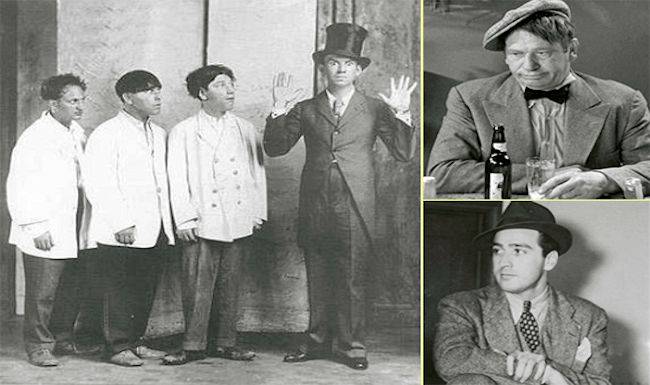
Ted Healy, founder of The Three Stooges and arguably the most influential comedian during the 1920s and '30s, has been regarded by historians as a brilliant improv comic with a volatile Jekyll-and-Hyde personality. He also managed several acts during the time and was an expert at talent searching, and discovered the stooges, not known by that name at the time, while searching various vaudeville venues.
On the night of December 20, 1937, Healy drunkenly staggered into Hollywood nightclub Trocadero where he was savagely beaten in the parking lot by movie star Wallace Beery and New York mobster Lucky Luciano's top henchman, Pat DiCicco. The last person he spoke to was Stooge, Shemp, whom he phoned to tell him who beat him. He fell into a coma and died the next morning. It has been said that movie mogul Louis B. Mayer covered up the murder to protect his biggest star, Wallace Beery. But Shemp knew the truth.
advertisement
#10 Curly’s Last Years
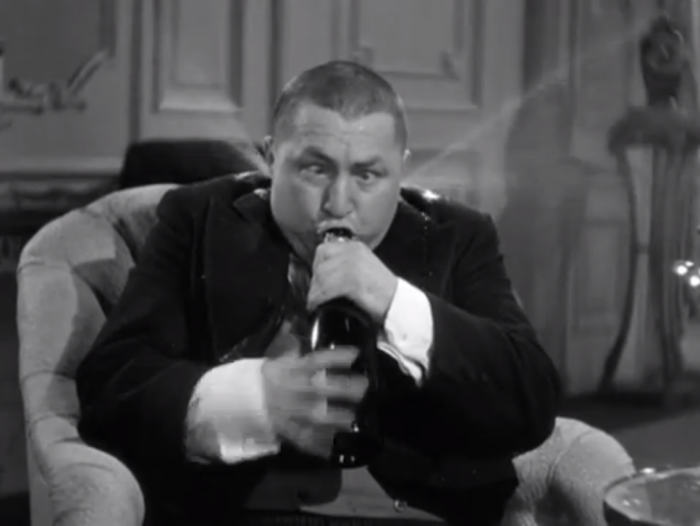
Curly's life was by far the most tragic of all the Stooges. Betrayed by those he had loved and trusted in addition to constant binges to mask his pain, his last years were plagued by a succession of strokes that left him paralyzed and confined to a wheelchair. At age 47, Curly was placed in a nursing home due to his declining health and the inability of his family to take care of his needs. Due to mental deterioration, Curly became problematic for the nursing staff and his family was advised to commit him to a mental hospital.
advertisement
#11 Curly Died In A Sanitarium All Alone
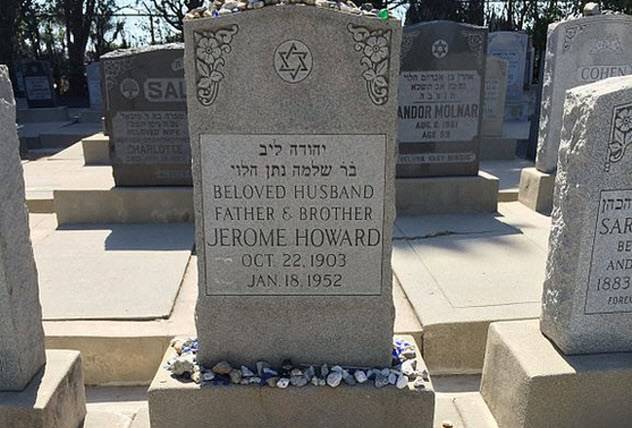
Moe adamantly refused the physicians' recommendations, ultimately sending his brother to the Baldy View Sanitarium in San Gabriel, California. This was Curly's final living facility, where he died bedridden and alone in January 1952 at age 48.
advertisement
#12 There Were Six Stooges Altogether
The Three Stooges have always had Moe and Larry to deliver big laughs, but the third Stooge was different from time to time after Curly became ill. The third stooge? In truth, he was a rotating numbskull played by five actors over 50 years. The third Stooge was, at varying times, Shemp, Curly, Joe, Curly Joe, and for a while after Shemp's death, the "Fake Shemp" which was a mix of old Shemp footage and another actor's back and side. Shemp was the original third stooge, and he, Curly, and Moe were brothers, the Horwitz's. He left the group and was later replaced by brother Curly in 1933. When Curly suffered a debilitating stroke in 1946, Shemp rejoined the act. After Shemp's death in 1955, he was replaced by bald-headed comedian Joe Besser, after the use of stuntman Joe Palma to record several "Shemp" shorts after his death. Eventually, Joe "Curly-Joe" DeRita would replace him. After Larry suffered a serious stroke in 1970 he was unable to continue performing. Emil Sitka, a longtime actor in Stooge comedies, was contracted to replace Larry, but no film was ever made with him in the role, although publicity photographs exist of him with his hair combed similarly to Larry's posing with Moe and Curly-Joe. However, Larry's paralyzing stroke in 1970 effectively marked the end of the act.