For most of us, social media is a central part of daily life. Yet the relative newness of the phenomenon means that its effects on our lives and well-being are still largely a mystery. Social media has reshaped the world in which we live irrevocably. The population of Facebook is far larger than the population of America, and national identity may even be less relevant than such virtual social groups. In our capitalist world, companies are desperate to understand what social media means for their sales and engagement with customers. Keen to move with the times and stay competitive, major corporations have invested in research and strategies to leverage the power and importance of social media and online data. Others have been concerned by the rapid, unmanaged and unmediated infiltration of social media into our private lives and most personal moments. Although to be honest, relatively little is genuinely understood about the way the human psyche works, behavioral scientists have launched themselves into studying how social media affects us, both individually, and societally. Studies have cropped up to support both sides of the social media coin. Some suggest that as advertised by the name, social media benefits our relationships and well-being by connecting us better with the world and the people around us. But it is interesting that the majority of the research and public perception are both to the contrary. Yet, we keep using social platforms. If you’ve ever been curious about the nature of this central yet untested aspect of modern life, read on.

Ways You May Not Realize Social Media Is Affecting You.
You Talk Less In Real Life
A recent global study conducted by Kaspersky Lab indicates that social media users are interacting less face-to-face than in the past, because of their newfound ability to constantly communicate and stay in touch online. In the study, researchers found that about one-third of people communicate less with their parents (31%), partners (23%), children (33%), and friends (35%) because they can simply follow them on social media. This may be doing more harm than good, in a world where editing one’s life to make it appear perfect is more appealing can replace actually living it. Under certain circumstances, the study showed, people, perceive their online communication as “hyper-personal”, meaning that we misread and over-interpret social media messages. Dr. Astrid Carolus, Media Psychologist at the University of Würzburg says: “We feel especially close, we blind out the rather negative, focus on the possible positive intentions behind a message, and over-interpret.” The study was conducted among 16,750 participants, split evenly between men and women, over 16 years old and from 18 countries.

It Both Boosts And Lowers Your Self-Esteem
A study by Dr. Patti Valkenburg, Dr. Jochen Peter, and Alexander Schouten (MA) investigate the effects of networking sites on the self-esteem and well-being of young people. The study revealed that the frequency with which adolescents used the site had an indirect effect on their social self-esteem and well-being. Frequent use of networking on the sites increased the number of relationships formed, the frequency with which participants received feedback on their online profiles, and the (positive or negative) tone of this feedback. According to this study, positive feedback on their profiles enhanced adolescent’s social self-esteem and well-being, whereas negative feedback decreased their sense of self-esteem and well-being. In other words, social media was found to have a magnifying effect on individuals’ natural self-esteem level, whether that be high or low, as well as increasing reliance on external feedback. The survey was conducted on a test group of 881 adolescent individuals between 10 and 19, who had an online profile on a Dutch networking site.

Your Social Media Might Define You More Than Your Nationality
Statisticians have shown that Facebook’s population is almost 4 times greater than the USA’s. Which means that the population of this new country might be even more impactful on world events than America. Is Mark Zuckerberg the real President? The stats show that the population of the U.S. is nearing 319 million, compared with Facebook’s 1.59 billion users (and counting). The population of this virtual country is comprised of more kids than you might think too. Despite the legal terms and conditions that prohibit anyone under the age of 13 from using Facebook, over 5 million Facebook users are under the age of 10. According to Forbes, 95% of parents are aware that their kids use Facebook while 78% helped to create the account. Another interesting fact about America’s social media use is the revelation by one study that Democrats follow more Twitter accounts than Republicans. The study indicated that Democrats follow 78 Twitter accounts on average, compared with Republicans, who follow about 52 normally. So if you want more followers, it appears it’s better to be a leftie.

Your Social Media Is Anti-Social
Facebook and Instagram help us to stay connected with family and friends, but spending too much time on social media could actually make you feel more alone, a new study suggests. According to psychologists at the University of Pittsburgh, the more time you spend on social media, the more likely they are to feel socially isolated. Too much time on sites like Twitter, Snapchat, Reddit, and Tumblr “may elicit feelings of envy and the distorted belief that others lead happier and more successful lives”, says the study published in the American Journal of Preventive Medicine. The author, Dr. Elizabeth Miller, explains: “We do not yet know which came first, the social media use or the perceived social isolation.” Why is it important to know that social media is actually pretty antisocial? Another psychologist involved in the study, Brian Primack says: “This is an important issue to study because mental health problems and social isolation are at epidemic levels among young adults”. Looks like checking your phone can be self-destructive. Brian says: “We are inherently social creatures, but modern life tends to compartmentalize us instead of bringing us together.”

Facebook Users Might Feel Happier Though
Although there is a substantial body of evidence that suggests the contrary, social media use is a complex picture, and other studies have suggested that social media does, in fact, succeed in its intention of making us better socially connected people. A study by Sebastian Valenzuela and Kerk Klee shows that Facebook can make us happier and increase the sense of social trust and engagement among users, especially physically isolated ones, due to illness or geographical seclusion. Given that our brains are wired to connect, it seems logical to expect that social networks, by enabling sharing, could cause a self-reinforcing sense of psychological satisfaction.The study used data from a random web survey of 2,603 college students across Texas and revealed positive relationships between intensity of Facebook use and students’ life satisfaction, social trust, civic engagement, and political participation. However, the association between Facebook and increased social capital (well being) was small.
A Third Of Us Have Experienced Cyberbullying
In a McAfee poll of 11- to 17-year-olds in 2014, 35% reported that they have experienced cyberbullying. Jean-Baptiste Pingault, lecturer in developmental psychopathology at University College London, says that cyberbullying has certain distinctive features: “With classical bullying you have safe spaces [places where the bullies can’t go, such as home], but with cyberbullying, technology is often on all the time so you are constantly exposed to the risk.” He notes, too, that cyberbullying makes it possible to be “bullied by people you barely know”. The American Psychological Association defines bullying as aggressive behavior by an individual that causes discomfort to another. Cyberbullying ranges from direct threatening and unpleasant emails to anonymous activities such as trolling. While direct unpleasant emails or messages are the most straightforward form of cyberbullying, they are probably the least prevalent in that only 13% of surveyed youngsters admitted to receiving threatening or aggressive messages. Pew research found that 15% of teens were disturbed and uncomfortable about having had their private message forwarded or posted in a public forum and that nearly 39% of teens on social networks have been cyberbullied in some way. And if you thought Trolls lived under a bridge, 28% of America lives there, it seems.
You Have More, But Not Better, Information
Unsurprisingly, social media has been shown to provide users with access to more information from developing events around the world, in real time. But as good old Adam and Eve discovered when they ate the apple of knowledge, ignorance (or innocence) can be bliss. In a “false news” environment, social media can be an echo chamber that reflects your own views back to you, hindering the diversification of viewpoints once stimulated by monolithic news sources. Since the way we consume news has changed, we are more vulnerable to unregulated and irresponsible news sources warping the facts. Meanwhile, many people are traumatized by the availability of video recordings and photographs of violent acts being committed. A study by Dr. Pam Ramsden at the University of Bradford suggested that some social media users develop post-traumatic stress disorder symptoms when they view disturbing content. Of 189 people in the study, about a fifth developed PTSD symptoms after viewing the content. This is concerning, especially considering the prevalence of videos circulating online that reveal violence by police towards people of color. Symptoms can be depression, sleeplessness, apathy, and avoidance. As a result, many have emphasized the importance of self-care overviewing every disturbing video as a way of setting boundaries, rather than ignoring worrying social problems, such as racism.
Posting About Boo Can Make You Closer But Also Shows Insecurity
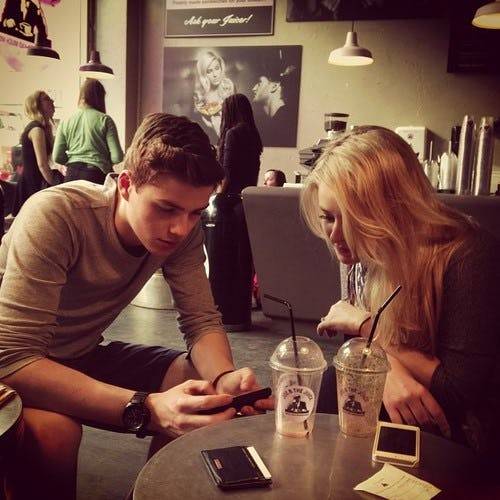
Two studies in the past few years have found that couples are happier when they are present in each other’s social media lives. “For instance, Saslow and colleagues (2013) found that people whose Facebook feeds and profile pictures included their significant other reported feeling more satisfied in and committed to their relationships. And another relevant study by Castaneda, Wendle, and Crockett (2015) found that people who frequently interacted with their partners over Facebook tended to feel more closeness in their relationships.” This may not always ring true, though. The more you post about your significant other, the more insecure you may be in your relationship. Think of it as a keeping up appearances: you want the world to think you’re madly in love because that’s what the world wants to see. So conversely to the above research, a 2014 study by Lydia F. Emery found that the more a partner posted about their relationship, the more insecure they were about said relationship. “As a general rule of thumb,” Psychiatrist Dr. Miriam Korn tells us, “it’s a good idea to ask your partner for clarification if there’s something you’re upset by or confused about.”

Social Media Can Break Up Your New Relationship(!)
A recent study by Clayton, Nagurney, & Smith (2013) explores whether the use of Facebook can result in breakups. The researchers hypothesized that excessive Facebook use by one partner may be detrimental to a relationship, resulting in “Facebook-related conflict” like trust issues and potential infidelity. The study investigated a sample of 205 Facebook users, 144 of whom currently in a romantic relationship. Consistent with previous research, it was found that there was a correlation between Facebook use and Facebook-related conflict and even breakup. This was only the case though if you have been with your partner less than 3 years. The relationships of those who had been together longer were unaffected by the use of social media. So Facebook is only a problem if you are in a new relationship. But if you’re posting online a whole lot while you’re in that first flush of love, it can spell doom for the relationship!
Social Media Is Gratifying
Like chocolate and winning money, a lot of likes on your photos on social networks makes you feel really good for a brief time. The study, published in Psychological Science, a journal of the Association for Psychological Science, proved this by essentially tricking teenagers! Scanning teenagers’ brains, while they used social media, saw the reward centers light up when they saw high numbers of likes, which were in reality assigned at random by the researchers. The 32 subjects in the study were aged between 13 and 18. “When the teens saw their own photos with a large number of likes, we saw activity across a wide variety of regions in the brain,” said lead author of the study, Lauren Sherman, who is a researcher in the brain mapping center and the UCLA branch of the Children’s Digital Media Center, Los Angeles. A brain region that is especially active when you look at social media is a part of the striatum called the nucleus accumbens. This reward circuitry is particularly sensitive during adolescence. So social media might be especially exciting and addictive in your youth.

Social Media Is Bad For Your Mental Health
Especially if you use it a lot and compare yourself with other people. You are three times more likely to be depressed if you use social media heavily, a large-scale University of Pittsburgh study showed. Another study of young adults in Michigan showed that recent Facebook use worsens “how people feel moment to moment and how satisfied they are with their lives.” Yet another study at Lancaster University analyzed 30 different studies on the relationship between Facebook and mental health. David Baker, a trainee clinical psychologist, found that the problem is when you compare yourself with other people through the technology. According to David, people who compared themselves with others online were more likely to feel depressed, as were people who ruminated on what they’d seen. “If you spend a lot of time thinking about what you’ve seen while you’re online, that might be more likely to lead to depression.” Researchers at the Centre for Addictions and Mental Health analyzed data from over 10,000 adolescents. This indicated that young people who use social media more than two hours per day are much more likely to rate their mental health as “fair” or “poor” compared with occasional users.
You Are More Likely To Feel Lonely If You Use Social Media
Young people who spend a lot of time on social media — websites designed to bring people together — seem to be more isolated, new research suggests. Ironically, the researchers found that the heaviest users of social media had about twice the odds of feeling socially isolated compared to their less “web-connected” friends. The findings “remind us that social media is not a panacea for people who feel socially isolated,” said study lead author Dr. Brian Primack. Brian also believes social media to be anti-social and is director of the University of Pittsburgh’s Center for Research on Media, Technology, and Health. Those who use social media more often — either in terms of the number of times they used them or in the total amount of time spent on them — are more likely to report feeling isolated from other people, researchers found. “Compared with those in the lowest quarter for frequently checking social media, people in the top quarter were about three times as likely to have increased social isolation,” says Brian.