

Is it just people on the autism spectrum who stim?
advertisement
What Is Stimming and Why Is It Common In Autistic People?
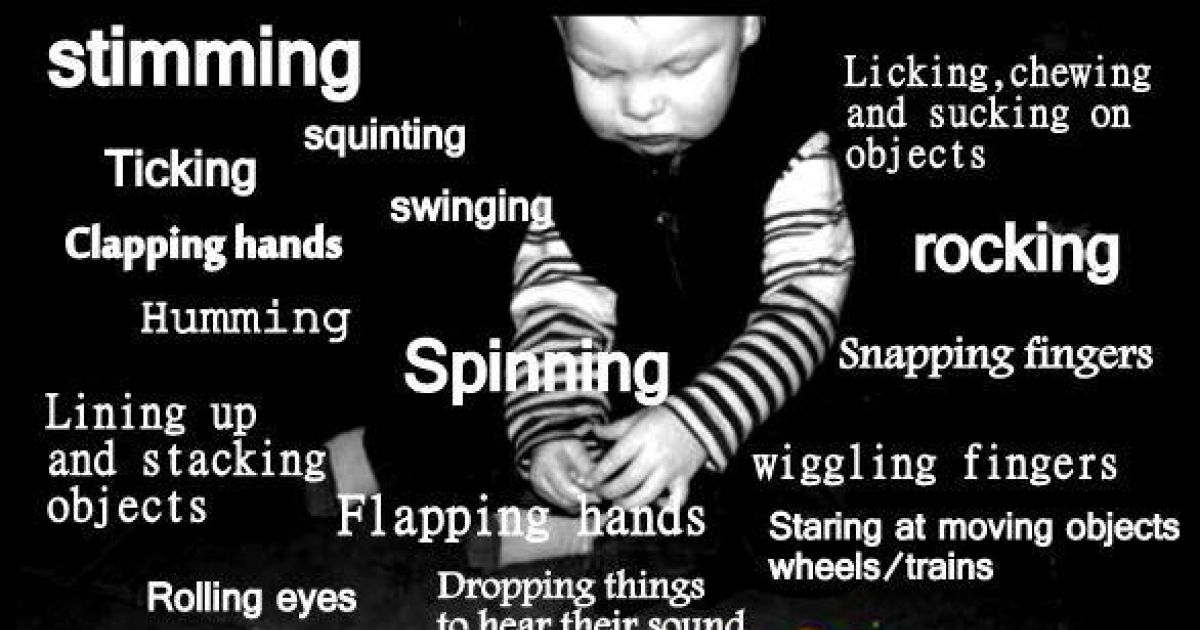
The term "stimming" is short for self-stimulatory behavior, sometimes also called "stereotypic" behavior. In a person with autism, stimming usually refers to specific behaviors such as flapping, rocking, spinning, or repetition of words and phrases.
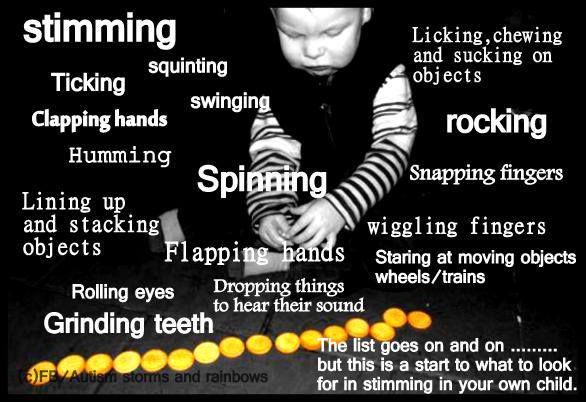
Stimming symptoms include: gazing at a wall or fixating on an object; repetitive body movements such as rocking back and forth; repetitive movement of objects, such as turning on and off light switches.

advertisement
Stimming is almost always a symptom of autism, but it's important to note that stimming is also a part of most people's behavior patterns.
If you've ever tapped your pencil, bitten your nails, twirled your hair, or paced, you've engaged in stimming.
The biggest differences between autistic and typical stimming are the choice and quantity of stim. While it's at least moderately acceptable to bite one's nails, for example, it's considered unacceptable to wander around flapping one's hands. There's really no good reason why flapping should be less acceptable than nail biting (it's certainly more hygienic!). But in our world, the hand flappers receive negative attention while the nail biters are tolerated.
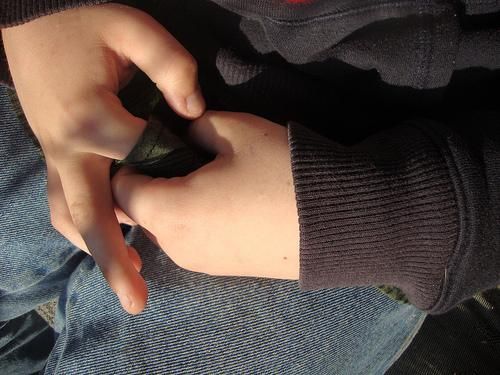
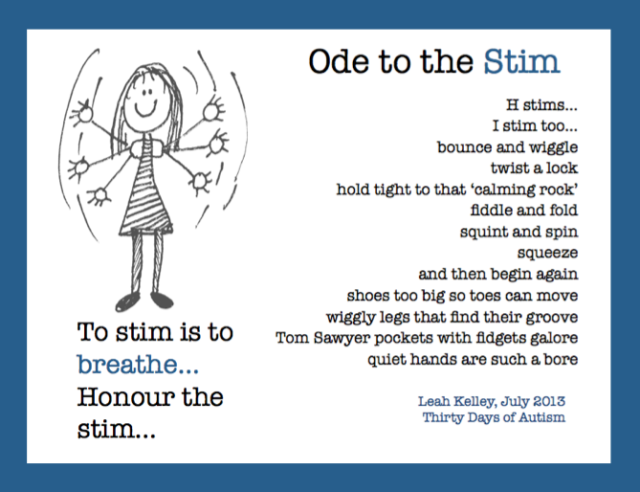
Like anyone else, people with autism stim to help themselves to manage anxiety, fear, anger, and other negative emotions.
Like many people, people with autism may stim to help themselves handle overwhelming sensory input (too much noise, light, heat, etc).

advertisement
We all use stimming sometimes.
For example, some children suck their thumbs or twirl their hair for comfort, and others jiggle their legs while they're working on a difficult problem or task. You might pace up and down if you're anxious, or fiddle with a pen in a boring meeting.

advertisement
Here are some stereotypical stimming behaviors.
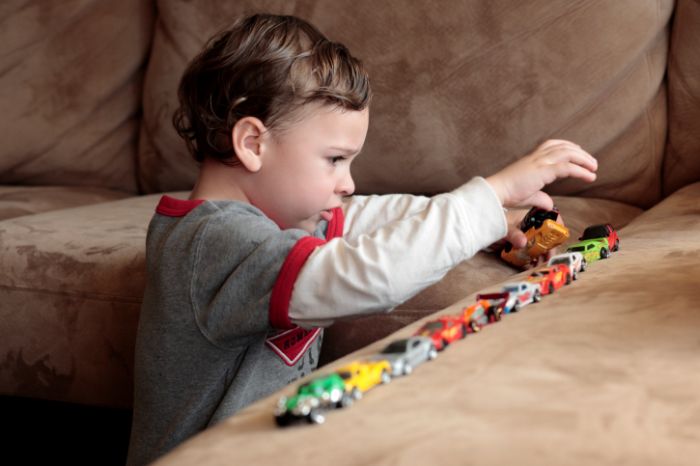
Visual: Staring at lights or ceiling fans; repetitive blinking; moving fingers in front of the eyes; hand-flapping, gazing at nothing in particular; tracking eyes; peering out of the corners of eyes; lining up objects; turning on and off light switches.
Auditory: Vocalizing in the form of humming, grunting, or high-pitched shrieking; tapping ears or objects; covering and uncovering ears; snapping fingers; making vocal sounds; repeating vocal sequences; repeating portions of videos, books or songs at inappropriate times.
Tactile: Scratching or rubbing the skin with one's hands or with another object; opening and closing fists; tapping surfaces with fingers.
Vestibular: Rocking front to back; rocking side-to-side; spinning; jumping; pacing.
Taste: Placing body parts or objects in one's mouth; licking objects.
Smell: Sniffing or smelling people or objects.
advertisement
Children with ASD engage in stimming for a variety of reasons.
One explanation is that it releases opiate-like substances in the brain called beta-endorphins, which can produce either a euphoric or anesthetic effect. Others believe that stimming could be due to the mechanism that provides: (a) an extra dose of internal stimulation for children with ASD who feel under-stimulated or (b) a feeling of tranquility for children who feel overstimulated.
Children who are hypersensitive, or overly sensitive to stimuli, may engage in stimming because they want to reduce their current level of stimulation, whether they perceive their environments as too loud, bright or crowded.

advertisement
The Wrong Question
"How do I stop the stim?" That's usually the first question parents ask when a young child discovers stimming. But it's the wrong question.
First of all, no one can stop self-stimulatory behavior completely, because everyone does it anyway! Secondly, even if one stim can be removed, it will be replaced by another and the next stim may be less preferable that the current one.
The most important reason not to eradicate stimming is that you may cause your loved one to withdraw more and more, and lose your opportunity to encourage healthy interactions.

advertisement
Like anyone else, people with autism stim to help themselves to manage anxiety, fear, anger, and other negative emotions.
advertisement