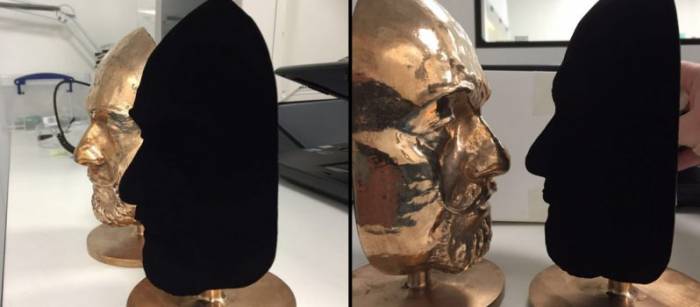
World’s Blackest Material Is Now The World’s Blackest Spray Paint
For the layman, black is simply black. Unlike other colours, pure black and white don’t have any shades; or do they? For our day to day basis, we might not be concerned with this minuscule difference, but for other purposes like building an ultra-sensitive space telescope, these things do matter. For example, to minimise reflections within the telescope as much as possible, you would require a material that is “blacker than black”.
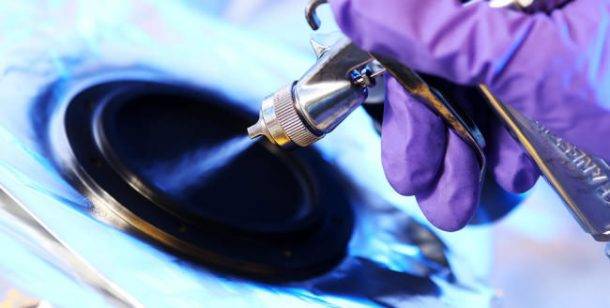
In this regard, we saw Surrey NanoSystems release a colour coating called Vantablack two years ago; which is claimed to be the darkest material on the planet. And now expanding its applications, the material has been made available in a spray-on form as well.
#1
Vantablack is composed of a forest of vertical tubes which are "grown". When light strikes vantablack, instead of bouncing off, it becomes trapped and is continually deflected among the tubes, eventually becoming absorbed and dissipating into heat.
Vantablack was an improvement over previous similar substances developed at the time. Vantablack absorbs 99.965% of visible light. Also, this new material can be created at 400 °C (752 °F); NASA had developed a similar substance that could be grown at 750 °C (1,380 °F). Vantablack can be grown on materials that cannot withstand higher temperatures.
The outgassing and particle fallout levels of Vantablack are low. The high levels in similar substances in the past had prevented their commercial usefulness. Vantablack also has greater resistance to mechanical vibration, and has greater thermal stability.
#2
Now the newer version available in spray paint known as Vantablack S-VIS is almost as good, for it can trap 99.8 percent of ultraviolet, visible and infrared light. To give you an idea, that's 17 times more absorbent than the reflective black paint used in the Hubble telescope!
Company CTO Ben Jensen said in an interview, "The new sprayable version really does open up the possibility of applying super-black coatings in many more types of airborne or terrestrial applications. Possibilities include commercial products such as cameras, equipment requiring improved performance in a smaller form factor, as well as differentiating the look of products by means of the coating's unique aesthetic appearance."
That being said, the application of paint is still not as simple as any other conventional one, and still, it requires some "pre- and post-application steps" for achieving the desired results. The paint is also not very wear-resistant, so a glass or some other protective layer is recommended as a protection.
#3 99.96% Light absorbing!
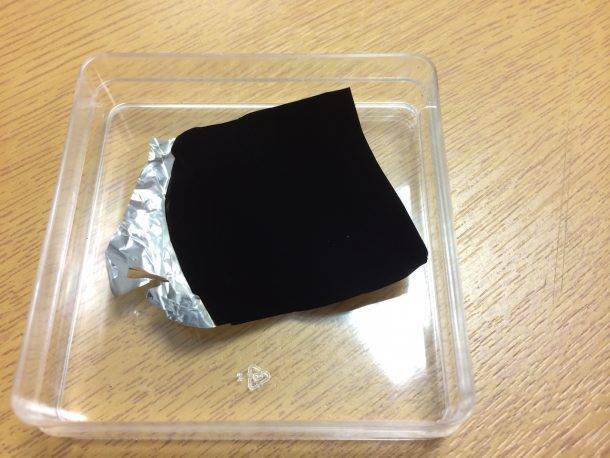
Surrey NanoSystems introduced the original Vantablack, the company said the carbon nanotube material is capable of absorbing 99.96 percent of light that touches it. It's so dark, it can fool your eyes into seeing a smooth surface even when the nanotubes were actually grown on crumpled foil (seriously -- watch the video below the fold). Well, the new version of Vantablack is darker than that. In fact, Surrey can't even give us the percentage of light that gets absorbed, because its spectrometers can't measure it.
#5 You can see the material engulf the laser pointer in darkness when it moves across.
#6 This one's the older version, which is still so dark, looking at it is like peering into the abyss: