

Tracing where the word comes from and how it became the name most people use today.
advertisement
The holiday season. The festive period. Yuletide. This time of year goes by many different names, ranging from simple modern phrases to older terms that carry centuries of history behind them.
The phrase holiday season, for example, is actually an American invention that dates back to the late 1700s. Like many broad labels, it reflects the fact that Christmas is not the only celebration on the calendar, with holidays such as Thanksgiving and New Year’s also falling around the same time. People have also been wishing each other a "Happy Holidays,", for instance, since the mid-19th century.
Yuletide, by contrast, reaches much further back into the history of the English language. In this context, tide simply means "time,", while yule comes from the Old English word geol. It originally referred to a pagan winter festival that later became linked with Christmas as medieval Europe gradually shifted toward Christianity.
But where does the word Christmas itself come from?
advertisement
The Origins of the Word “Christmas”
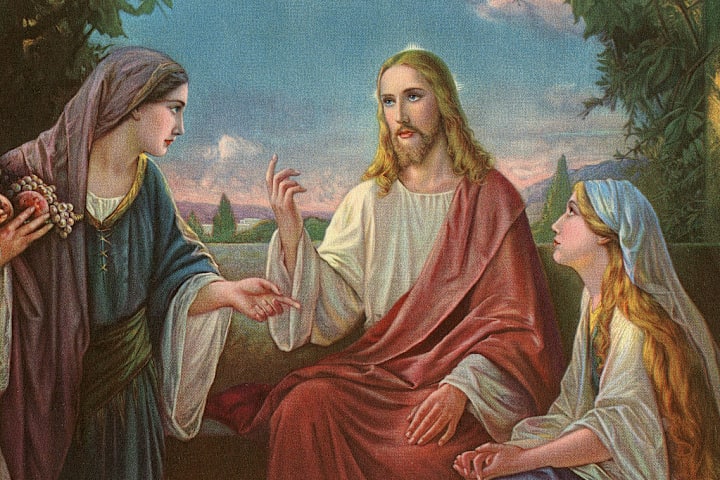
Vintage illustration of a blond-haired Jesus Christ with the Virgin Mary and Mary Magdalene; screen print, 1915 | GraphicaArtis/GettyImages
Given the meaning of the holiday, it is no surprise that Christmas takes its name from Jesus Christ. The exact date of Jesus’s birth is not known, and some biblical scholars and historians have suggested it may have taken place in September or even in the spring. Over time, however, late December became the accepted date as Christian celebrations blended with earlier winter festivals that were already held at the end of the year.
The "mass" in Christmas refers to the same mass that is still celebrated in the Catholic Church today. From a language point of view, the word can be traced from Old English back into Latin, where it originally referred to the dismissal of the congregation at the end of a church service. In fact, mass is distantly related to the word dismissal itself. In this setting, the term likely comes from the traditional closing words of the Latin service, "Ite, missa est,", meaning "Go, you are dismissed.".
Put together, Christmas literally means "Christ's Mass," or "Mass on Christ's day". In other words, it refers to the Christian church service held on the day that became most closely associated with the birth of Jesus, which is December 25.
"Christ's Mass" later evolved into "Christmas," in much the same way that "St. Martin's Mass" and "St. Michael's Mass" eventually became known as Martinmas and Michaelmas. It is likely that the names of specific church services and feast days were used so often that the separate words gradually blended together and became a single term over time.
advertisement
Why This Word?

American actress Anita Louise (1915 - 1970, right) reading a book while two other children play with their presents under a Christmas tree, circa 1927. | George Rinhart/GettyImages
That still leaves one question. If this time of year has been known by so many names, why did Christmas become the one that stuck? After all, it is not the oldest term for the season, since the period we now connect with Christmas was called Yule or Yuletide long before medieval England adopted Christianity.
The Oxford English Dictionary records its earliest use of the word Christmas in a homily written by Wulfstan, a Benedictine monk who lived in the 11th century. By that point, much of England had already been Christian for nearly 500 years.
Yule, on the other hand, appears even earlier. It was used by St. Bede in the mid-700s to describe what we would now recognize as Christmas.
advertisement
As Christianity became more firmly established in Britain and the traditions of Christmas Day slowly took shape, a name that directly referenced the birth and celebration of Jesus Christ made clear sense. Over time, the older and more pagan-rooted term Yule faded into history, leaving us with the name, the date, and the traditions that continue to define Christmas today.