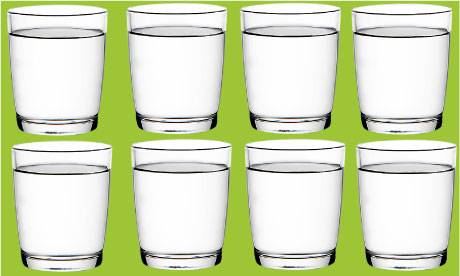
No, You Really Don’t Have To Drink 8 Glasses Of Water Every Day...
#1
Many people believe that in order to stay healthy we all need to drink 2.5 litres of water per day (plus or minus half a litre, depending on your weight and level of physical activity). Almost every day, we hear and read statements like, 'not drinking enough water is bad for your health'; or 'you need to drink water even when you're not thirsty.' However, Aaron E. Carroll, a professor of pediatrics at Indiana University School of Medicine, believes that there is no good scientific evidence behind any of these claims.
#2
Nevertheless, the recommendation to 'drink as much fluid as you can tolerate' circulates widespread in our society and is generally accepted. But the truth is, myths like these just play on our fears about one day experiencing serious health problems.
Nine years ago, a BMJ medical journal published a list of common medical and health-related beliefs that are widely reproduced by doctors and in the media. The myth that we need eight glasses of water a day took the first place in the list. This article was widely reprinted by on news sites and covered by many famous magazines around the world. A couple of years later, scientists even published a book dispelling false notions about water, but the popular myth didn't go away people continued to worry.
As the authors of the book claim, the approximate adequate daily intake of fluids does come to 2.5 litres. But most of this water is contained in prepared foods, vegetables, fruit and beverages like tea or coffee.
#3
Caroll has already co-written a widely cited research paper and book debunking common health myths - primarily the idea that all humans need to drink eight 8-ounce (237 mL) glasses of water a day - but the rumour just won't go away, with an onslaught of media this year alleging that dehydration is on the rise due to children not drinking enough water. So Caroll took to The New York Times this week to clear things up once and (hopefully) for all.
"Contrary to many stories you may hear, there's no real scientific proof that, for otherwise healthy people, drinking extra water has any health benefits," he writes. "For instance, reviews have failed to find that there's any evidence that drinking more water keeps skin hydrated and makes it look healthier or wrinkle free."
So where did the great water myth come from? It's generally believed that the source is a 1945 Food and Nutrition Board Recommendation that declared, "a suitable allowance of water for adults is 2.5 litres daily in most instances. An ordinary standard for diverse persons is 1 millilitre for each calorie of food". As you might have guessed, 2.5 litres more or less works out to be around eight glasses. But what's usually ignored from that report is the crucial next sentence: "Most of this quantity is contained in prepared foods."
#4
In fact, depending on your diet, there may be no reason to drink excess water at all. "Water is present in fruits and vegetables. It's in juice, it's in beer, it's even in tea and coffee," writes Caroll. "Although I recommended water as the best beverage to consume, it's certainly not your only source of hydration. You don't have to consume all the water you need through drinks."
Before you object and tell us that coffee, tea, and alcohol dehydrate us, and therefore can't count towards our daily water intake, science has debunked that myth too.
A 2002 review by physician Heinz Valtin from Dartmouth University in the US found that not only was there no peer-reviewed evidence to support the eight glasses a day rule, there was also no research to suggest that other drinks couldn't be used to adequately hydrate us.
"This conclusion is supported by published studies showing that caffeinated drinks (and, to a lesser extent, mild alcoholic beverages like beer in moderation) may indeed be counted toward the daily total, as well as by the large body of published experiments that attest to the precision and effectiveness of the osmoregulatory system for maintaining water balance," Valtin concludes.
#5
In the same study, he also broke down the myth that by the time we feel thirsty it's 'too late'. In reality, we feel thirsty exactly when we're supposed to: "when the concentration of blood (an accurate indicator of our state of hydration) has risen by less than 2 percent," he says, "whereas most experts would define dehydration as beginning when that concentration has risen by at least 5 percent."
#6
Of course, it's worth noting here that these recommendations are for healthy people living pretty sedentary lifestyles in non-extreme temperatures. People living in hot climates, anyone who's exercising a lot or battling with an illness may very well need to drink eight glasses - or more - of water a day in order to alleviate their thirst.

#7
And that should be what it all comes down to, according to the research - drink more water when you feel thirsty. But don't stress out about following some pre-prescribed formula to health, because all it's going to do is see you running to the bathroom more often than you need to. And ain't nobody got time for that.
#8
So, you don't need to worry about being thirsty. In fact, the human body is finely tuned to signal you to that you need to drink long before you're actually dehydrated. Contrary to many common beliefs, there's no real scientific proof that drinking extra water has any health benefits for your skin or kidneys. Moreover, consuming too much water can lead to serious kidney problems.
Rehydration is important only when your body is using more fluids than usual, e.g. when you are ill, have been working out intensively, or have otherwise been sweating excessively.
So, drinking water just because you feel the need to keep yourself 'on schedule' with your fluid intake is pointless. The only people who will actually benefit from this habit are the manufacturers of bottled water!
Ultimately, pay attention to the signals your body sends you: if you feel thirsty, drink; if you don't feel thirsty, don't drink unless you want to. And stop thinking that eight glasses of water is mandatory.