

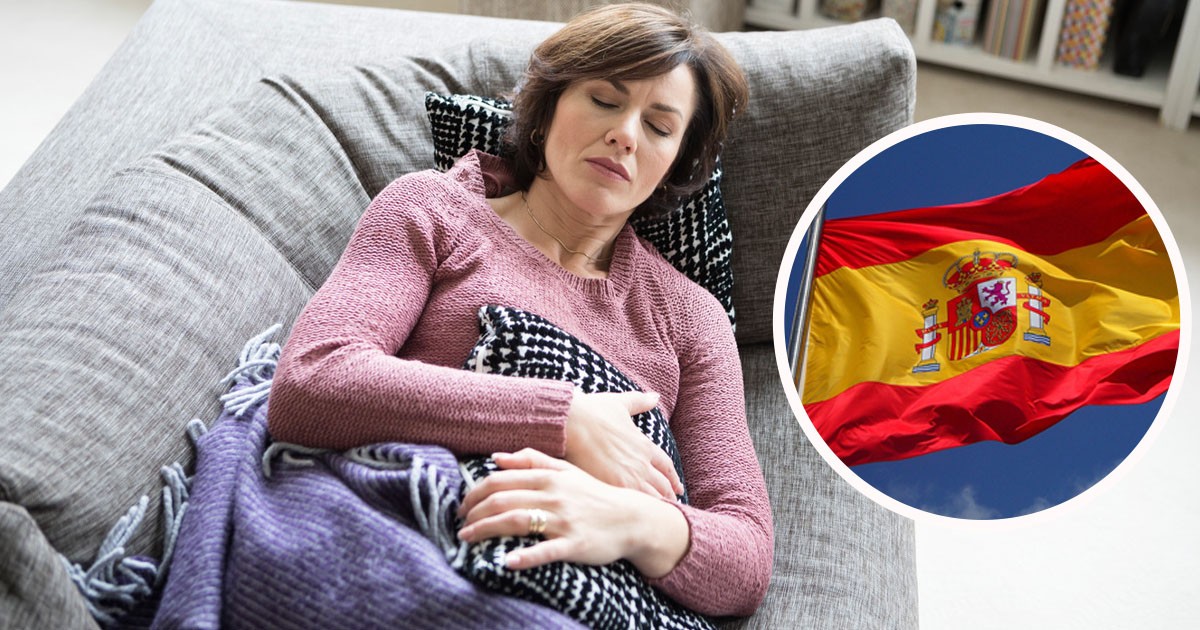
Spain has become the first European country to pass a law that will allow women to take upto three days of 'paid menstrual leave.' This law was passed as part of a broader package on sexual and reproductive rights that includes allowing anyone 16 and over to get an abortion or freely change the gender on their ID card.
Spain Becomes First European Country To Offer Menstrual Leave
By
Samantha in
Health and Fitness
On 21st February 2023
advertisement
Spain has passed a law that will allow those with painful periods to take paid "menstrual leave" from work, in a European first.
The bill approved by Parliament on Thursday is part of a broader package on sexual and reproductive rights that includes allowing anyone 16 and over to get an abortion or freely change the gender on their ID card.
Alamy
The law gives the right to a three-day “menstrual” leave of absence - with the possibility of extending it to five days - for those with disabling periods, which can cause severe cramps, nausea, dizziness and even vomiting.
The leave only needs a doctor's note and the bill will be covered by the public social security system.
The law states that the new policy will help combat the stereotypes and myths that still surround periods and hinder women's lives.
Alamy
advertisement
Equality Minister Irene Montero, an outspoken feminist in the leftwing government, hailed "a historic day of progress for feminist rights".
“There will be resistance to its application, just as there has been and there will be resistance to the application of all feminist laws,” she told parliament.
“So we have to work (…) to guarantee that when this law enters into force, it will be enforced".
Alamy
"The days of (women) going to work in pain are over," Montero said last year when she unveiled her government’s proposal.
Spain had a long road before they reached this milestone today. This policy had everyone divivded including the politicions and trade unions and some even feared backfire over this new law and there were fears that this law could stigmatise women in the workplace.
Worldwide, menstrual leave is currently offered only in a small number of countries including Japan, Taiwan, Indonesia, South Korea and Zambia.
advertisement
Italy tired to move ahead with the idea in 2016 and there was bill proposed to allow three fully paid days off to workers who obtained medical ceritificates, but it sadly failed to progress before the parliamentary term ran out in 2018.
"It's such a lightning rod for feminists," Elizabeth Hill, an associate professor at the University of Sydney who has extensively studied menstrual leave policies worldwide, told Euronews Next.
The debates around menstrual are often intense, she said, with concern focused on whether such a policy can help or hinder women.
"Is it liberating? Are these policies that recognise the reality of our bodies at work and seek to support them? Or is this a policy that stigmatises, embarrasses, is a disincentive for employing women?"
According to the Spanish Gynaecology and Obstetrics Society, around a third of women who menstruate suffer from severe pain known as dysmenorrhea.
Symptoms include acute abdominal pain, diarrhoea, headaches and fever.
advertisement
Some Socialists have voiced concern a menstrual leave could backfire against women by discouraging employers from hiring them.
"In the long term, it may be one more handicap that women have in finding a job," Cristina Antoñanzas, deputy secretary of the UGT, a leading Spanish trade union, told Euronews Next when the draft bill was first unveiled.
"Because we all know that on many occasions we have been asked if we are going to be mothers, something that must not be asked and that men are not asked. Will the next step be to ask us if we have period pains?"
advertisement
Spain’s other main trade union, Comisiones Obreras, has supported the idea of menstrual leave. Though there have been some reservations regarding the details of the policy such as whether women would have to prove they suffer from a condition known to worsen period pain - such as endometriosis or polycystic ovary syndrome - to claim this menstrual leave.
"How many women are we leaving out?" Carolina Vidal, its confederal secretary for Women, Equality and Working Conditions, told Euronews Next last year.
"In many, many cases periods become unbearable and disabling, but they are not considered illnesses".
In the end, only the doctor will decide on whther the pain is disbaling and how many days leave should be suitable.
The law states the right to a “three-day medically supervised leave, with the ability to extend to five, for those with disabling periods: severe pain, cramps, cramping, cramping, nausea, dizziness and vomiting that some women suffer every cycle”.
advertisement
Menstrual leave is part of sweeping new legislation introducing new reproductive rights. Under the new laws, Spain will also roll out free feminine hygiene products in certain public facilities, such as educational institutions and prisons.
advertisement
When it was first unveiled last year, the draft bill also aimed to scrap or slash VAT on specific feminine hygiene products. That provision was ultimately left out but is expected to be revived in the government’s next general budget review.
advertisement
Teenagers as young as 16 will now be allowed to seek an abortion in any public hospital without needing their parent’s or legal guardian’s consent.
The new law allows a new paid prepartum leave from the 36th week of pregnancy up to the time of birth, including, the provision of free contraceptives and the morning-after pill, as well as the prohibition of surrogacy, declaring the practice a form of violence against women.