This Is What Skin Cancer Looks Like - Shocking Pictures Show The Results Of Invasive $27,000 Surgery
By
Editorial Staff in
Bizarre
On 7th March 2016
A woman who has spent over $27,000 getting her skin cancer cells removed has released pictures warning others of the effects of staying in the sun too long.
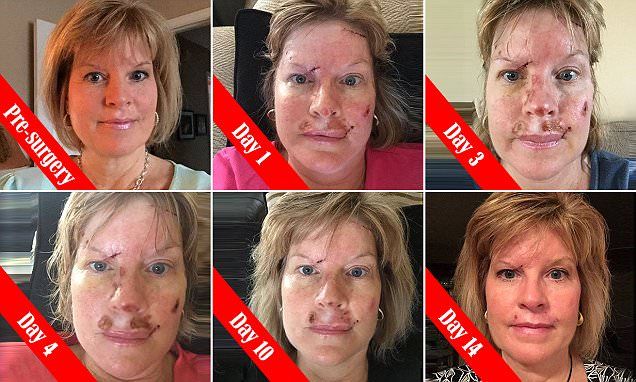
The shocking photos show her before and after painfully invasive surgery, where she had 23 spots of skin cancer removed from her face, chest, arms, and legs.
The fourth surgery she has had to undergo, Judy Cloud, 49, decided to share the photos of her most recent operation to show the results of frequenting tanning salons and not using sunscreen.
#1
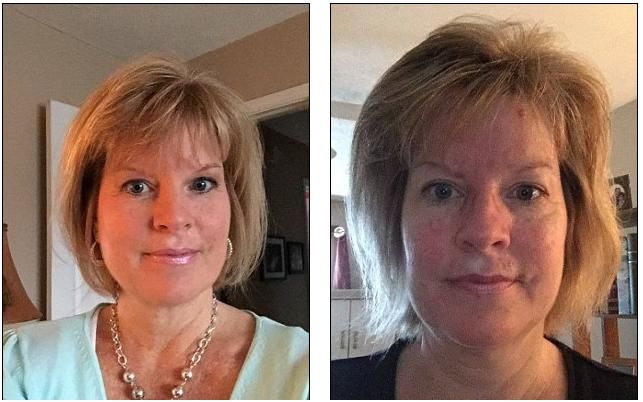
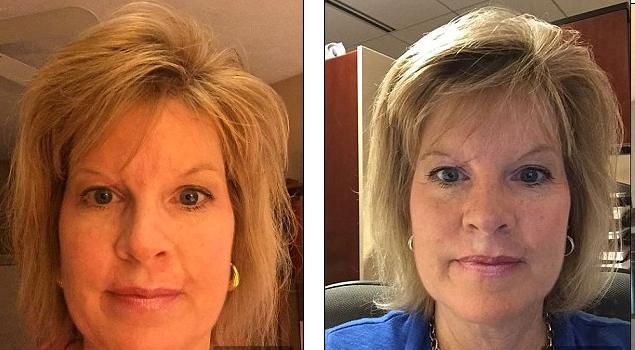
Left: Most recent photo of Cloud prior to surgery. Right: Getting ready to head to the hospital.
#2
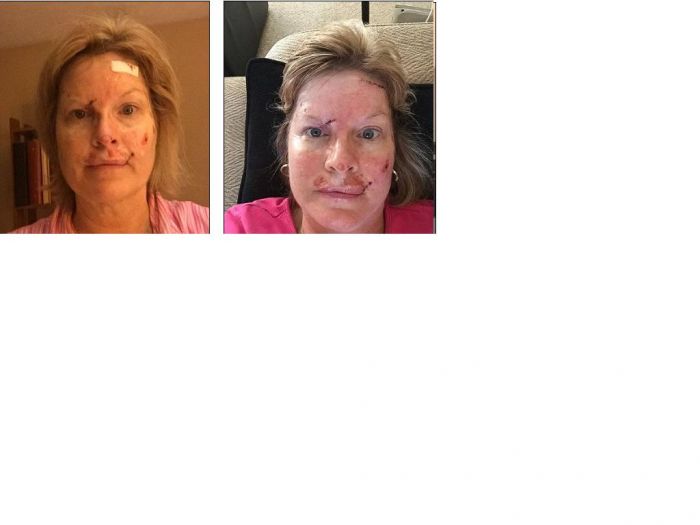
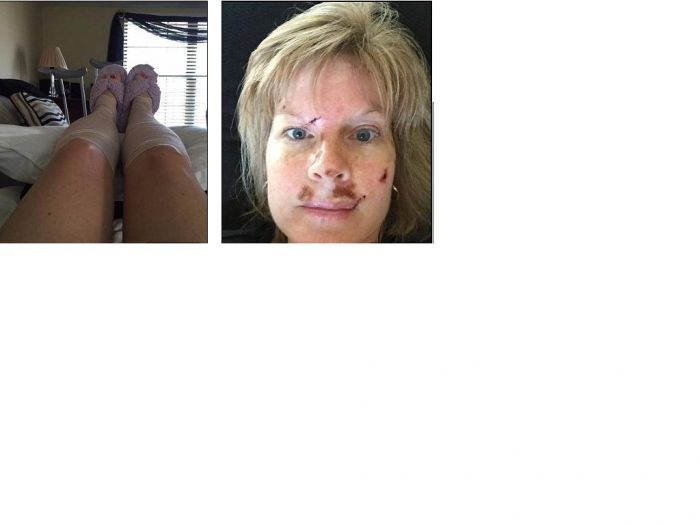
Left: Six hours post surgery, Cloud is back home 'ready for bed, with lots of painkillers in me'. Right: Morning after surgery, the swelling of her mouth is starting.
Cloud spent a lot of time in the sun as a child and in her 20s, she visited tanning beds about four times a year, reported SELF.
And while Cloud's family had a family history of cancer, she never thought that she would be at risk.
She was first diagnosed with skin cancer in 1995, while in her late 20s, when she went to get a scab checked out. That was when her long battle with cancer began.
Since her initial diagnosis, Cloud has undergone four surgeries to remove spots of basal cell carcinoma - the most common form of skin cancer, but also the least dangerous since it rarely spreads.
But the mother of two's latest surgery, which she had in September, was her most invasive to date and the doctors removed 23 cancer spots, including cutting into a muscle in her mouth and moving a nerve in her head and cost her $26,845.87.
Cloud, a legal assistant from Greenwood, Indiana, shared the results of her surgery on her Facebook page, in an album simply entitled 'Skin Cancer'.
She also sent a stern message of warning to would-be tanners: 'I hear too many people say that they feel better about how they look after they go to a tanning bed or after they bake in the sun for hours on end.
#3
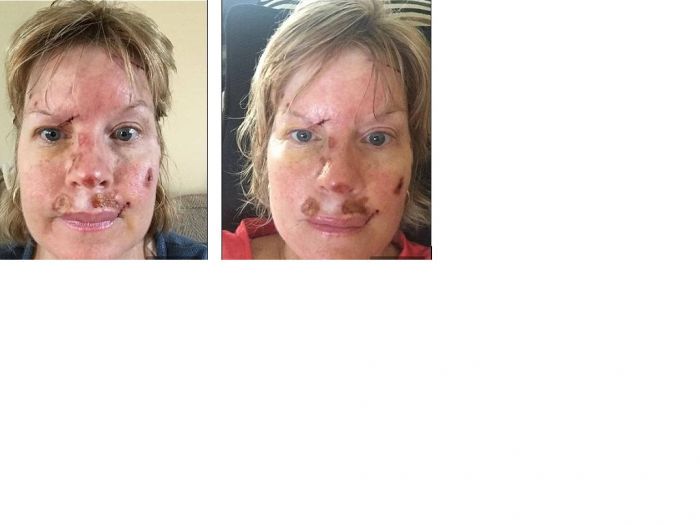
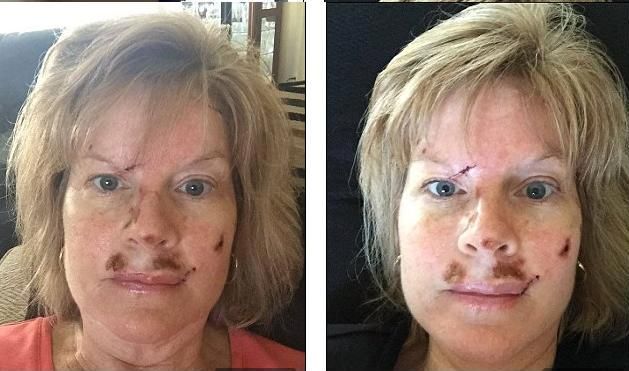
Left: Three days post operation: The laser wounds are getting pus and thick scabs, bruising around eye is starting. Right: Four days post surgery, her lip is still swollen and she says she still can't move her mouth.
#4
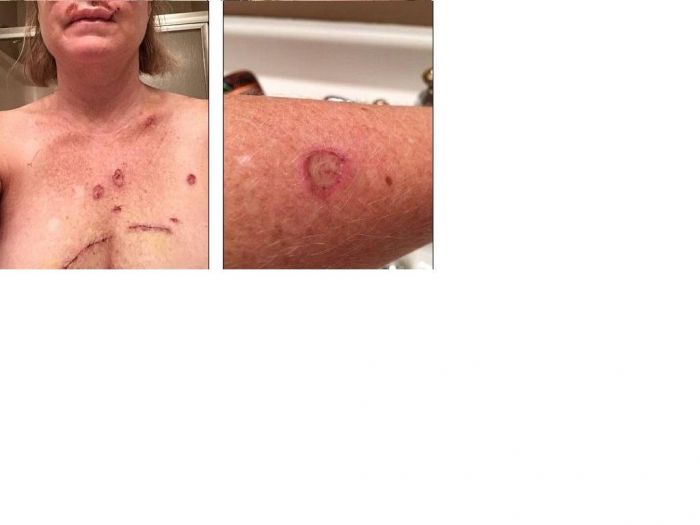
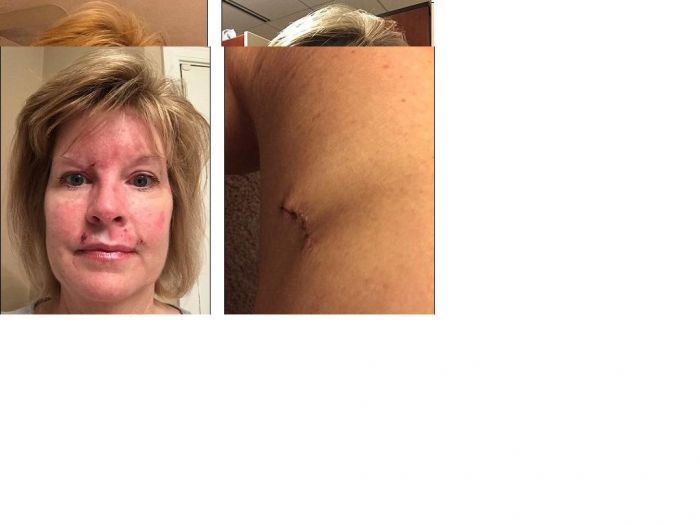
Left: The dramatic surgery wounds on her chest, five days post operation. Right: Cloud describes how a small dot of sun damage on skin becomes a good-sized crater after laser removal.
'Look at the pictures. This could be you. Anyone can get skin cancer, even people who have darker skin tones.
'It is a misconception that only fair-skinned people can get skin cancer. Skin cancer doesn't discriminate.'
She explained that the surgery left her 'lying on a couch during the day with my legs elevated.
'I worried about blood clots and I worried about getting pneumonia, both of which could happen post-surgery with immobility.
'I couldn't take a real shower for two weeks because my lower legs were wrapped and I couldn't get the wraps wet.'
#5
Left: Cloud says this is what she had to do for two weeks 'all day, all night' with the leg wraps on the entire time. Right: Cloud says that intense itching from the laser scabs has started but not much change on the wounds -but she was able to dry her hair that day for her follow-up appointment with her doctor, this is six days post op
#6
Left: Eight days post op; not much change. Right: Now ten days post op. Some of the scabs are starting to fall off, she says that laser scabs leave a bright red scar
She added that four weeks post-surgery, she still couldn't open her mouth all the way and still couldn't eat extremely chewy or crunchy foods.
She said the wounds on her arm, chest, shoulder, and legs took much longer to heal and she now has a 3' scar and a 2-1/2' scar on her chest, along with several laser scars.
She added: 'Does that sound worth it for you to keep going to a tanning bed?'
Cloud ended the post with: 'I'm really hoping the thought of going to a tanning bed no longer sounds quite so attractive to you.'
#7
Left: Three weeks post op, Cloud is starting to look almost fully recovered. Right: And four weeks after surgery the scars are barely visible at all
#8
Left: This was taken on her way to a follow-up doctor's appointment; 13 days post op. Right: A large incision wound/scar on her thigh, 13 days post op.
In an interview with SELF, Cloud explained: 'My 20-year-old self would never share [these pictures] and my 30-year-old self would never share them, but when my doctor said I was going to have another surgery.
'I'm going to document it this time and post it afterwards.
'I never thought I would show myself on Facebook without makeup on let alone without makeup on and looking so injured. But, I'm old enough now to know this is needed.'
The World Health Organization ruled that tanning beds are 'carcinogenic to humans' in 2009 but tanning salons remain a $3 billion industry in the US.
In December last year, the FDA proposed a ban on children under 18 using tanning facilities and would require adult customers to sign a 'strongly worded' consent form every six months.
To date 11 states have taken there own action and have already banned minors from using tanning salons, reported Bloomberg.
#9 THE DAMAGING EFFECTS OF SKIN CANCER: THE FACTS
Skin cancer is the uncontrolled growth of abnormal skin cells. It occurs when unrepaired DNA damage to skin cells (most often caused by ultraviolet radiation from sunshine or tanning beds) triggers mutations, or genetic defects.
The most common form of skin cancer is basal cell carcinoma. It is seen as the least dangerous as it rarely spreads, but can become life threatening if untreated.
There were an estimated 2.8 million cases of basal cell carcinoma in America in 2010.
The most dangerous form of skin cancer is melanoma, which can be caused by sun exposure, number of moles on the skin, skin type and family history.
People who use tanning beds before the age of 35 increase their risk of getting melanoma by 75 percent.
Skin cancer is the most common form of cancer in the United States and one in five Americans will develop skin cancer in the course of a lifetime.
To avoid increasing the risk of skin cancer, doctors recommend seeking shade between 10 am and 4 pm, avoid tanning and UV beds, use sunscreen and keep checking your skin every month for any abnormalities.