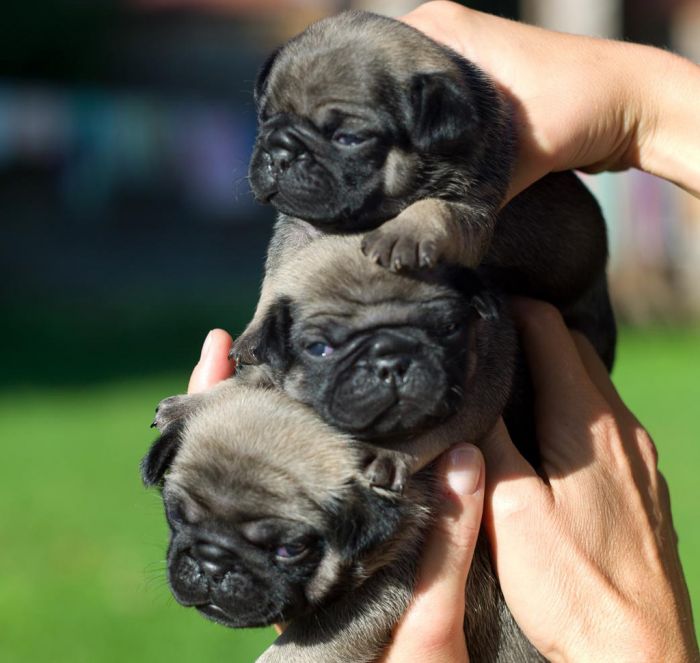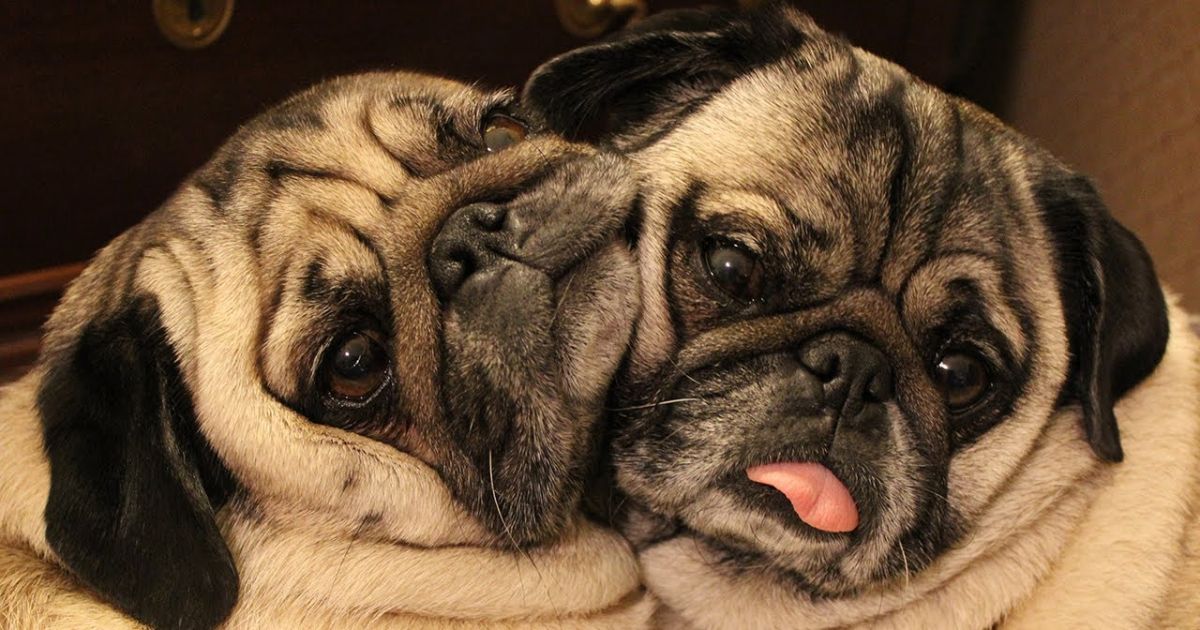
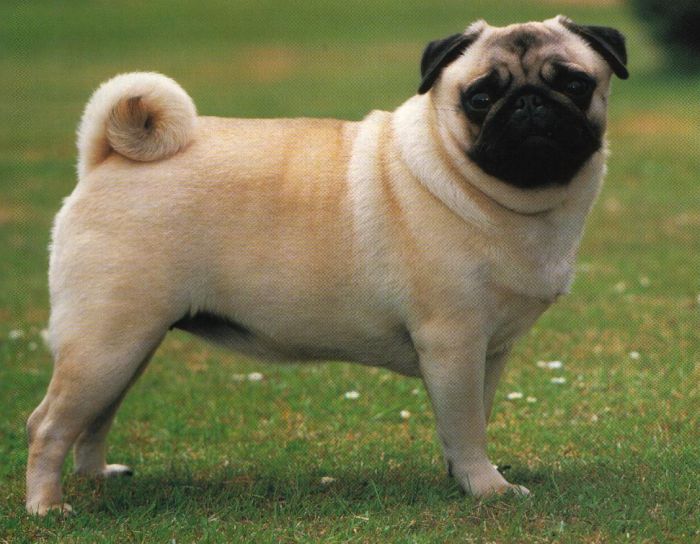
The breed has a fine, glossy coat that comes in a variety of colours, most often fawn or black, and a compact square body with well-developed muscles.
advertisement
Pugs often are described as a lot of dog in a small space.
These sturdy, compact dogs are a part of the American Kennel Club's Toy group, and are known as the clowns of the canine world because they have a great sense of humor and like to show off. Originally bred to be a lap dog, the Pug thrives on human companionship.
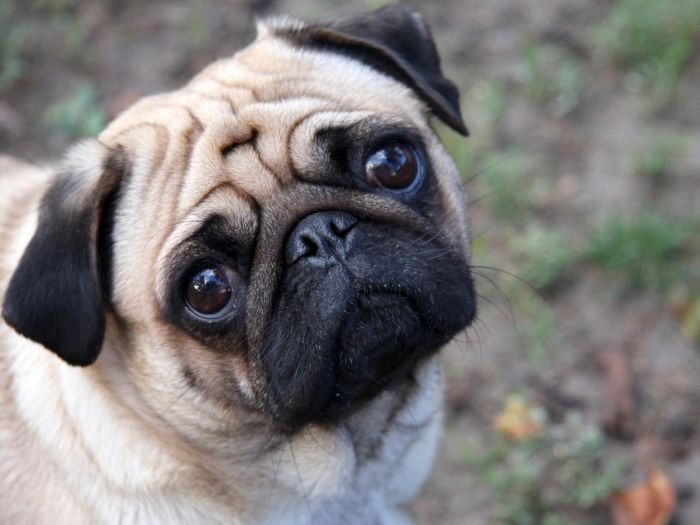
The Pug is a small, stocky, square, thickset dog.
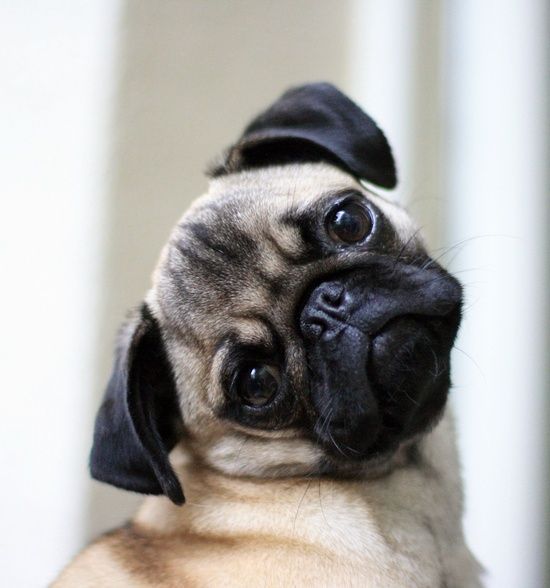
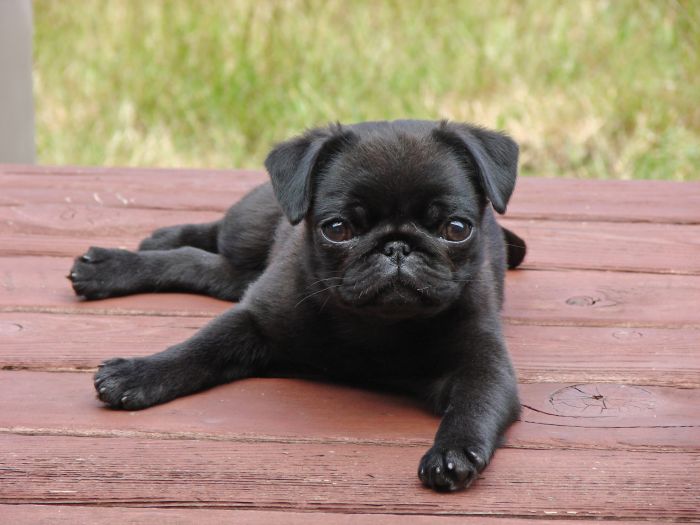
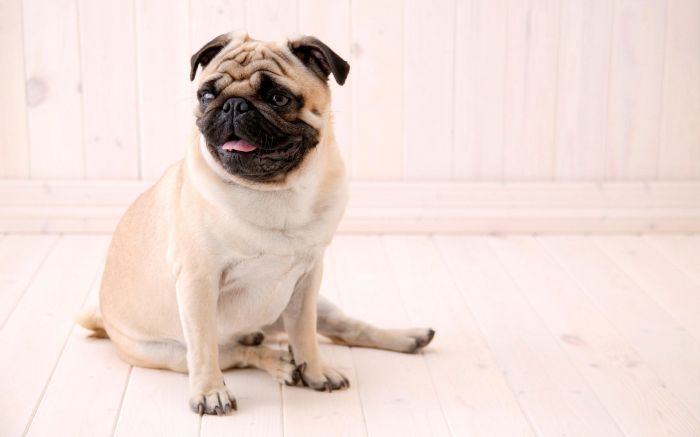
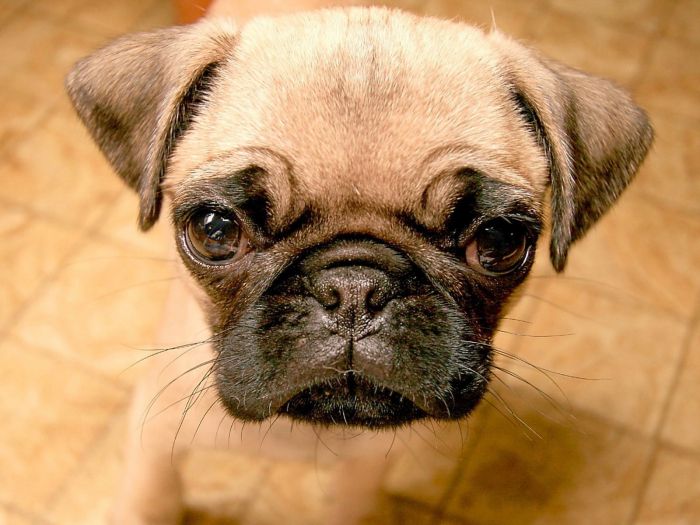
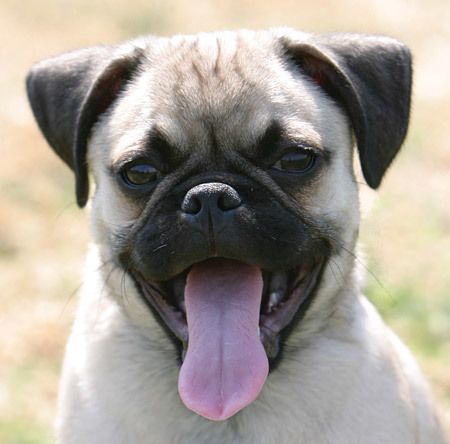
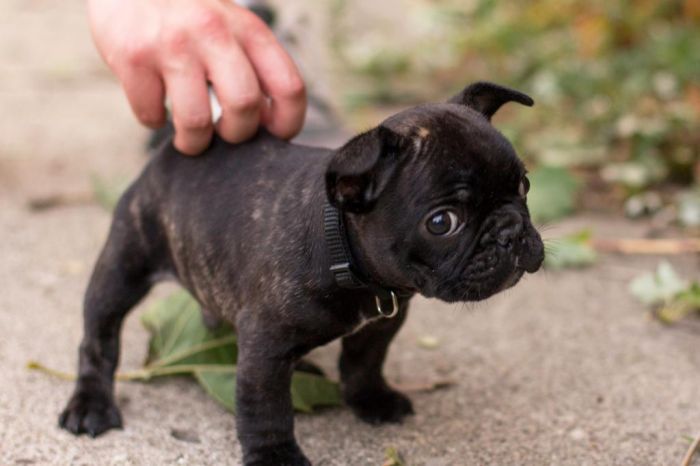
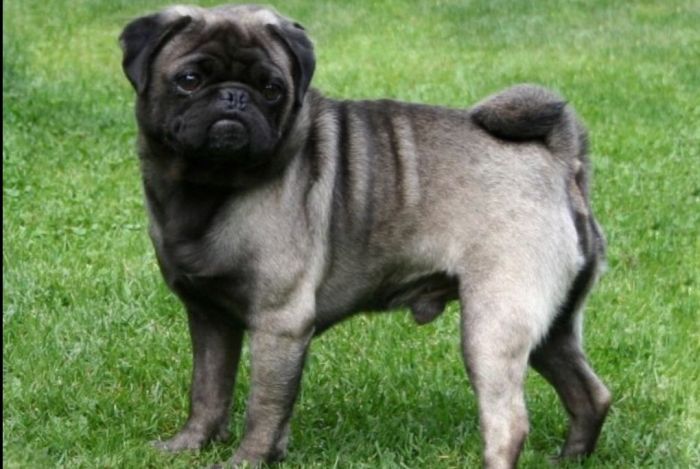
The round head is massive with a short, blunt, square-shaped muzzle. Moles on the cheeks are considered beauty spots. The teeth meet in a slight undershot bite. The very large, prominent eyes are dark. The small, thin ears are either rose or button shaped. The face has large, deep wrinkles. The high-set tail is curled over the back and a double curl is preferred in the show ring. Dewclaws are usually removed. The short coat is soft, fine and smooth. Coat colors come in apricot, fawn, black and silver.
advertisement
The Pug is keen, with a happy-go-lucky attitude.
Animated, peppy and spirited, it is loyal, loving and affectionate with its family. Playful, lively and rambunctious, it is sure to keep you laughing. Highly intelligent, it bores easily without variety in its training. These dogs can be a bit willful if they sense they are stronger minded than the humans around them. Pugs are sensitive to the tone of your voice, so harsh punishment is unnecessary. They need an owner who is calm, yet firm, confident and consistent with the rules.
This dog is neither excitable nor dull.
They are good watchdogs, very devoted and are not yappers. Pugs get along well with other dogs and pets, and they behave impeccably with both children and visitors. Be sure to be your Pug's pack leader. Pugs that do not have strong human leaders can become jealous, and begin to display guarding behaviors, such as guarding furniture, food, toys, or other spots in the house. This behavior only happens when dogs are allowed to take over. These behaviors can be corrected when the owners start displaying the proper leadership. Dogs that feel they need to run the home are not as happy as dogs that know they are the human's followers, as it is very stressful for a dog to need to keep "its" humans in line.
advertisement
.
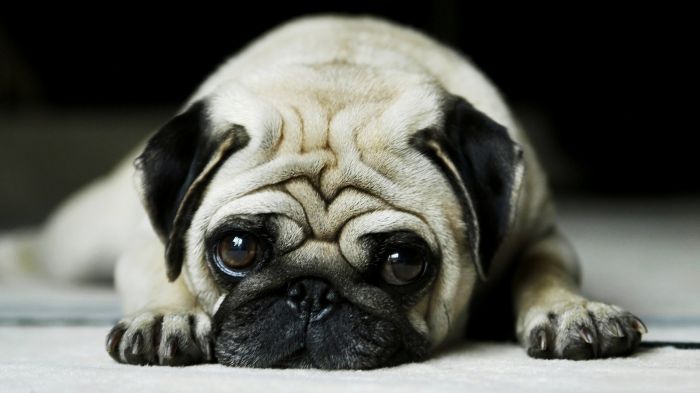
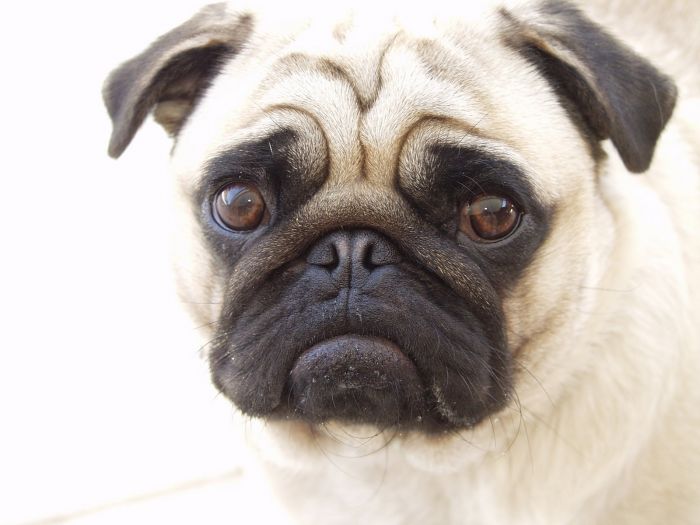
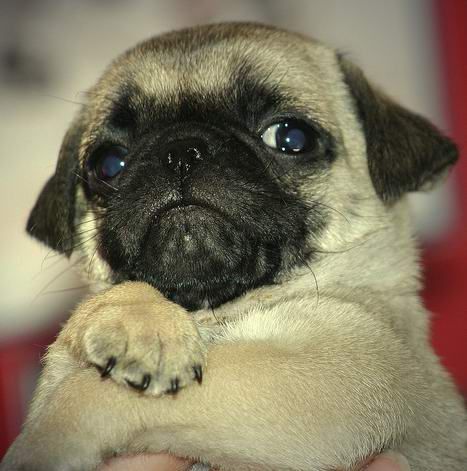
The Pug's comical face, with deep wrinkles around big, dark eyes and a flat round face, can't help but make you smile. It is believed that the Pug's name comes from the Latin word for "fist" because his face resembles a human fist.
advertisement
Physical Characteristics
The Pug's attentive and soft expression is its distinguishing feature. Its coat, which is fawn and black in color, is short, fine, and smooth. A compact and square-proportioned dog, the Pug moves with a jaunty and strong gait; its hindquarters roll slightly. The Pug also has clearly defined black markings on its muzzle, ears, cheeks and forehead, which has deep and huge wrinkles.
advertisement
Personality and Temperment
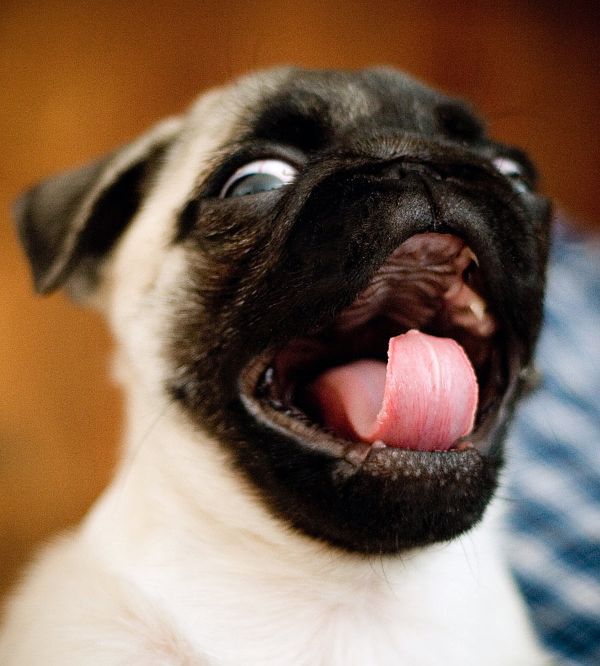
The Pug is a playful, confident, and friendly companion that magnificently combines comedy with dignity. It is usually pleasant and willing to please, but it can be headstrong and adamant at times. The breed is also known to frolic and flaunt about.
advertisement
Care
Coat care for the Pug is minimal, requiring only occasional brushing to remove the dog's dead hair. Meanwhile, regular cleaning and drying is necessary to prevent skin infections, especially in the dog's facial wrinkles.
advertisement
Exercise
As far as exercise requirements, the Pug's needs can be met daily with a moderate leash-led walk or an energetic game. Sensitive to humidity and heat, the Pug should be kept indoors. The breed is also prone to snoring and wheezing because of their flat, small muzzles.
advertisement
Health
The Pug has a lifespan of 12 to 15 years and is prone to major health problems like Pug Dog Encephalitis (PDE) and canine hip dysplasia (CHD), as well as minor concerns like elongated palate, patellar luxation, stenotic nares, Legg-Perthes disease, entropion, keratoconjunctivitis sicca (KCS), hemivertebra, obesity, and skin infections. Nerve degeneration, demodicosis, seizures, distichiasis, and allergies are occasionally seen in this breed of dog.
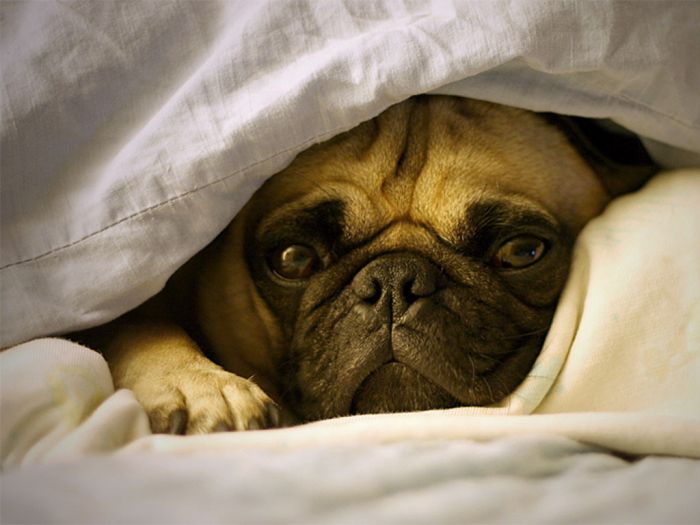
Its facial wrinkles must be kept clean to prevent skin fold dermatitis, a form of skin inflammation. The Pug is also sensitive to heat and anesthesia.
advertisement
Pugs catch colds easily and are stressed by hot and cold weather.
They are prone to allergies and the short muzzle contributes to chronic breathing problems, making the Pug tend to wheeze and snore. (Pugs suffer from poor ventilation.) Prone to skin problems. Prone to mast cell tumors. Prone to Pug Dog Encephalitis (PDE), an inflammation of the brain that strikes adolescent Pugs usually between the ages of 2 and 3. The cause is unknown. They are not the easiest whelpers. Dams usually have to have cesarean sections due to the size of the pups' heads. There is a chance of Keratitis (inflammation of the cornea) and ulcers on the cornea. Eyes are prone to weeping and cherry eye. Do not overfeed a Pug, as they will eat more than is good for them, quickly becoming obese and living much shorter lives.
advertisement
History
Multum in Parvo, meaning "a lot in a little," is the official motto of the Pug and sums up its description. The Pug has had various names throughout the years, including Mopshond in Holland, Chinese or Dutch Pug in England, and Mops in Germany. But the word "pug" is thought to have come from the Latin pugnus, meaning fist and attributed to its clenched fist-like head, or from the 18th-century marmoset "pug" monkey, which purportedly appeared quite similar to the dog.
The Pug is one of the oldest breeds known today
believed to have originated before 400 BC. There is somewhat of a debate over the origin of the Pug. Most researchers agree that the Pug originated from Asia, descended from a shorthaired Pekingese. Another theory is that it is the result of crossing a small Bulldog, while others speculate that it is a miniature form of the French Mastiff ( Dogue de Bordeaux).
advertisement
.
Although its exact ancestry is not known, many consider the Pug as one of the first breeds miniaturized in Asia. China is the earliest known source of the breed, where Buddhist monasteries of Tibet favored the Pug as a pet. The Chinese considered the Pug's facial wrinkles an important feature of the breed, referring to it as the "prince mark" because of its similarity to the Chinese figure for prince.
.
Brought to Holland by the Dutch East India Trading Company, a pug would become a pet to William I, the Prince of Orange in the mid 16th century. The Pug was also bestowed the position of the House of Orange official dog after one of its kind saved the life of William I by alarming him to the approach of an upcoming attack of Spaniards at Hermingny in 1572. Later, when William II landed at Torbay to be crowned King of England, his cortege included pugs, making the breed fashionable for generations.
advertisement
.
By 1790, the Pug had made its way to France. Most notably used by Josephine, wife of Napoleon, her pug, "Fortune," carried secret messages under his collar to Napoleon while she was confined in Les Carmes prison.
.
In England, the Pug gained popularity during the Victorian era. These pugs sported cropped ears, which further enhanced their wrinkled expressions. And in 1885, the American Kennel Club would recognize the Pug. Since then, the Pug has become not only a popular show dog, but a wonderful family pet.