

Dr Michael Guillen, a former Harvard physics instructor, shared his striking new theory in an open essay
advertisement
For centuries, the idea of “heaven” has sparked debate, often dividing scientists and theologians who rarely reach the same conclusions.
While art, religion, and popular culture have long portrayed heaven as a bright place filled with clouds and angels, one scientist argues that this familiar image may not match reality at all. He believes the truth could be far more complex and claims there is a specific place in the universe where it may exist.
Dr Michael Guillen, a former Harvard lecturer with PhDs in physics, mathematics, and astronomy, laid out his thinking in an open essay for Fox News. In it, he explained the scientific ideas that led him to this conclusion and why he believes science and faith may not be as disconnected as many assume.
He began by explaining that the universe is constantly expanding and that distant objects are not just moving away from us, but doing so at increasing speeds. This idea was first brought into focus by astronomer Edwin Hubble.
He said: "In 1929, American attorney-turned-amateur astronomer Edwin Hubble discovered that galaxies are rushing away from one another like so much shrapnel from a bomb."
"Hubble also discovered there's a definite pattern to how galaxies are rushing away from each other, namely: The farther 'up' in space a galaxy is located — the farther away it is from Earth — the faster it's moving away from Earth and everything else."

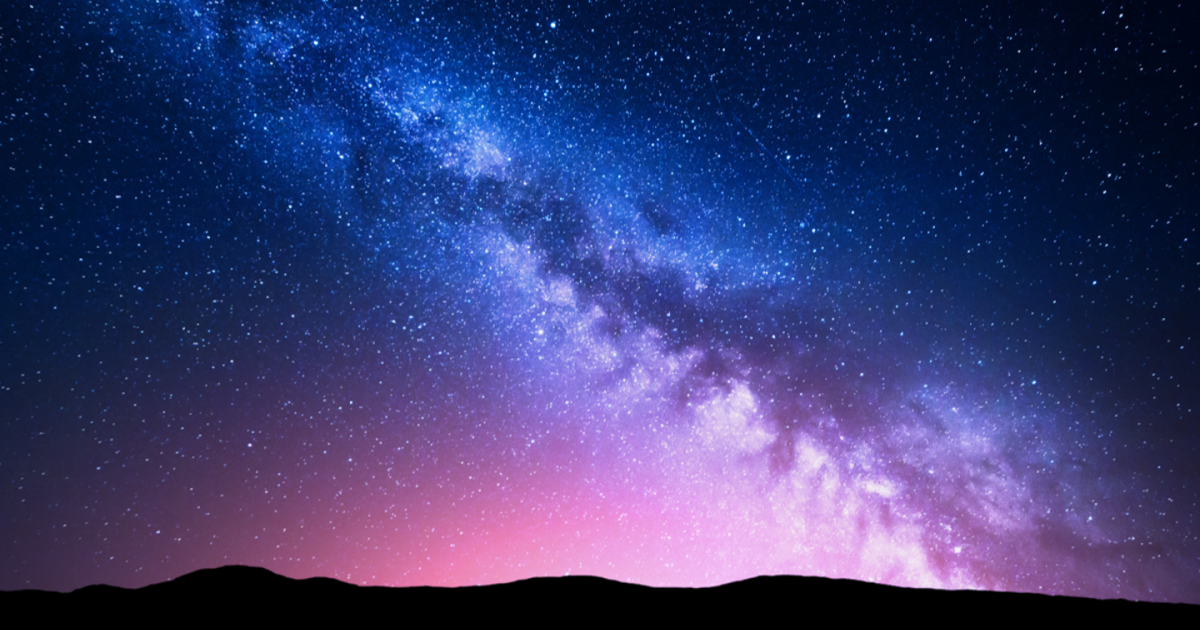
Popular culture has often depicted heaven as being a realm full of clouds
Witthaya Prasongsin/Getty Images
advertisement
Building on Hubble’s findings, Dr Guillen went on to explain: "Theoretically, a galaxy that's 273 billion trillion (273,000,000,000,000,000,000,000) miles away from Earth would move at 186,000 miles per second, which is the speed of light."
"That distance, way 'up' there in space, is called the Cosmic Horizon. That means you and I can never reach the Cosmic Horizon — not even aboard the most souped-up, nuclear-powered rocket imaginable — because, as Einstein explained in his theory of special relativity only light and certain other non-material phenomena can travel at the speed of light."
This boundary, known as the Cosmic Horizon, is what Dr Guillen believes could align with descriptions of heaven. He argues that this concept fits closely with how heaven is described in biblical texts, particularly as a place that exists beyond human reach.
"According to the Bible, the lowest level of heaven is Earth's atmosphere. The mid-level heaven is outer space. The highest-level heaven is what we're talking about: It's where God dwells," he clarified.
"As for heaven's location, the Bible contains many verses that describe us as looking 'up' at God in heaven, and God as looking 'down' at us on Earth."
The Cosmic Horizon represents the farthest point “up” in the observable universe. According to Dr Guillen, humans can never cross it while alive, which supports the idea that whatever lies beyond it remains inaccessible. This, he suggests, is exactly where heaven could exist.
advertisement
"According to modern cosmology, an entire universe exists beyond the Cosmic Horizon. But it's permanently hidden from us because we can never reach, let alone cross over, the Cosmic Horizon," began the physicist.
"Our best astronomical observations — and Einstein's theories of special and general relativity — indicate that time stops at the Cosmic Horizon. At that special distance, way 'up' there in deep, deep, deep space, there is no past, present or future. There's only timelessness."

The reality however, may lie beyond the cosmic horizon
DrPixel/Getty Images
advertisement
"Unlike time, however, space does exist at and beyond the Cosmic Horizon. Which means the hidden universe beyond the Cosmic Horizon is habitable, albeit only by light and light-like entities."
He then added: "According to modern cosmology, the Cosmic Horizon is lined with the very oldest celestial objects in the observable universe. That means whatever exists beyond the Cosmic Horizon predates these oldest objects… predates the so-called big bang… predates the beginning of the observable universe."
Taken together, these scientific ideas led Dr Guillen to his conclusion. He believes they align closely with biblical descriptions of heaven as a place located “up” beyond human access, inhabited by timeless and nonmaterial beings. In his view, it is also described as the dwelling place of a being that existed before the universe itself and may have been responsible for its creation.