

The team of physicists from the University of Amsterdam tested Stephen Hawking's radiation theory.
Scientists Simulated A Black Hole In A Lab To Test Stephen Hawking's Theory And It Started To Glow
By
maks in
Science and Technology
On 21st March 2024
advertisement
Over time, many scientists have come up with many ideas and theories, but haven't been able to verify if they're all true right away because of how complicated they are and what our technology can do.
Yet, in a groundbreaking experiment conducted in 2022, a group of scientists managed to simulate a black hole, providing them with a unique opportunity to put Stephen Hawking's renowned theory of radiation to the test.
The team from the University of Amsterdam was both surprised and fascinated when the simulated black hole they were studying started to glow unexpectedly.
This glowing was a big deal in learning more about black holes, which are some of the most mysterious things in space.
Credit: Getty Stock Photo
To facilitate their research, they crafted an event horizon within a laboratory setting, aiming to closely monitor black hole behavior in conditions that were both safe and meticulously controlled.
advertisement
In astrophysics, the event horizon represents a critical boundary where, once crossed, events cannot influence an outside observer, essentially acting as the point of no return.
Science Alert reported that this artificial black hole exhibited a unique form of radiation, initially hypothesized by Hawking himself.
That sparked considerable interest among the scientific community.
The researchers embarked on a detailed analysis of Hawking radiation properties by creating a laboratory analog, only to be greeted by an unusual glow emanating from the setup.
Hawking radiation arises from particle creation, a result of disturbances in quantum fluctuations caused by the black hole's intense gravitational pull on spacetime.
advertisement
This radiation takes on a visible form of glow, a phenomenon that seems paradoxical considering that a black hole's event horizon is traditionally thought to be a zone from which neither light nor matter can escape.
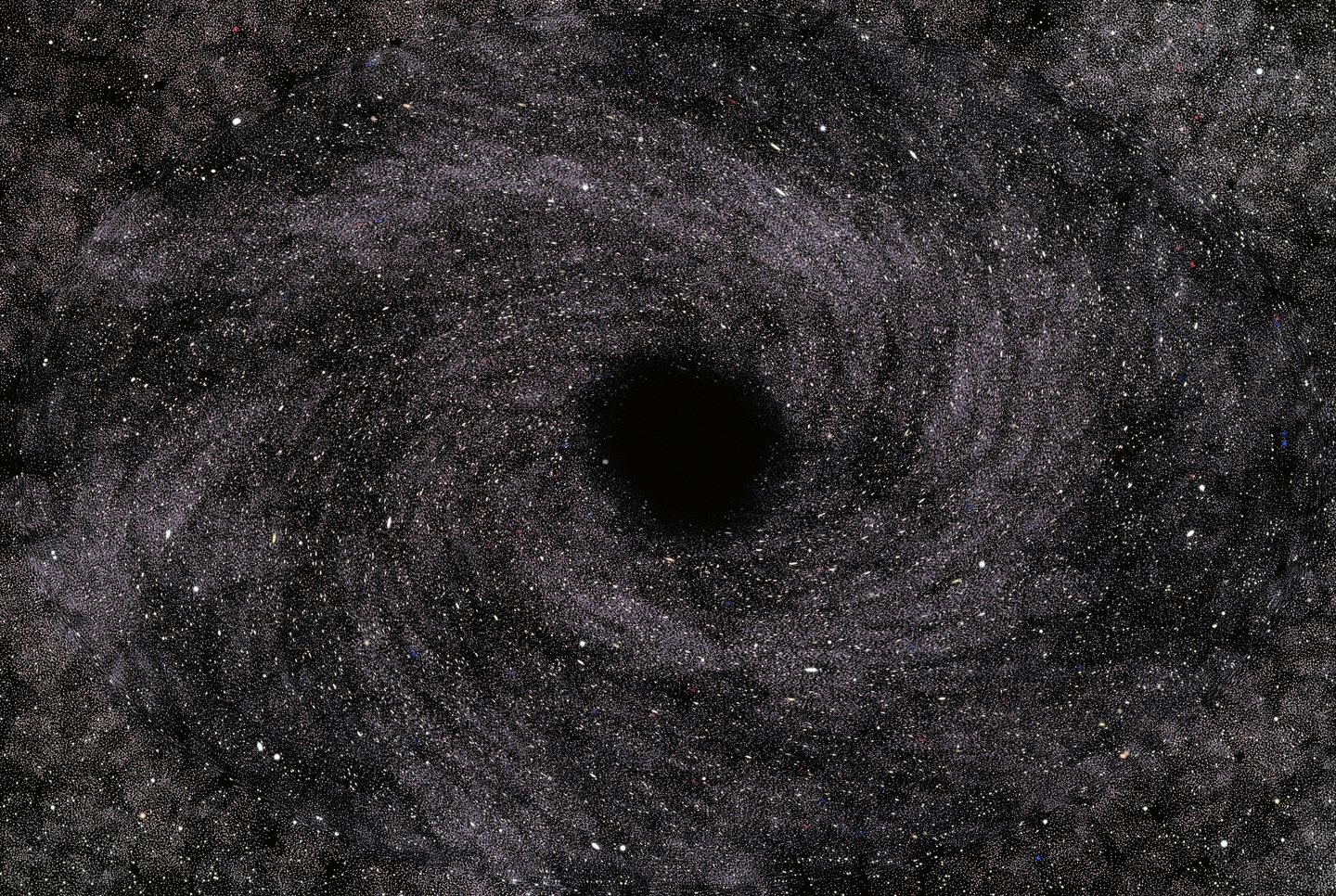
Black holes stand as some of the most peculiar and enigmatic entities in the cosmos, characterized by their immense density.

Credit: Getty Stock Photo
Within a specific radius from a black hole's center, known as the event horizon, nothing in the known universe, not even particles moving at the speed of light, can escape its gravitational pull.
advertisement
The research team noted that this glowing phenomenon was observed when part of their simulated system extended beyond the event horizon, hinting at a possible key role of particle entanglement across the event horizon in generating Hawking radiation.
In their paper, published by Physical Review Research, the scientists wrote: "This can open a venue for exploring fundamental quantum-mechanical aspects alongside gravity and curved spacetimes in various condensed matter settings."
advertisement
They discovered that the Hawking radiation exhibited thermal properties within a specific range of 'hop amplitudes' and under simulation conditions that replicated a 'flat' spacetime scenario.
This finding suggests that Hawking radiation's thermal emission may be contingent on certain conditions, particularly changes in spacetime curvature due to gravitational forces.
advertisement
However, one of the most exciting parts of their discovery was seeing that the simulated Hawking radiation actually glowed.
This gave us a real look into the quantum mechanical processes happening around black holes.